
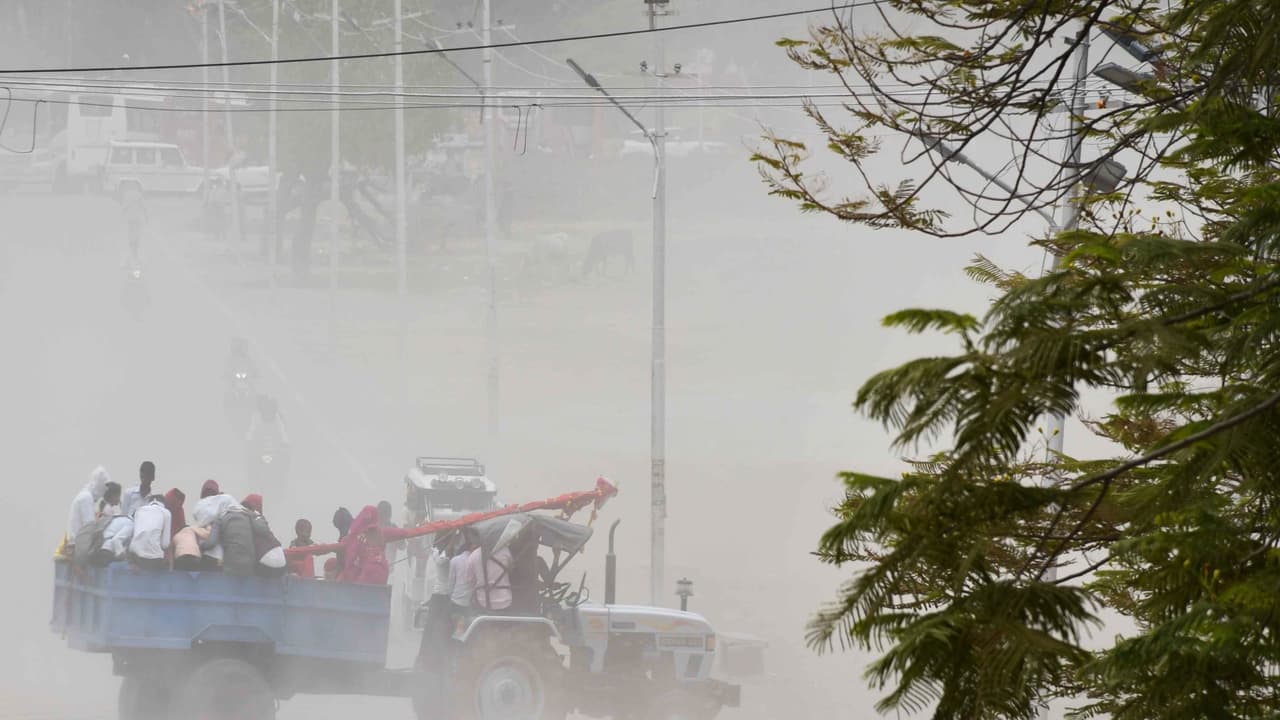
Delhi's air quality turned 'poor' for the first time this season on Wednesday, with the AQI reaching 238. A thick haze enveloped the city after Dussehra celebrations, a significant jump attributed to seasonal weather shifts and lower wind speeds.
The national capital recorded its first "poor" air quality day of the season here on Wednesday morning, as a thick layer of haze engulfed parts of the city following overnight Dussehra celebrations.
According to data from the Central Pollution Control Board (CPCB), Delhi’s Air Quality Index (AQI) surged to 238 at 10:00 AM. The sudden spike marks a significant jump of 59 points from Tuesday afternoon's reading of 179.
According to CPCB data from 56 of Delhi’s 59 monitoring stations, two locations—Jahangirpuri and Pusa—entered the "very poor" air quality category, registering AQI levels of 308 and 314, respectively. Meanwhile, 16 stations, including Anand Vihar, maintained air quality in the "moderate" category.
Factors Behind Worsening Air Quality
Environmental officials attributed the decline to seasonal weather shifts, including falling temperatures and fluctuating wind speeds, which hinder the dispersion of airborne pollutants and lead to atmospheric accumulation.
Recent Air Quality Trends
The reading marks Delhi’s first instance of "poor" air quality since July 12 and 13, when the city recorded AQIs of 261 and 246, respectively.
Air quality had remained mostly in the "moderate" band throughout October, aided by light rain on October 12 and 16.
Over recent days, the AQI stood at 187 on October 18, 139 on October 19, and 179 at 4:00 PM on Tuesday.
AQI Categories and Health Warnings
Under CPCB guidelines, an AQI between 0 and 50 is categorised as "good," 51 to 100 as "satisfactory," 101 to 200 as "moderate," 201 to 300 as "poor," 301 to 400 as "very poor," and 401 to 500 as "severe."
On October 5, the air quality in the national capital deteriorated to the higher end of the 'Moderate' category, recording an Air Quality Index (AQI) of 187, marking the highest level seen in nearly three months (83 days), according to the Central Pollution Control Board's (CPCB) 24-hour bulletin.
Data from the pollution control board showed that particulate matter 10 (PM10) remained the prominent pollutant across the city, based on readings compiled from 43 out of 46 active ambient air quality monitoring stations in the capital.
An AQI between 101 and 200 is categorised as 'Moderate', which the CPCB notes can cause "breathing discomfort to people with lung, asthma, and heart diseases."
Winter Outlook
The statement came ahead of the winter season, when Delhi-NCR generally witnesses a deterioration in air quality due to multiple factors, including meteorological conditions and emission sources. (ANI)
(Except for the headline, this story has not been edited by Asianet Newsable English staff and is published from a syndicated feed.)