
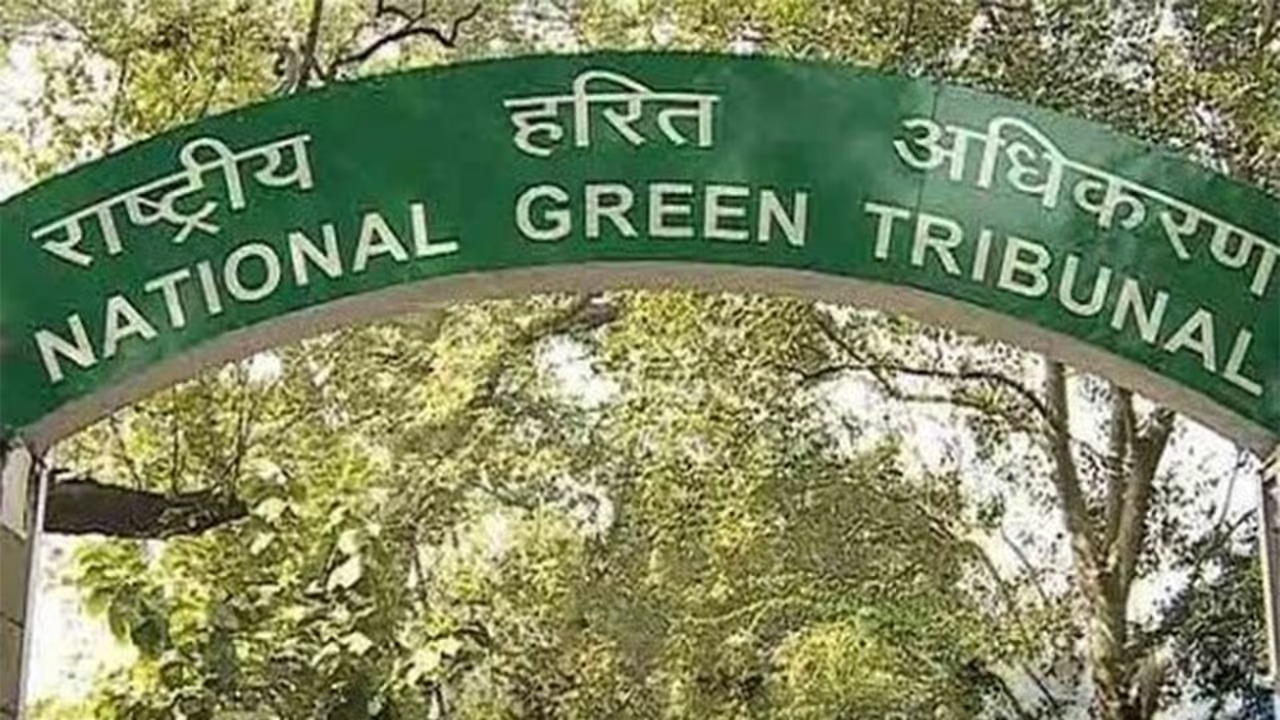
The NGT has directed the Delhi government to ensure strict enforcement of PUCC norms for all government and government-hired vehicles. The tribunal noted that thousands of government vehicles are plying on Delhi roads with expired PUCCs.
The National Green Tribunal (NGT) has directed the Delhi government to ensure strict enforcement of Pollution Under Control Certificate (PUCC) norms against government and government-hired vehicles, observing that the enforcement mechanism must be implemented with "full seriousness at the ground level."
A bench headed by NGT Chairperson Justice Prakash Shrivastava and Expert Member Dr Afroz Ahmad said that if any government vehicle is found plying on Delhi roads without a valid PUCC, the enforcement agencies must take requisite remedial and punitive action.
Directive to Comply with GAD Circular
The Tribunal also directed the concerned departments of the Delhi government to ensure compliance with a circular issued by the General Administration Department (GAD), GNCTD, on April 7, 2026, mandating that all government-owned and hired vehicles used for official purposes must have valid PUCCs at all times. The circular specifically states that no vehicle without a valid PUC certificate shall be deployed for official duty.
The directions came while disposing of an application filed by Jitendra Mahajan, who had raised several issues concerning alleged non-compliance with norms by government vehicles in Delhi. During the hearing, the applicant confined his submissions to government vehicles allegedly plying without valid PUCCs.
Government's Compliance Data
The Tribunal took note of the compliance data placed on record by the Delhi government. According to the government's affidavit, out of 30,995 active registered government vehicles running on diesel, petrol or CNG, excluding electric vehicles, as on June 19, 2025, 14,569 had valid PUCCs, while 12,399 had expired PUCCs. PUCC data for another 4,027 vehicles was not available.
The government further informed the Tribunal that 1,360 vehicles with expired PUCCs had been detected through the Automatic Number Plate Recognition (ANPR) system at fuel stations and challaned by Nawgati as of June 24, 2025.
The order also records the status of 106 vehicles referred to in the application: 102 government vehicles and four private vehicles. Of these, 30 had valid PUCCs, 60 had expired PUCCs and had been challaned, four were condemned, two were under the process of condemnation, three were non-plying, five were end-of-life vehicles for which notices had been issued under Section 133, and two had been scrapped.
Automated Enforcement and Regulations
The Tribunal noted that the Delhi government had disclosed an enforcement mechanism under which ANPR cameras installed at 498 strategic locations, including fuel stations and ISBTs, are integrated with the VAHAN portal to identify vehicles without valid PUCCs. Challans are automatically generated when violations are detected.
The government also informed the Tribunal that its enforcement system does not distinguish between government and private vehicles for PUCC-related violations. Thus, government vehicles are also liable to challans when found non-compliant.
The NGT further took note of the fact that the PUCC software contains a built-in mechanism preventing issuance of certificates to end-of-life diesel vehicles older than 10 years and petrol vehicles older than 15 years, with the rule applying equally to government and private vehicles.
Oversight of PUC Centres
The Tribunal also noted that approximately 950 PUC centres are operating across Delhi and that the Transport Department had conducted 2,050 inspections between May 2023 and May 2025. During this period, 274 advisories and 76 show-cause notices were issued, 146 warnings were given and operations of 17 centres were suspended or stopped.
NGT's Final Order
The bench recorded that the applicant's contention that PUCC rules should be strictly and equally applicable to government and government-hired vehicles was not disputed by the Delhi government.
Against this backdrop, the Tribunal said the enforcement mechanism disclosed in the government's affidavit "must be implemented with full seriousness at the ground level" and directed the concerned GNCTD department to ensure compliance with the April 7, 2026 circular. The NGT accordingly disposed of the original application.
The applicant was represented by advocates KK Mishra, Tanvi Jain, Shashank Arora and Parth Chhabra. The Delhi government was represented by advocates Jyoti Mendiratta and Ananya Basudha, along with Transport Department Enforcement Officer Sultan Singh. Advocate Sakshi Popli appeared for respondent no. 3. (ANI)
(Except for the headline, this story has not been edited by Asianet Newsable English staff and is published from a syndicated feed.)