
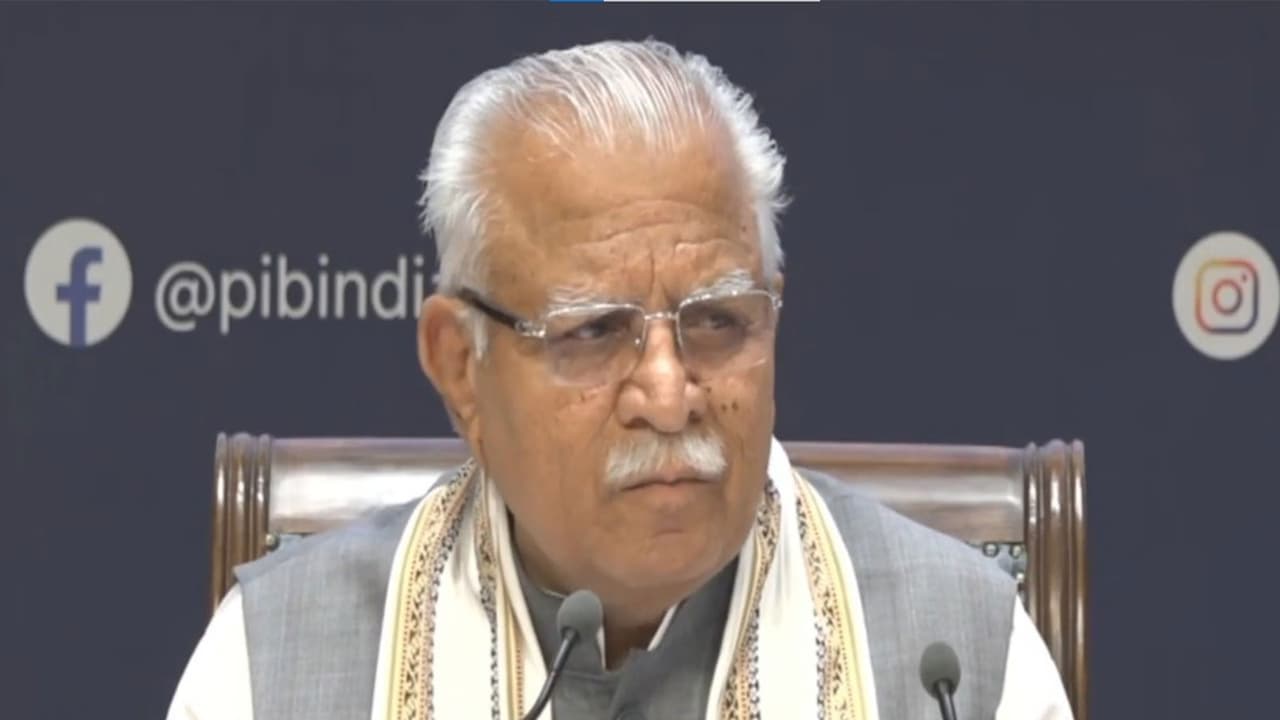
Union Minister Manohar Lal Khattar unveiled the Delhi Master Plan 2047, aiming to add 30-40 lakh new housing units with a focus on affordable housing to accommodate the capital's projected population of 3.20 crore by 2047.
Union Minister Manohar Lal Khattar on Thursday said the Delhi Master Plan 2047 envisages the addition of 30 to 40 lakh new housing units, with a primary focus on affordable housing, to accommodate the national capital's growing population.
Khattar unveiled the Delhi Master Plan 2047 along with Delhi Chief Minister Rekha Gupta and Lieutenant Governor Taranjit Singh Sandhu, outlining a long-term roadmap for Delhi's urban development in line with the vision of 'Viksit Bharat'.
Accommodating a Growing Population
Addressing the press conference, Khattar said Delhi's population has grown rapidly over the decades, rising from 94 lakh in 1991 to 1.38 crore in 2001 and 2.12 crore in 2021. The population is currently estimated at around 2.40 crore and is projected to reach 3.20 crore by 2047.
"Because the city's total land area remains fixed at 1,483 square kilometres, this surging population creates immense spatial and infrastructural pressure, reinforcing the need for planned urban development," Khattar said.
"To accommodate an expected population increase of 80 lakh and the growing prevalence of nuclear families, the new plan targets the addition of 30 to 40 lakh new housing units, with a primary focus on affordable housing," he said.
Khattar said the plan was designed to ensure that Delhi's future expansion takes place in a planned manner while addressing the changing needs of its population.
Enhanced Mobility and 24-Hour Zones
"Furthermore, to support seamless mobility, the framework prioritises public transport corridors--spanning Metro rail, bus networks, and RRTS--backed by a dedicated Transit-Oriented Development (TOD) policy to guide high-density growth along major transit routes," the Union Minister said.
Highlighting the proposal for round-the-clock activity zones, Khattar said, "There is a proposal to develop '24-hour city' zones, where operations continue around the clock."
"Provisions are being made to ensure 24-hour transportation services, particularly Metro connectivity, for these locations," he added.
Development in Low-Density Areas
On low-density development areas, Khattar said, "Plans have been formulated for low-density areas; these include provisions for internal roads with an 18-meter width and master trunk roads with a 45-meter Right of Way (ROW)."
"To manage congestion effectively, the layout requires leaving open space along the plots on both sides of the 15-to-18-meter internal roads," he said.
Land Development and FAR Provisions
Explaining the provisions related to land development, Khattar said, "Regarding the plots carved out in these zones, owners will be granted TDR (Transferable Development Rights) and FAR (Floor Area Ratio) based on a standard 2.5-acre benchmark."
"This ensures that even if a plot is smaller than 2.5 acres, the owner receives the full FAR entitlement associated with a 2.5-acre plot," he added.
Khattar further said, "Consequently, farmhouses cannot be constructed in these low-density development zones on plots smaller than 2.5 acres."
Evolution of Delhi's Urban Planning
Tracing the evolution of Delhi's urban planning, Khattar said the Delhi Development Authority (DDA) was established in 1957, leading to the formulation of the city's first development plan in 1962.
"To better integrate Delhi's expansion with neighbouring regions and enhance regional infrastructure, the NCR Planning Board was established in 1985," he said.
"This was followed by the second development plan in 1991 (the 2001 Plan) and the third in 2007 (the Delhi Development Plan 2021)," Khattar added.
"Today, in 2026, the Delhi Development Plan 2047 has been officially launched, aligned with the contemporary vision of Viksit Bharat (Developed India) to establish a structured roadmap for the capital's growth through 2047," he said. (ANI)
(Except for the headline, this story has not been edited by Asianetnews Editorial staff and is published from a syndicated feed.)