
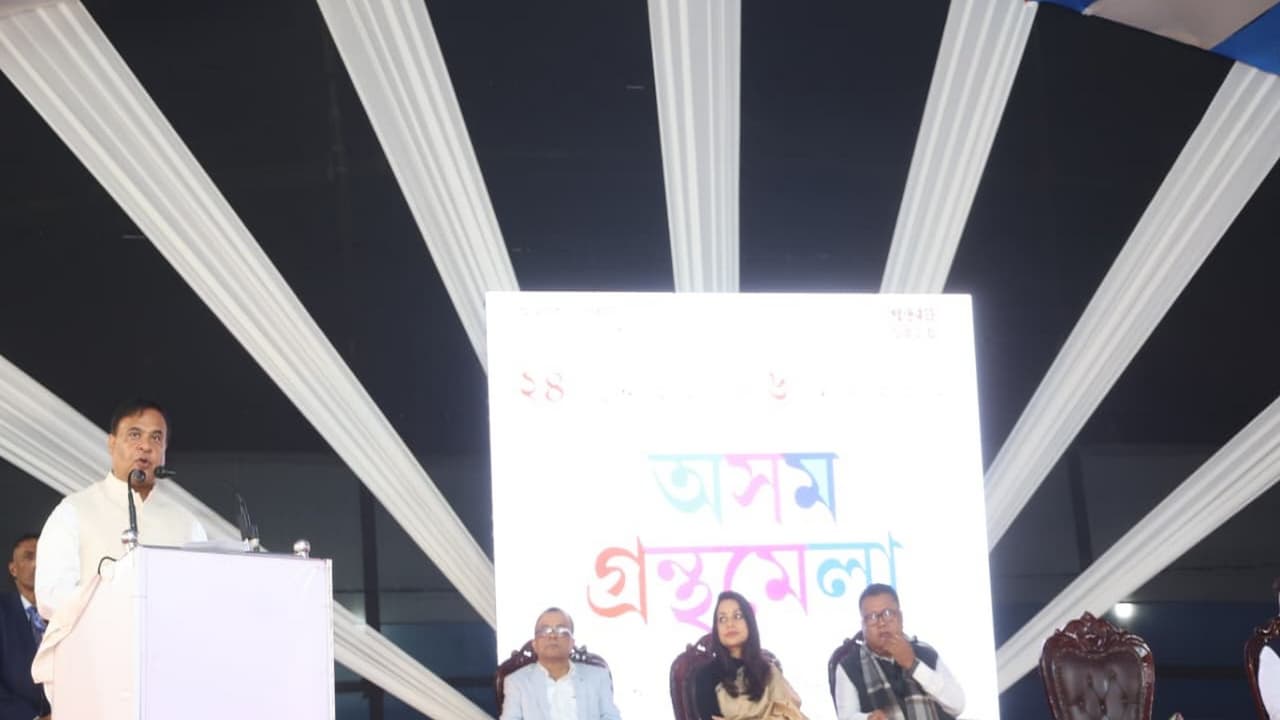
Assam CM Himanta Biswa Sarma inaugurated the 14-day Assam Book Fair 2025 in Guwahati. He also presented the Yuva Lekhak Samman, including a Rs. 25,000 cash award, to 818 young writers as part of the state's 'Year of Books' initiative.
Assam Chief Minister Himanta Biswa Sarma on Wednesday inaugurated the Assam Book Fair 2025 and presented the Yuva Lekhak Samman to 818 young writers at a programme jointly organised by the Assam Publication Board and the All Assam Book Publishers and Sellers Association at the playground of Khanapara Veterinary College, Guwahati.
As a part of the Yuva Lekhak Sanman, the Chief Minister honoured each young writer with a cash award of Rs. 25,000 each. It may be noted that the Assam Book Fair, which began today and will continue for 14 days, has witnessed the participation of more than 135 publishing houses from Assam as well as from Delhi, Haryana, Kolkata, Mumbai and Hyderabad.
'Year of Books' and Expansion of Fairs
Addressing the enthusiasts on the occasion, the Chief Minister said that the Assam Government had declared 2025 as the "Year of Books." As part of the programme, initiatives have been undertaken to organise book fairs in Bongaigaon, Lakhimpur, Nalbari, Jorhat, Tinsukia, Silchar, and Mangaldoi, along with the one in Guwahati.
"Earlier the Assam Publication Board organised book fairs only in Guwahati, but from this year onwards, book fairs are being organised across various districts of the state," the Assam Chief Minister said. He expressed confidence that these book fairs will have a positive impact on book sales and would also help create a larger readership.
"In keeping with the spirit of the 'Year of Books', the State government has undertaken the initiative of conferring the Yuva Lekhak Samman on writers below the age of 40. Applications were invited from young writers engaged in literary pursuits in Assamese, Bengali, Bodo, Mising, Karbi, Nepali and other community languages of Assam. Out of nearly 2,300 applications received, a total of 818 young writers were selected for this honour," he said.
A Glimpse into Assamese Literary History
Referring to the recognition of Assamese as a classical language last year, Sarma said that this recognition reflects the acceptance of the originality and richness of the Assamese language by the scholarly community of India.
Highlighting the glorious history of Assamese, he recalled that the Chinese traveller Hiuen Tsang, who visited Kamarupa during the reign of King Bhaskar Varman in the 7th century, had observed that the language spoken there was somewhat different from that of central India.
Describing the Charyapadas of the 9th to 10th centuries as one of the earliest examples of the antiquity of the Assamese language, the Chief Minister said that poet Hem Saraswati's Prahlad Charitra was the first literary work of the post-Charyapada and pre-Sankarite period.
"During this era, poet Madhav Kandali translated Valmiki's Ramayana into Assamese, making it the first translation of the Ramayana into a regional language among all North Indian languages. Srimanta Sankardeva and Madhavdeva firmly established Assamese with a vast corpus of distinctive literature. In later times, Bhattadev's prose works such as Katha Bhagavata, Katha Gita and Katha Ratnavali laid the foundation of Assamese prose literature," the Assam Chief Minister said.
The Chief Minister also noted that organisations such as the Asamiya Bhasha Unnati Sadhini Sabha and journals like Jonaki laid a strong foundation for poetry, prose, drama and novels in Assamese literature. CM Sarma observed that modern Assamese literature took shape from around the 1940s, and that the Jnanpith Awards conferred on Birendra Kumar Bhattacharyya and Mamoni Raisom Goswami elevated Assamese literature to a new level.
CM's Message to Young Writers: Originality and Responsibility
"While today's young writers are not the founders of the language, they bear the responsibility of their predecessors. The literature they create over the next 50 years will determine the future trajectory of the Assamese language. Every year, at least one young writer's work should create a stir in society, which has not been happening, largely due to a lack of originality," he said. Without original creation, no writer can leave behind an enduring legacy, he added, urging young writers to dedicate themselves to original literary creation.
The Chief Minister noted that original creation today faces the challenge posed by Artificial Intelligence. While AI may appear capable of producing literature-like content, he said that the truth is that no machine can fully replicate the depth of the human mind and human emotions. AI-generated content, he said, cannot be a true competitor to human literature. He urged young writers to move forward on their literary journey with originality.
The Chief Minister further remarked that while books were once the primary medium of literature, the medium has now changed. "With the advent of social media and various digital platforms, literary engagement is becoming possible across multiple formats. Although the medium has changed, the importance of literature has not diminished. Literature will always remain relevant as long as it resonates with the times. Therefore, literature must be kept alive through creative cultivation," he said.
On Protest Literature and Social Accountability
Sarma observed that Assam has witnessed three major upheavals in recent decades: the Assam Movement, followed by the armed insurgency of ULFA, and other mass movements. "The Assam Movement was even more widespread than the recent 'Gen Z' movements in Nepal or Bangladesh, as people ranging from youth to 90-year-old elders participated. Yet today, the outcomes and relevance of those movements are rarely discussed or critically analysed," he said.
The Chief Minister stressed that writers who attempt to awaken a spirit of protest through their works must remain conscious of whether that protest leads to positive social change or pushes society back into turmoil.
"Writers must have responsibility and accountability, and must assess their role through the lens of ethics. If one seeks to ignite the fire of protest but lacks the strength to extinguish it, one has no right to light that fire. Young writers should keep this in mind while moving towards original, protest-oriented or revolutionary thought. They must remain aware of whether the instability created by their writing will ultimately lead society towards a better future or drag it backwards," the Chief Minister said.
He concluded by saying that originality, responsibility, and narratives of social and individual success and happiness must find expression in the writings of the new generation. A true writer, he said, is one who portrays society honestly, in both its strengths and weaknesses.
A Call to Action for a Lasting Legacy
Urging young writers to engage more deeply with creative, reflective and original literature, the Chief Minister expressed hope that their literary work would further strengthen the foundation of Assamese language and literature. He also called upon the Education Department and the Assam Publication Board to take necessary steps to ensure that the initiative of honouring young writers becomes a lasting tradition.
The programme was attended, among others, by Minister of Education Ranoj Pegu, Vice-Chairman, Assam Publication Board Sumanta Chaliha, noted author Amish Tripathi, President of Asom Sahitya Sabha Basanta Kumar Goswami, Director of Higher Education Pomi Barua, Secretary of the Assam Publication Board Pramod Kalita, and several other distinguished personalities. (ANI)
(Except for the headline, this story has not been edited by Asianet Newsable English staff and is published from a syndicated feed.)