You Spend 78 Minutes Travelling Each Day, No Matter Where You Live or How You Travel
A study found people tend to travel about 78 minutes a day, regardless of transport mode, income or location. Researchers say energy savings should focus on low-energy modes, not speed. Designing cities for walking, cycling, electric transit is key.
A Global Pattern in Daily Travel
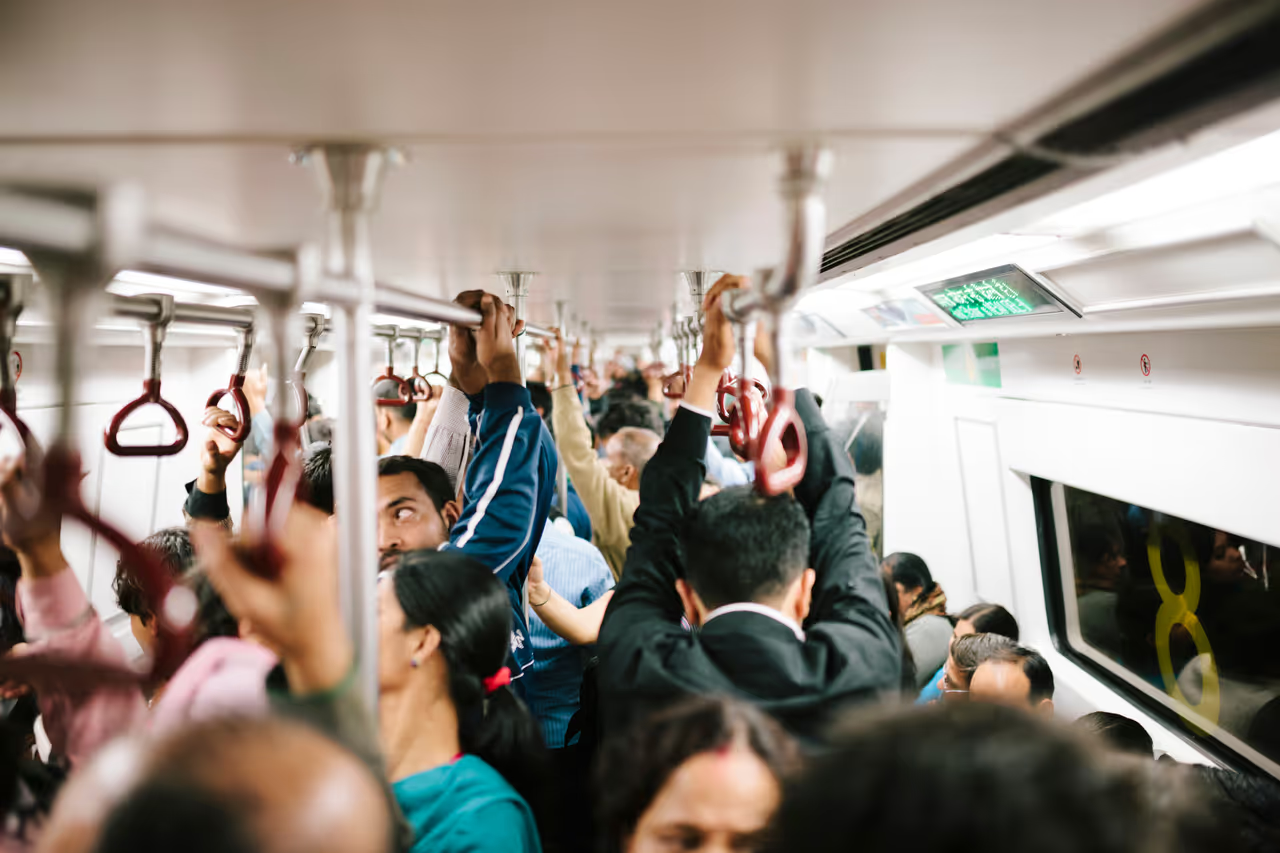
A new analysis covering 43 countries has found that people around the world spend almost the same amount of time travelling each day, about 78 minutes, or 1 hour and 18 minutes. This pattern appears across rich and poor nations alike. Whether someone lives in a busy city or a rural town, the daily travel time stays surprisingly stable. Researchers say this shared global behaviour shows a deep-rooted human tendency to devote a fixed part of each day to moving around.


Commute Time Holds Steady Across Transport Modes
The study shows that people typically travel between 66 and 90 minutes a day, regardless of how they travel or how far they go. Walking, cycling, cars, buses, and trains all still lead to roughly the same daily time spent on the move. The authors say this stability suggests that people naturally adjust their choices so that their total travel time remains steady, even when transport becomes faster or more convenient.
Findings Based on Wide Global Data
The research, published in Environmental Research Letters, used data that reflect the travel habits of more than half of the world’s population. It covered trips made for work, errands, and personal reasons. By studying so many countries with different cultures and income levels, the researchers were able to confirm that the 'convergent' daily travel time is not linked to national wealth or regional lifestyle. Instead, it appears to be a common behavioural pattern shared across societies.
Why People Still Travel the Same Amount of Time
According to the authors, the steady daily travel time may arise from both psychological and practical factors. Humans seem to have a natural desire to leave home, experience their surroundings, and explore.
At the same time, there are practical limits, such as fatigue, time pressure, or responsibility, that stop people from travelling too long. This balance leads most individuals, in most countries, to settle into a daily travel routine that averages around 78 minutes.
Faster Travel Means Travelling Further, Not Less
One key finding is that improving transport speed does not reduce daily travel time. Instead, people simply use faster travel to cover longer distances. Lead author Eric Galbraith, from the Autonomous University of Barcelona, explained that when transport becomes more efficient, people expand the area they travel across rather than cutting their travel time.
This behaviour means that technological upgrades often increase total travel distance, even though the commute time itself remains unchanged.
Energy Use Depends on Time, Not Distance
The researchers argue that the most important factor shaping future transport energy demand is energy used per hour of travel, not energy per kilometre. Since the time spent travelling stays almost constant, making transport more energy-efficient by distance alone will not necessarily cut total energy use.
Co-author William Fajzel, from McGill University, said the best way to lower energy demand is to design places where people can choose low-energy travel modes during those 78 minutes.
What the Findings Mean for Cities and Policy
The study offers a practical tool for understanding how society might respond to new technology or transport policies. Because people tend to maintain a fixed daily travel time, the mix of walking, cycling, public transport, and driving becomes the real driver of energy use. For instance, a city where residents spend part of the day on energy-intensive rail travel will consume far more energy than a walking-centred city. Urban planners can use this insight to guide future sustainable development.
Check the Breaking News Today and Latest News from across India and around the world. Stay updated with the latest World News and global developments from politics to economy and current affairs. Get in-depth coverage of China News, Europe News, Pakistan News, and South Asia News, along with top headlines from the UK and US. Follow expert analysis, international trends, and breaking updates from around the globe. Download the Asianet News Official App from the Android Play Store and iPhone App Store for accurate and timely news updates anytime, anywhere.