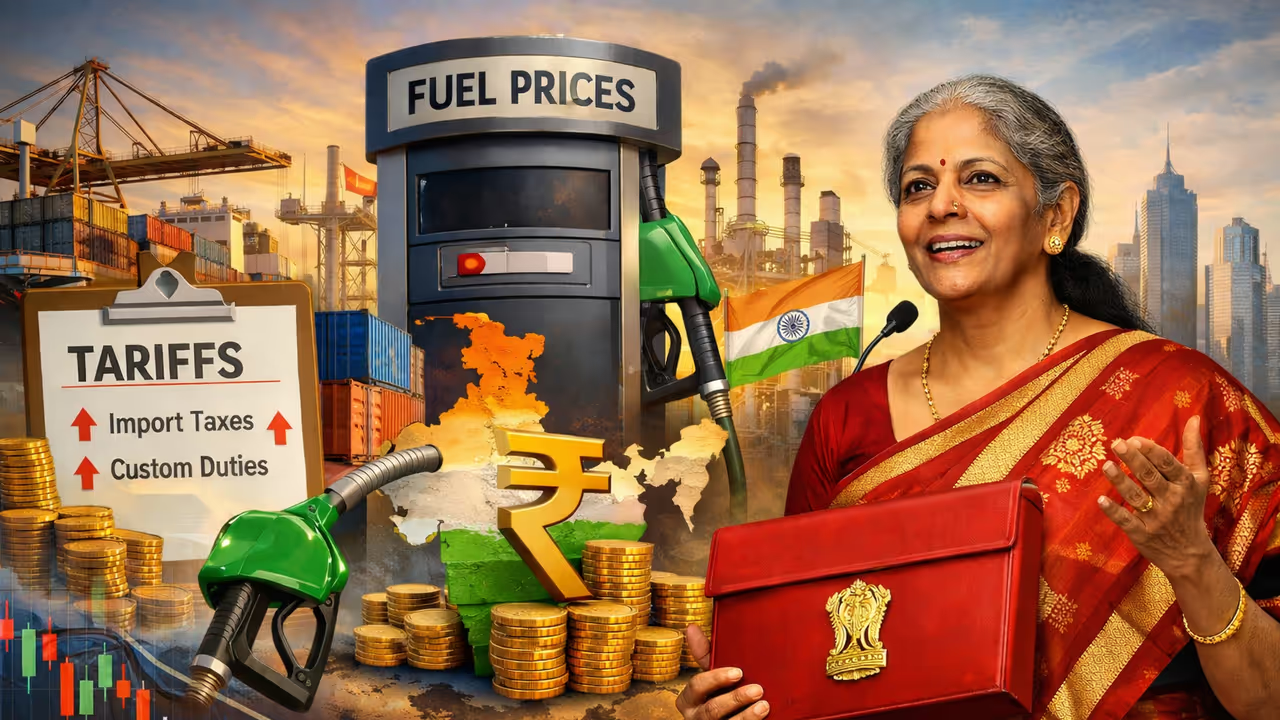
FM Nirmala Sitharaman’s FY26-27 Budget faces global trade tensions, revenue stress and market jitters, with capex, jobs, tax stability and fuel levies in focus as India navigates uncertainty.
Finance Minister Nirmala Sitharaman will present her ninth consecutive Union Budget on February 1, an unprecedented feat, as she lays out the government’s economic roadmap for FY27 (April 2026–March 2027) amid global uncertainty, fiscal constraints and fragile market sentiment. The Budget presentation will also mark a first in independent India’s history, as it is scheduled for a Sunday.
Economists expect the FY26-27 Budget to focus on sustaining growth momentum, maintaining fiscal discipline and pushing reforms that could help insulate India from escalating global trade frictions, including US tariffs.
Global Headwinds, Domestic Pressures
The Budget comes at a time when the global economy is grappling with geopolitical tensions, volatile commodity prices and uneven monetary easing by major central banks. While India’s domestic demand has remained resilient and inflation has eased from recent peaks, the external environment continues to cloud the outlook.
Related Articles

At home, the government faces mounting pressure to boost consumption, accelerate job creation and maintain a strong capital expenditure push, all while keeping the fiscal deficit on a declining trajectory.
Tariffs, Tax Cuts and the Revenue Challenge
Sitharaman’s earlier sweeping income tax and GST cuts, combined with sustained infrastructure spending and interest rate reductions by the RBI, have helped India absorb the shock of the punitive 50 per cent tariff imposed by US President Donald Trump on Indian goods.
However, those same tax cuts have also nibbled into government revenues, significantly narrowing the fiscal space available to support the economy in FY26-27.
Her biggest challenge, economists say, will be to identify a new growth driver against the backdrop of a fragmented global economy, jittery financial markets and a steady uptrend in global commodity prices.
Investor Confidence Under Strain
Restoring investor confidence will be another immediate test. Uncertainty surrounding India–US trade talks has unsettled financial markets, triggering continued foreign portfolio outflows from Indian equities and pushing the rupee to a record low.
In this context, market participants will be watching the Budget closely for signals of policy continuity and macroeconomic stability.
Fuel Taxes May Be Tapped Again
Some economists believe the government could once again turn to its reliable revenue lever — petrol and diesel.
With a limited window available before international oil prices rise further, Sitharaman may increase excise duty on auto fuels. The hike is expected not to be passed on to consumers, but adjusted against the retail price cut that should have occurred when global oil prices fell last year.
Focus on Reforms, Not Spending Cuts
Despite tight purse strings, the government is not expected to cut spending. Instead, Sitharaman may focus on simplifying regulations and advancing structural reforms to attract both domestic and foreign investment.
The Budget could also carry political undertones, with possible new measures for poll-bound states — West Bengal, Tamil Nadu, Kerala and Assam. Some existing schemes may be re-packaged rather than expanded outright.
Capex Push Likely to Continue
Capital expenditure is expected to remain the central pillar of the FY26-27 Budget.
Over recent years, the government has sharply raised spending on roads, railways, defence manufacturing, urban infrastructure and logistics, aiming to crowd in private investment.
For FY26-27, economists anticipate another meaningful increase in capex, though at a more measured pace than the post-pandemic surge. Priority areas are expected to include railways, renewable energy, power transmission, defence and urban transport, alongside continued support for state-level infrastructure through interest-free loans.
Tax Stability Over Big Giveaways
On the tax front, major changes appear unlikely.
The government has consistently signalled a preference for stability and predictability, particularly in direct taxes. Any personal income tax tweaks are expected to be incremental, aimed at easing the burden on the middle class to support consumption rather than offering sweeping relief.
Corporate tax rates are also likely to remain unchanged, with the focus shifting to improving compliance, widening the tax base and strengthening digitisation and data-driven enforcement.
Jobs, Manufacturing and MSMEs in Focus
Job creation is expected to feature prominently in the Budget narrative.
Possible measures include incentives for labour-intensive manufacturing, expanded skilling and apprenticeship programmes, and enhanced support for micro, small and medium enterprises (MSMEs), which continue to face margin pressures due to high input costs and tight credit conditions.
MSME-focused schemes may receive higher allocations or expanded credit-guarantee support.
The government may also fine-tune production-linked incentive (PLI) schemes as it reviews their impact on manufacturing capacity, exports and employment generation.
Green Transition and Energy Security
India’s energy transition goals are expected to get renewed emphasis in FY26-27.
The Budget is likely to strengthen support for renewable energy, green hydrogen, battery storage and electric mobility, along with incentives to boost domestic manufacturing of clean-energy equipment and reduce import dependence.
At the same time, allocations for oil and gas infrastructure and strategic petroleum reserves are expected to be maintained, reflecting concerns over energy security amid global volatility.
Political Undertones, Fiscal Balancing Act
While FY26-27 is not a general election year, the Budget will be closely scrutinised for its political signals ahead of key state polls.
Balancing welfare spending with fiscal prudence will be a delicate task, especially amid demands for higher rural support and targeted subsidies.
Overall, economists expect the Budget to prioritise continuity over surprise, reinforcing India’s long-term growth strategy while managing near-term risks.
Economists Weigh In
According to economists at SBI Research, the Budget is being framed against the “domino effects of a new emerging order of realpolitik, still largely opaque, yet frightening.”
“A bigger concern is if crude oil breaks free from the artificially managed supply glut and joins the bandwagon, even for a short while,” they warned.
SBI Research expects modest growth in tax revenue and flat growth in non-tax revenue, adding that government capex may cross Rs 12 lakh crore in FY26-27, reflecting a year-on-year growth of around 10 per cent.
Radhika Rao, Senior Economist at DBS Bank, noted that net tax receipts are likely to miss budgeted estimates due to GST rate rationalisation, direct tax relief and lower tax buoyancy amid weaker nominal growth.
“We expect Budget measures to align with the economy’s strategic ambitions, including on manufacturing and social welfare,” Rao said.