
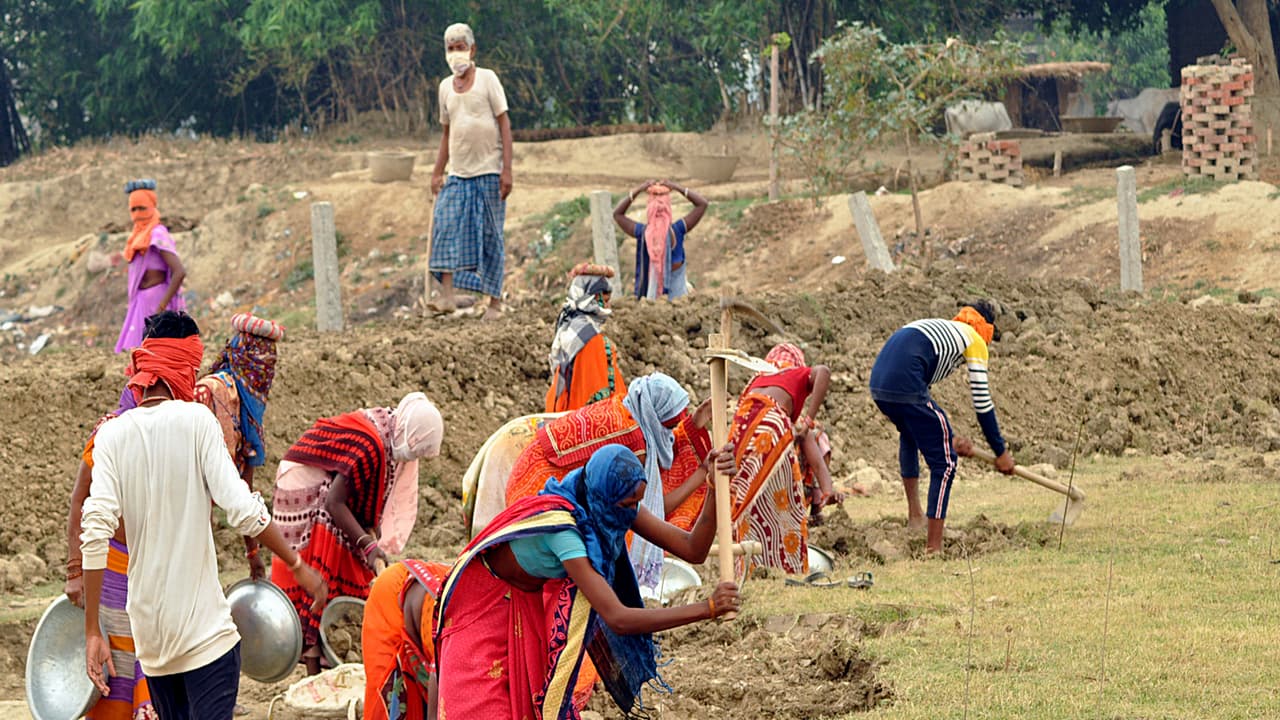
States are expected to be net financial gainers under the new VB-G RAM G Act, collectively gaining Rs 17,000 crore, says an SBI report. It dismisses fears that the revised 60:40 funding ratio will worsen state finances.
States to Gain Financially Under New Act: SBI
States are expected to remain net gainers in fund sharing under the proposed (Viksit Bharat Guarantee for Rozgar and Ajeevika Mission) VB-G RAM G Act, and the framework can be further scaled up by states through their own contribution, according to a report by State Bank of India (SBI).
The report said that using a simulated scenario of a normative assessment based only on the Centre's share, states could collectively gain around Rs 17,000 crore when compared to the average allocation of the last seven years. This analysis is based on seven attributes or parameters, structured around the twin fulcrum of equity and efficiency. It stated "We estimate the States gain around approx. Rs 17,000 crores when compared to average allocation of last 7 years, hinting at a scenario where most of the states will be net gainers."
Addressing Concerns Over 60:40 Funding Ratio
SBI noted that since the introduction of the Bill, there has been significant debate, particularly around concerns that the revised funding pattern could shift a higher financial burden to states. One of the major criticisms relates to the change in the funding ratio to 60:40 between the Centre and states (excluding North-Eastern states, Union Territories, and Himalayan states).
However, the report argued that fears of the revised ratio worsening state finances or forcing higher borrowing are unfounded and largely stem from a lack of understanding of state finances. According to SBI, the new framework, when assessed through objective and normative criteria, actually improves overall fund distribution to states.
Analysis Reveals Overall Gains for States
Under the analysis, SBI calculated the share of each state as a percentage of the total allocation for all states across each parameter. It then compared the results of this normative assessment with the average allocation under MGNREGA (Mahatma Gandhi National Rural Employment Guarantee Act) during FY19-FY25, excluding FY21.
The findings show that overall, states gain around Rs 17,000 crore compared to the average allocation of the past seven years. It stated that only two states showed minimal losses. In the case of Tamil Nadu, SBI highlighted that if the FY24 allocation outlier, which saw a 29 per cent rise compared to the average of FY22 and FY23, is removed, the loss becomes negligible.
The report identified Uttar Pradesh and Maharashtra as the top gainers, followed by Bihar, Chhattisgarh, and Gujarat. Overall, SBI said that adopting objective criteria can enhance devolution for both developed and laggard states, while maintaining a balance between equity and efficiency.
The report added that states can further improve outcomes by effectively leveraging their 40 per cent contribution under the revised funding structure.
VB-G RAM G Act Becomes Law
During the recently concluded winter session, the Parliament passed the VB-G RAM G bill, with the Rajya Sabha approving the legislation hours after the Lok Sabha passed it. President Droupadi Murmu, on 21st December, gave assent to the VB-G RAM G Bill, 2025
The Bill guarantees 125 days of wage employment per rural household, up from the existing 100 days, for adult members willing to undertake unskilled manual work. (ANI)
(Except for the headline, this story has not been edited by Asianet Newsable English staff and is published from a syndicated feed.)