
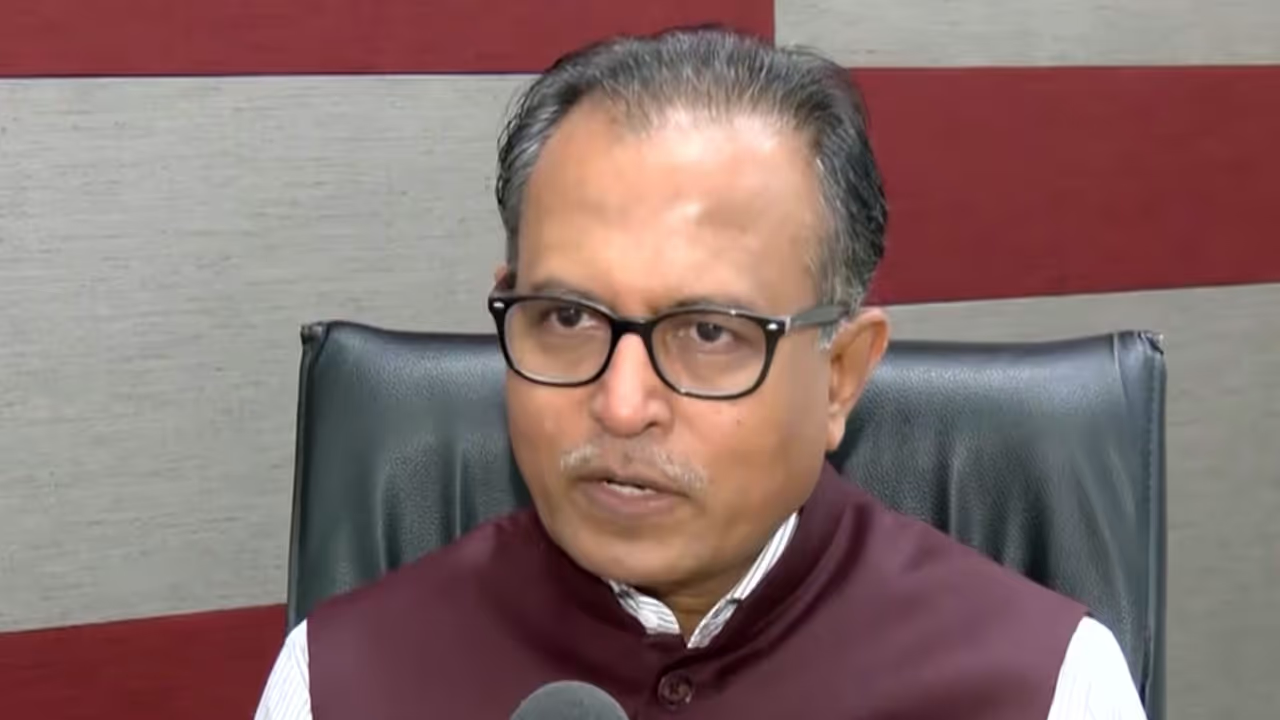
Kotak Mutual Fund MD Nilesh Shah said SEBI's new closing auction session could face initial difficulties but will stabilise. He stated it will benefit passive funds by reducing tracking errors but pose challenges for arbitrage funds.
SEBI's New Closing Auction Session
Kotak Mutual Fund Managing Director Nilesh Shah said the newly implemented closing auction session (CAS) under SEBI's revised trade mechanism could take some time to stabilise, but is likely to become an integral part of the Indian market as participants become more familiar with it. Speaking exclusively with ANI, Shah said the system may initially face operational difficulties, but SEBI is open to feedback and improvements.
"Now, when you roll out a new system, there be some hiccups? Answer is yes. Will SEBI take the market feedback and make any improvement if required? Answer is yes," Shah said.
He said the closing auction mechanism, which provides a single execution price and is particularly beneficial for passive funds, is not unique to India and is already used in several developed markets. "The closing auction is not an innovation in India. It exists in many parts of the world. It was launched to provide passive funds, a single price of execution," Shah said.
Impact on Different Funds
He said the initial difficulties should ease as market participants become more comfortable with the system. "If as people become more comfortable with the system, will the inefficiencies go out? Answer is yes," he said, adding that the mechanism had faced "some teething troubles" and was being resolved through active engagement between market participants and SEBI.
Shah said the new system could help passive funds by reducing tracking errors, while active funds could potentially use price movements around the closing auction to their advantage. "So again for passive fund, this is very positive that tracking error will come down. For active funds, obviously they'll take advantage of the plus or minus 3 per cent price movement and try to participate," he said.
Challenges for Arbitrage Funds
However, he flagged challenges for arbitrage funds, particularly because they may not know the final execution price of their cash-market transactions during the closing auction. "The challenges for arbitrage fund, when they can't participate in closing auction because they don't know at what price their cash transactions will be executed," Shah said.
Market Valuations and Corporate Earnings
On Indian equity market valuations, Shah said valuations are currently reasonable and do not appear either excessively expensive or cheap. He said corporate earnings have remained supportive and that future market returns are likely to be driven more by earnings growth than valuation re-rating. "Valuations are fair, not cheap, not expensive," Shah said.
He said first-quarter corporate earnings had been broadly in line with or ahead of expectations, with relatively few disappointments. Excluding oil marketing companies, he said, the broader economy delivered fairly good results. "We still believe despite that strong set of numbers, markets return will still be linked with earnings growth," Shah said.
According to Shah, earnings growth is expected to remain the larger contributor to portfolio returns, with growth appearing to be in the low double digits.
Broader Market Outlook
On the broader market outlook, Shah said three factors -- sentiments, flows and fundamentals -- would determine market movement. "On a fundamental basis, economy has done well to weather the Middle Eastern crisis, monsoon deficiency. Obviously, we need to be cautious," he said.
He added that corporate earnings for March 2026 and June 2026 had been good, while valuations were around historical levels.
Shah said foreign portfolio flows had also started turning positive, with FPI buying seen in July and continuing into August.
Advice for Long-Term Investors
For long-term investors, he remained positive on the Indian market's ability to generate returns through sustained earnings growth. "But overall for a long term investor, can Indian market deliver a compounding story? Answer is undoubtedly yes," Shah said.
He also cautioned investors against reacting sharply to individual inflation readings, saying markets had already factored in several known risks such as higher oil prices and monsoon-related inflation. "India is a long term growth story. You invest with a longer horizon. It will compound earnings growth equivalent return should come from our market over a period of time," Shah said. (ANI)
(Except for the headline, this story has not been edited by Asianetnews Editorial staff and is published from a syndicated feed.)