
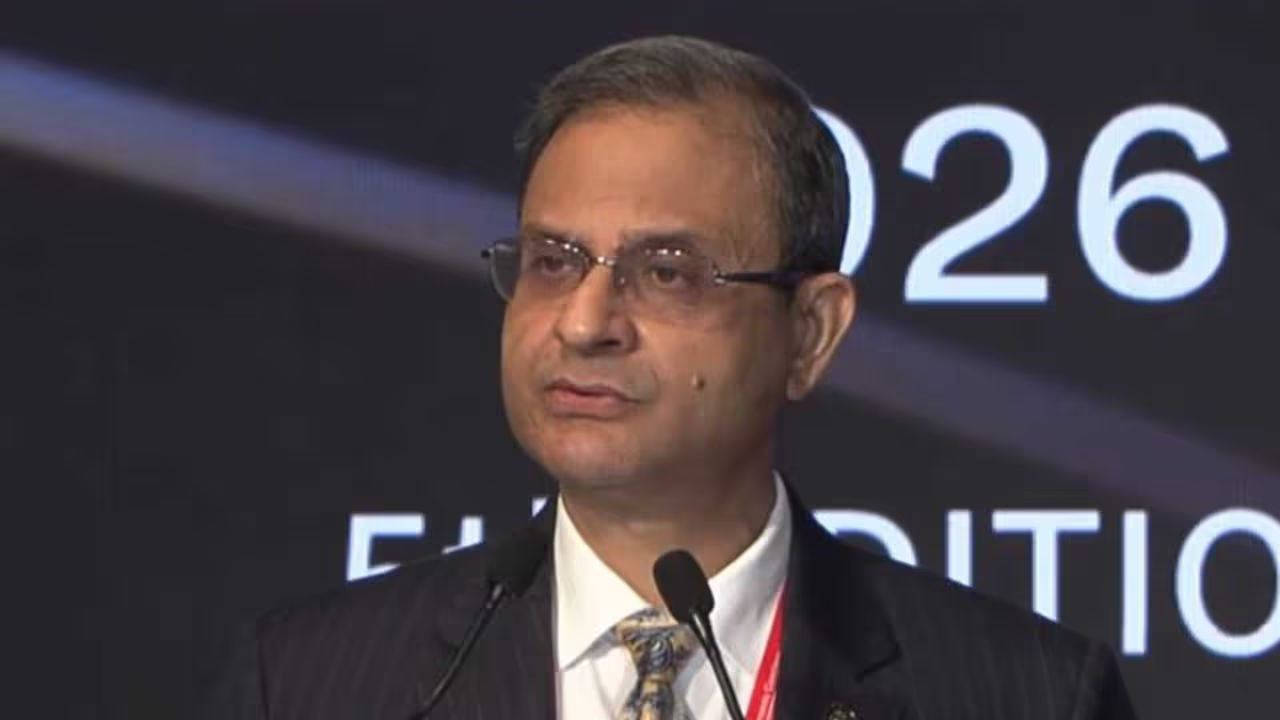
RBI Governor Sanjay Malhotra reiterated the central bank's cautious stance on private cryptocurrencies, citing risks to monetary policy. He noted that while RBI supports the underlying technology, it sees CBDCs as a better solution for cross-border payments.
RBI's Cautious Stance on Crypto
The Reserve Bank of India continues to take a cautious approach towards cryptocurrencies, while favouring the use of their underlying technologies and seeing central bank digital currencies as a possible way to address problems in cross-border payments, RBI Governor Sanjay Malhotra said on Saturday. Speaking at the Fifth Kautilya Economic Conclave in New Delhi, Malhotra said concerns around cryptocurrencies included the singleness of money, implications for monetary policy and, particularly for emerging market economies, implications arising from capital flow restrictions.
“Our approach is we need to promote the underlying technologies, and we are using some of these in the central bank and outside in PPP mode. But insofar as crypto is concerned, it has been a cautious approach,” Malhotra said.
CBDCs for Cross-Border Payments
He said the payments problem that such technologies seek to solve was increasingly not about domestic transactions, particularly in countries such as India where payments have become fast, cheap and convenient. “The problem primarily that is being solved is of cross-border payments, and there are other means, for example, CBDCs that can solve these problems,” the Governor said.
Financial Innovation and System Integrity
His comments underline the distinction the RBI has sought to draw between the technology behind digital assets and privately issued cryptocurrencies. In his formal address at the conclave, Malhotra also stressed that financial innovation should strengthen rather than weaken trust in the financial system.
“Artificial intelligence, tokenisation, and new forms of financial intermediation can dramatically improve efficiency. But innovation will be sustainable only if the financial system preserves the fundamental properties on which trust rests: sound institutions, settlement finality, singleness of money, and financial integrity,” he said.
The comments come as central banks globally continue to examine digital currencies and tokenisation while assessing the monetary and financial stability risks posed by privately issued crypto assets. For India, the RBI has been developing and testing its central bank digital currency, the digital rupee, while maintaining a cautious regulatory position on private cryptocurrencies. Malhotra’s remarks suggest that the central bank sees scope for using new financial technologies to improve efficiency, particularly in cross-border transactions, but does not view privately issued crypto assets as the only route to achieving those benefits. (ANI)
(Except for the headline, this story has not been edited by Asianet Newsable English staff and is published from a syndicated feed.)