
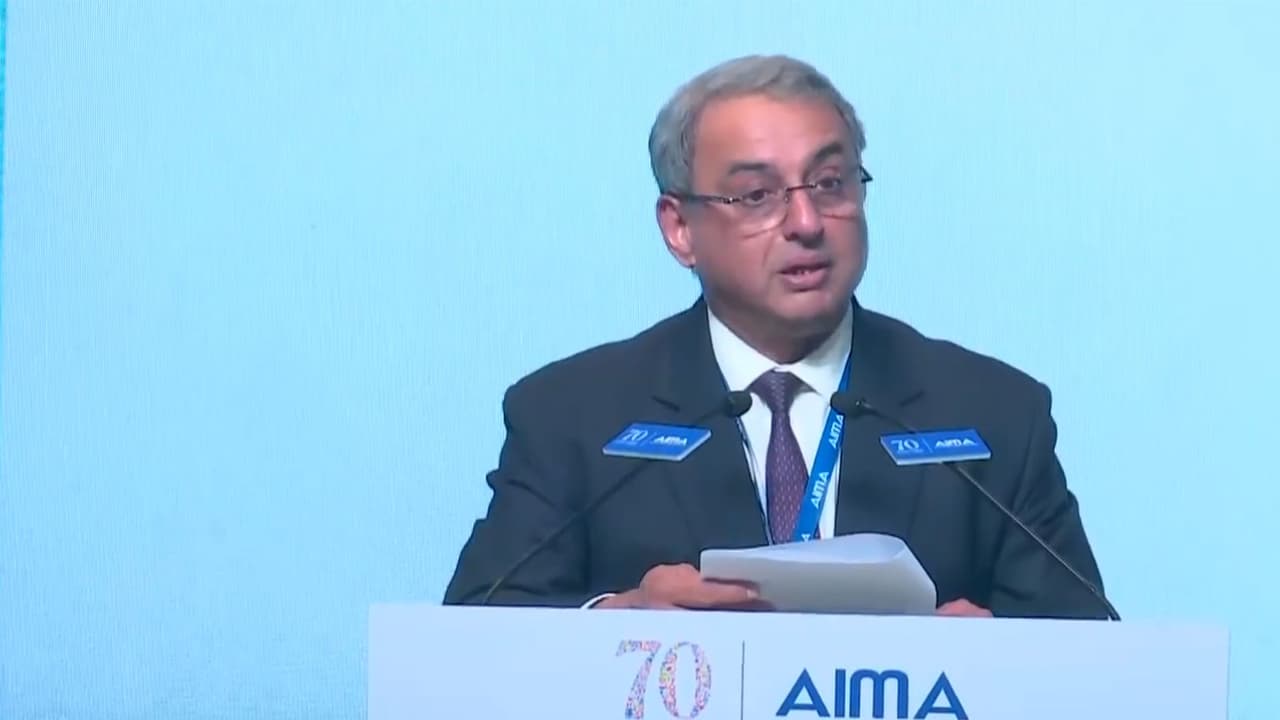
Tata Steel CEO T V Narendran stated that global interest in India as a market, manufacturing base, and strategic partner is at an all-time high, but capturing this opportunity will depend on India's competitiveness and resilience amid global risks.
T V Narendran, Chief Executive Officer and Managing Director of Tata Steel Ltd and President of the All India Management Association (AIMA), stated that there has never been a time when the world has had more interest in India than now.
While addressing the Platinum Jubilee of the National Management Convention 2026 of AIMA, Narendran noted that global interest covers India as a market, a manufacturing base, a source of technology and talent, and increasingly as a strategic partner, even as predicting the global environment in the coming years remains difficult. “The world is changing and that change is creating an opportunity for India, but whether we are able to capture that opportunity will depend on how capable and competitive we become…There has probably never been a time when the world has been more interested in India as a market,” Narendran said.
Navigating Global Headwinds
Addressing the convention on the theme of growth with resilience, he pointed out that recent developments show a contested global trading framework, where focus remains fixed on trade, investment, technology, energy, and supply chains amid tariffs and trade barriers.
“Climate events can be very difficult to anticipate. Geopolitical developments can change the assumptions on which businesses have been planned for years. Technology is moving at a pace that can make some of the skills and business models we take for granted look very different in a short period of time,” he said.
He noted that disruptions such as the conflict in West Asia impacted shipping routes through the Strait of Hormuz, raising energy costs, freight rates, and insurance premiums, which directly affect the cost of doing business in India. Unpredictable disasters, including the recent devastating floods and loss of life in Nepal, also show the need to prepare beyond known risks.
India's Economic Resilience
Despite these headwinds, the Indian economy recorded a 7.8 per cent expansion in the April to June quarter, with investment growing by 11.9 per cent alongside strong contributions from manufacturing and services.
From Efficiency to Competitiveness
“Over the last few decades, we became very good at optimizing businesses for efficiency. We built global supply chains, reduced inventories, sourced from the lowest cost locations and moved capital and products across borders,” Narendran said.
“Today the question is not only what is the most efficient way to do this, but also what happens if something changes. Where do we source from? How quickly can we find an alternative? How much technology do we control ourselves? Do we have the talent to adapt? Can we continue to compete if energy prices change sharply or trade barriers go up? And this is where the conversation on resilience becomes a conversation about competitiveness,” he added.
Focus on Domestic Manufacturing
Focusing on manufacturing, Narendran highlighted that global firms look at cost, quality, logistics, infrastructure, and delivery at scale. Free trade agreements open market access, but long-term gains depend on domestic execution.
“There is a significant difference between assembling a product and designing and engineering that product,” Narendran said, adding that India must develop proprietary design, intellectual property, and technical talent across sectors.
(Except for the headline, this story has not been edited by Asianetnews Editorial staff and is published from a syndicated feed.)