
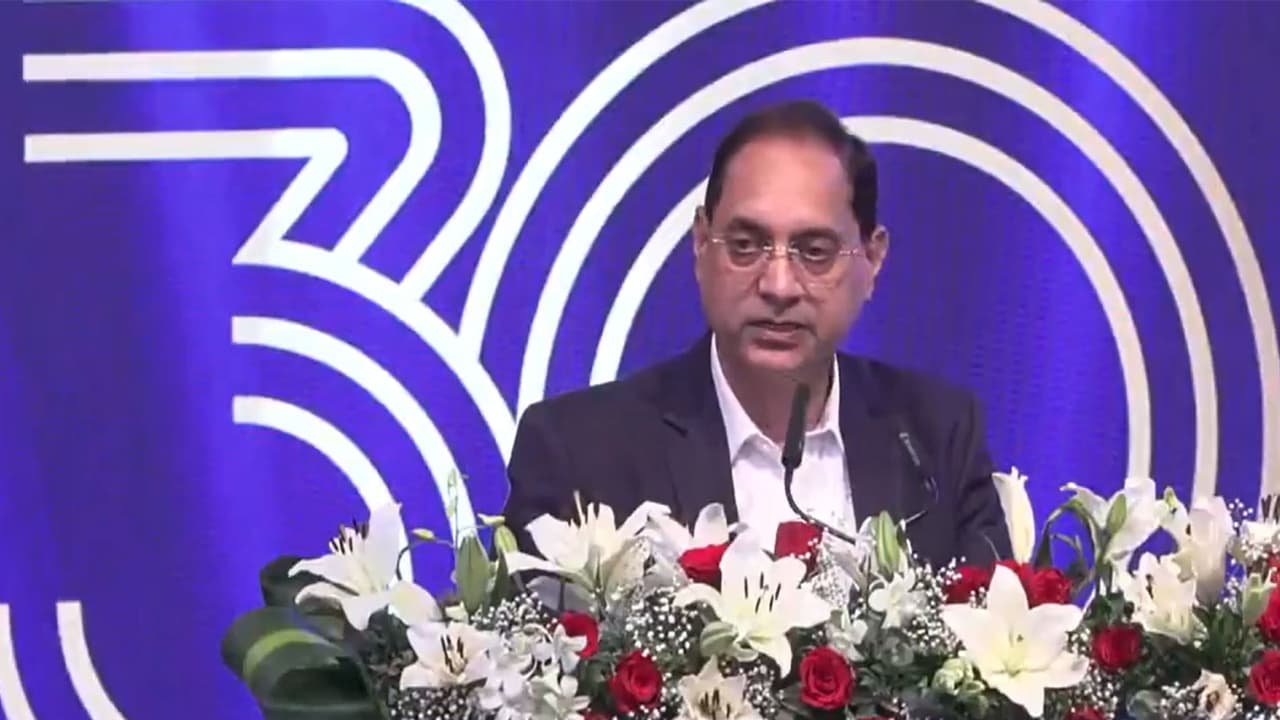
SEBI Chairman Tuhin Kanta Pandey said individuals & domestic MFs now hold 36% of Nifty 50's free float market cap. He highlighted this shift reflects India's economic growth and a rise in household savings moving to capital markets.
Individuals and domestic mutual funds together now hold about 36 per cent of the free float market capitalisation of Nifty 50 companies, said SEBI Chairman Tuhin Kanta Pandey, addressing the 30th anniversary of Nifty 50 at the National Stock Exchange (NSE).
Pandey in his address on Monday noted that the composition and performance of the Nifty reflected the broader expansion and diversification of the national economy over the last three decades, which marked a significant transition in the ownership structure of India's equity index. "As India's economy expanded and diversified, the composition and performance of the Nifty reflected these changes. Individuals and domestic mutual funds together now hold about 36% of the free float market capitalisation of Nifty 50 companies," he said.
Economic and Sectoral Expansion
The chairman observed that the market witnessed the rise of new industries and the expansion of existing sectors during this period. "Over the last 3 decades, we have witnessed the rise of new industries and the expansion of existing ones, from information technology and financial services to telecommunications, consumption-driven businesses, and several new-age sectors," he said.
Pandey also stated that, "The financial sector has expanded significantly, with its weight increasing from around 21% at the time of launch to about 38% as of February 2025." This shift underscores the changing nature of the index as it aligns with the country's economic trajectory.
Growth in Investor Participation and Market Cap
According to the chairman, the growth of the broader market ecosystem is equally notable. "India today has over 140 million unique investors," a figure that Pandey highlighted as a "steady shift of household savings towards capital markets."
This increased participation contributed to a market capitalisation for companies listed on the NSE that now exceeds 130 per cent of the GDP, in contrast to the approximately 35 per cent recorded in the 1995 fiscal year.
Robust Market Infrastructure and Collaboration
Pandey emphasised that the strength of the market infrastructure remains a vital component of this three-decade journey. He noted that India's exchanges currently rank among the most active globally. "Today, India's exchanges rank among the most active globally. Our markets host one of the largest numbers of listed companies, facilitate a very large number of IPOs each year, and account for one of the highest volumes of derivative contracts traded worldwide," he said.
The chairman highlighted that India emerged as a major global market in terms of efficiency, specifically citing faster settlement cycles and shorter listing timelines as key benchmarks.
"An important feature of our market ecosystem is that while exchanges compete with each other, they also collaborate when it comes to strengthening system-wide resilience," Pandey said. "Initiatives such as common contract nodes, interoperability across exchanges, clearing corporations, and the creation of alternate trading arrangements reflect this collaborative approach," he noted, highlighting that these ongoing developments reflect a "deeper and more mature market ecosystem" that supports the continued integration of domestic savings into the formal financial sector. (ANI)
(Except for the headline, this story has not been edited by Asianet Newsable English staff and is published from a syndicated feed.)