
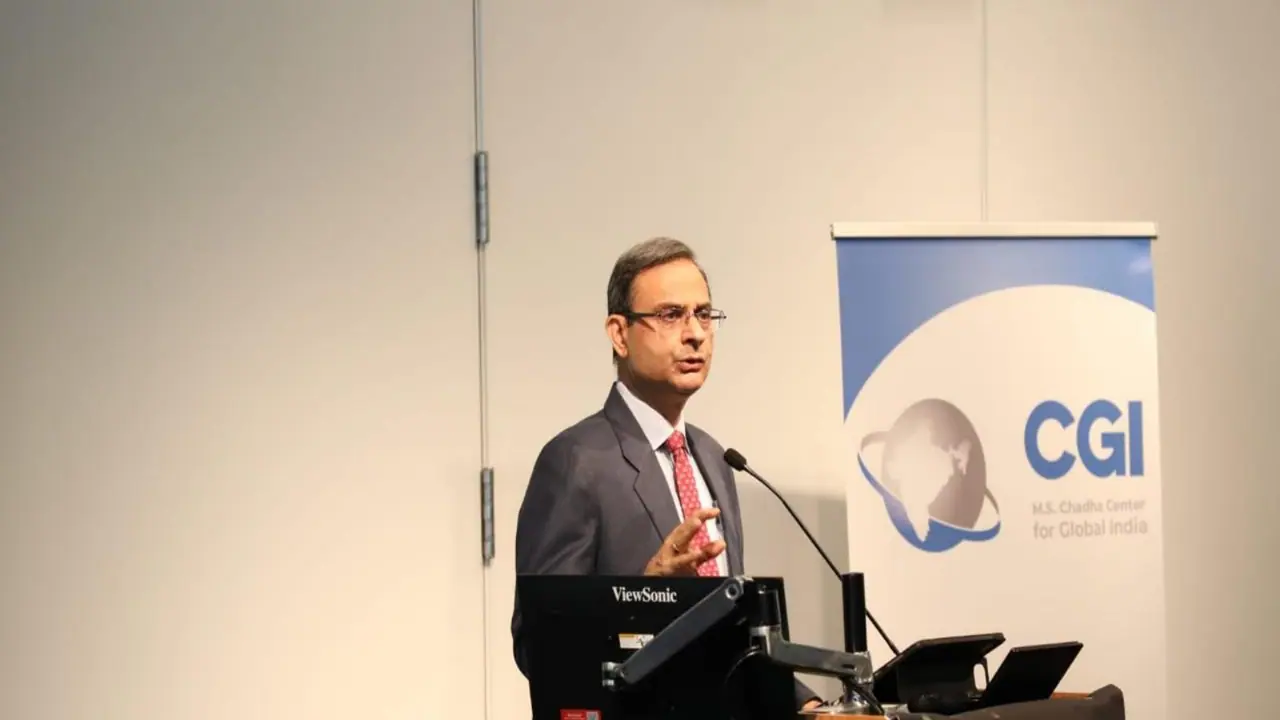
RBI Governor Sanjay Malhotra said India's economic resilience is due to robust policies and strong institutions. He noted the success of the FIT framework and the RBI's prudent, data-dependent approach to navigating global uncertainties.
Reserve Bank of India Governor Sanjay Malhotra has pointed out that the "the resilience of the Indian economy is not by chance," crediting the stability and growth of the central bank to its strong and credible institutions. Addressing an audience at Princeton University on Saturday, Malhotra said, "The resilience of the Indian economy is not by chance. It is because of the robust policy frameworks that have been successfully developed. It is due to the strong and credible institutions that have been assiduously built. It is on account of the various reforms undertaken steadily over the years. It rests on a foundation of stability and inclusion."
India's average annual growth of 6.1 per cent over the last decade resulted from robust policy frameworks and institutional strength. This growth significantly outpaced the global average of 3.2 per cent and the performance of regional peers, including China and Indonesia. Malhotra attributed this stability to the Reserve Bank's role in providing a facilitative ecosystem. He detailed how the central bank functions as a full-service institution, managing everything from currency and forex to the regulation of payment systems.
Inflation Targeting as a Key Anchor
The Governor's address highlighted that the formal adoption of a Flexible Inflation Targeting (FIT) framework in 2016 has been a primary anchor for this stability. Under the FIT mandate, average headline inflation dropped to 4.7 per cent between 2016 and 2025, compared to 7.4 per cent in the preceding years.
Navigating Uncertainty: RBI's Current Stance
The Governor noted that the central bank currently maintains a neutral stance and a "wait and watch" mode to navigate uncertainties stemming from the crisis in West Asia. This region is critical to India's economy, providing one-half of its crude oil imports and two-fifths of its inward remittances. "In central banking, the only certainty you have is uncertainty. This makes monetary policy making even more difficult. Our broad approach has been to be even more data dependent and to continuously reassess the balance of risks. We are therefore in wait and watch mode now," the Governor explained.
Fiscal-Monetary Coordination
Malhotra also emphasized the importance of fiscal-monetary coordination. He noted that the government's supply-side measures, such as enhancing agricultural resilience and infrastructure, complemented the RBI's efforts. Fiscal consolidation has seen the central government's deficit decline from 9.2 per cent in 2020-21 to 4.4 per cent in 2025-26. He cited the Direct Benefit Transfer system as a major efficiency gain, which saved an estimated USD 50 billion by early 2024.
Financial Stability and Prudent Regulation
Regarding financial stability, the Governor of the apex bank recalled how the RBI's historical prudence protected India during the 1997 Asian financial crisis and the 2008 global subprime crisis. He defended the central bank's regulatory approach, which prioritizes long-term health over short-term gains. "Our pursuit of financial stability is duly reflected in our broader regulatory framework. We have been willing to sacrifice some short term upside for long term growth. While some regard this as conservatism, we believe it is prudence. This is evident from our resilience over various crises," Malhotra added.
Digital Public Infrastructure
The RBI Governor concluded by highlighting India's digital public infrastructure. The Unified Payments Interface (UPI) processed over 22 billion transactions in March alone, and the RBI is now developing the Unified Lending Interface (ULI) to provide instant credit access for small farmers and business owners. (ANI)
(Except for the headline, this story has not been edited by Asianet Newsable English staff and is published from a syndicated feed.)