
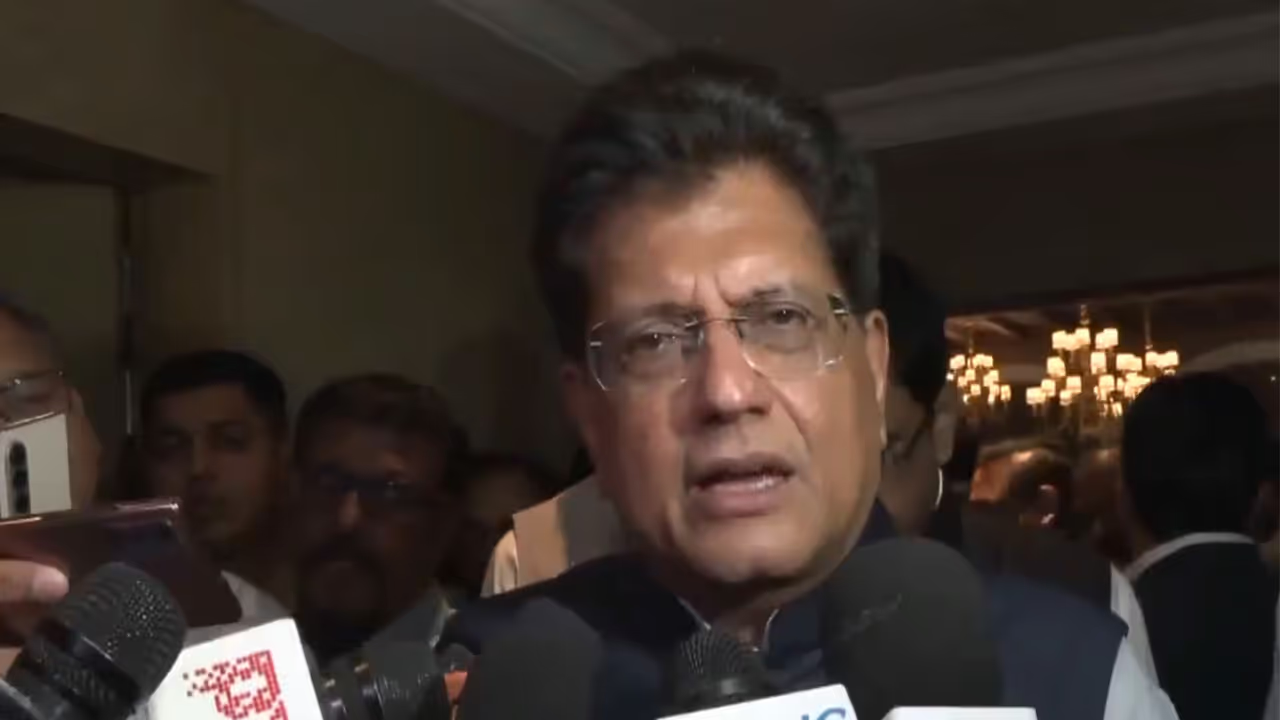
Indian exports grew significantly in early April despite geopolitical tensions, says Commerce Minister Piyush Goyal. He credits new trade deals for providing preferential market access and boosting opportunities across multiple sectors.
Indian exports witnessed a significant increase during the first three weeks of April compared to the same period last year, despite ongoing geopolitical tensions in West Asia. Union Commerce Minister Piyush Goyal, while speaking to the media, noted that the momentum in trade continues as new agreements provide preferential market access for Indian goods across several key sectors.
"Despite the war in West Asia, there is tremendous enthusiasm among Indian exporters. If we look at the April figures, our exports have increased significantly in the first three weeks of April compared to last April. As new trade agreements are coming into effect, the possibilities are also increasing," Goyal said.
The Minister identified several sectors where India sees vast opportunities. He explained that preferential access ensures that tariffs imposed on Indian products remain lower than those of many competitors, providing a substantial boost to these industries.
"Now, with great confidence, India will take its next steps in world trade. Different sectors, whether automobiles and auto parts, textiles, leather and footwear, agriculture, seafood, services and other sectors, people are seeing vast opportunities with major markets now open for India with preferential access. Which means that whatever tariff will be imposed on India, it will be less than our competitors. This will definitely give our multiple sectors great boost. With a lot a confidence, now India will step forward in the global markets," the Minister highlighted.
Addressing the current logistical landscape, the Minister mentioned that while the Strait of Hormuz remains a challenge for maritime trade, exporters are successfully navigating these hurdles by utilizing alternative routes. "It is going through different routes obviously, the Strait of Hormuz is still a challenge," he said.
Speaking on the India-US bilateral trade agreement, Goyal noted that, "We had very good discussions, I think about a week ago. Our team is back, and we continue to engage."
India-New Zealand Agreement Details
Earlier on Tuesday, while addressing the media, Goyal also confirmed that the India-New Zealand agreement established a comprehensive framework for cooperation across education, technology, and traditional medicine. The deal specifically targeted a significant increase in foreign direct investment from New Zealand over the next quarter-century to boost domestic industry and employment.
"100% of goods that can be imported from India to New Zealand will now be subject to zero duty...Partnerships in education, sports, culture, agriculture, productivity and technology, intellectual property, and traditional medicine, including AYUSH and Maori traditions, have also been established. A unilateral agreement has been signed in the fields of traditional medicine...It will be a highly beneficial FTA," Goyal said.
Major FDI Commitment from New Zealand
The Minister highlighted a substantial shift in the scale of bilateral capital flow. He noted that while New Zealand's past contributions to India's foreign direct investment remained modest, the new agreement set the stage for a transformational influx of capital. This investment aimed to support India's development goals during the "Amrit Kaal" period.
"Most importantly, New Zealand, which has invested only Rs 70 million in foreign direct investment over the last 25 years, or Rs 600-650 crore at today's exchange rate, will invest USD 20 billion dollars (approximately Rs 2 lakh crore) in India in the next 25 years. This massive investment will create millions of new employment opportunities, provide a major boost to business and industry, and enable us to move forward more rapidly in the 'Amrit Kaal'," the Minister added. (ANI)
(Except for the headline, this story has not been edited by Asianet Newsable English staff and is published from a syndicated feed.)