
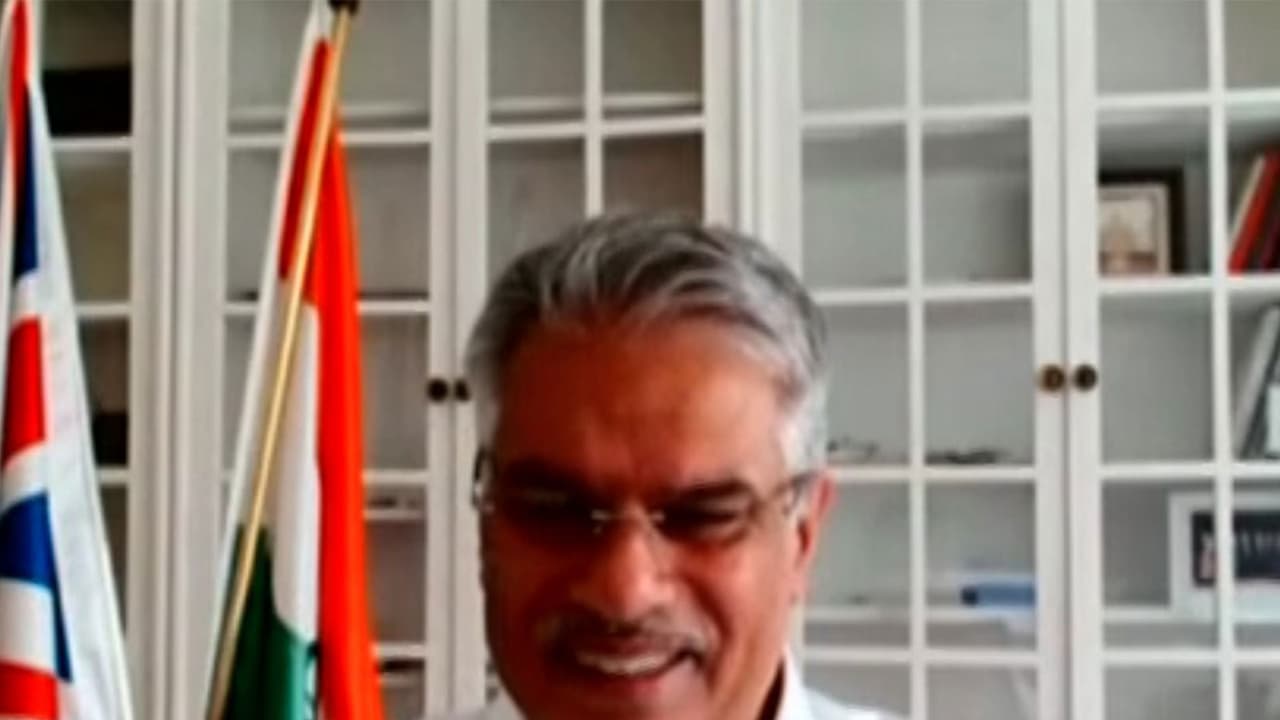
UK's Trade Commissioner Harjinder Kang highlights the new India-UK FTA as a 'base, not the ceiling' for a deeper geopolitical alliance, serving as a launchpad to expand bilateral ties across climate, education, defence, and technology.
Harjinder Kang, UK's Trade Commissioner for South Asia and former Chief Negotiator for the India-UK FTA, on Wednesday highlighted that bilateral economic agreements between New Delhi and London are merely the starting point for a deeper geopolitical alliance, adding that the trade deal will serve as a launchpad to expand bilateral ties across four other critical non-tariff sectors, which comes into effect from today.
FTA as a 'Springboard' for Deeper Ties
Speaking with ANI on the strategic trajectory of "phase two" of the India-UK relationship, Kang emphasised that the scope of cooperation stretches far beyond standard commercial calculations. He credited UK Foreign Secretary David Lammy with coining the phrase that the trade deal is the "base of our relationship with India, not the ceiling."
"Our previous Foreign Secretary, David Lammy, coined a phrase that was very good: this is the base of our relationship with India, not the ceiling. It starts from here, and from here we build," Kang stated. "There are areas where we can expand cooperation... Economic growth, trade, and investment through the FTA are just one pillar. There are four others, including climate, education, defence, and technology. All of these represent significant opportunities that we should build on. I see this agreement as a springboard for us to work even more closely together in the future."
Following the transition to the Labour government, Foreign Secretary David Lammy consistently championed this phrasing during bilateral engagements in New Delhi to convey that the completion of the FTA would not exhaust the scope of the partnership, but rather establish a baseline from which wider defence and technological cooperation would expand.
Focus on Technology and Security
Crucial to this expanded architecture is a separate, highly specialised technology framework formalised by top intelligence and defence officials to fast-track innovation in core future industries. "There was also another agreement reached around a year ago called the Technology and Security Initiative, signed by the National Security Advisers of both countries," Kang noted.
Kang said that the Technology and Security Initiative (TSI) was signed around a year ago by the National Security Advisers (NSAs) of both countries, targeting roughly eight industries, including life sciences, AI, and cyber. "This focuses on future-facing industries where we can collaborate, such as life sciences, artificial intelligence, cyber, and others. There are around eight industries where both countries are very keen to cooperate. Part of my role will be to help build connections and create corridors between the two countries in these industrial areas that we are both very excited about."
The India-UK Technology and Security Initiative (TSI) was officially launched and adopted in July 2024, led by Indian NSA Ajit Doval and his UK counterpart. The core agreement explicitly outlines a collaborative roadmap across key sectors including Telecoms, Semiconductors, AI, Quantum Tech, and Biotechnology/Health-Tech.
Trade Agreement Comes into Effect
The India-UK Comprehensive Economic and Trade Agreement (CETA) officially came into effect today. Signed in London, the landmark pact unlocks zero-duty access for 90.2 per cent of Indian exports to the UK and slashes India's import duties on key British products. (ANI)
(Except for the headline, this story has not been edited by Asianet Newsable English staff and is published from a syndicated feed.)