
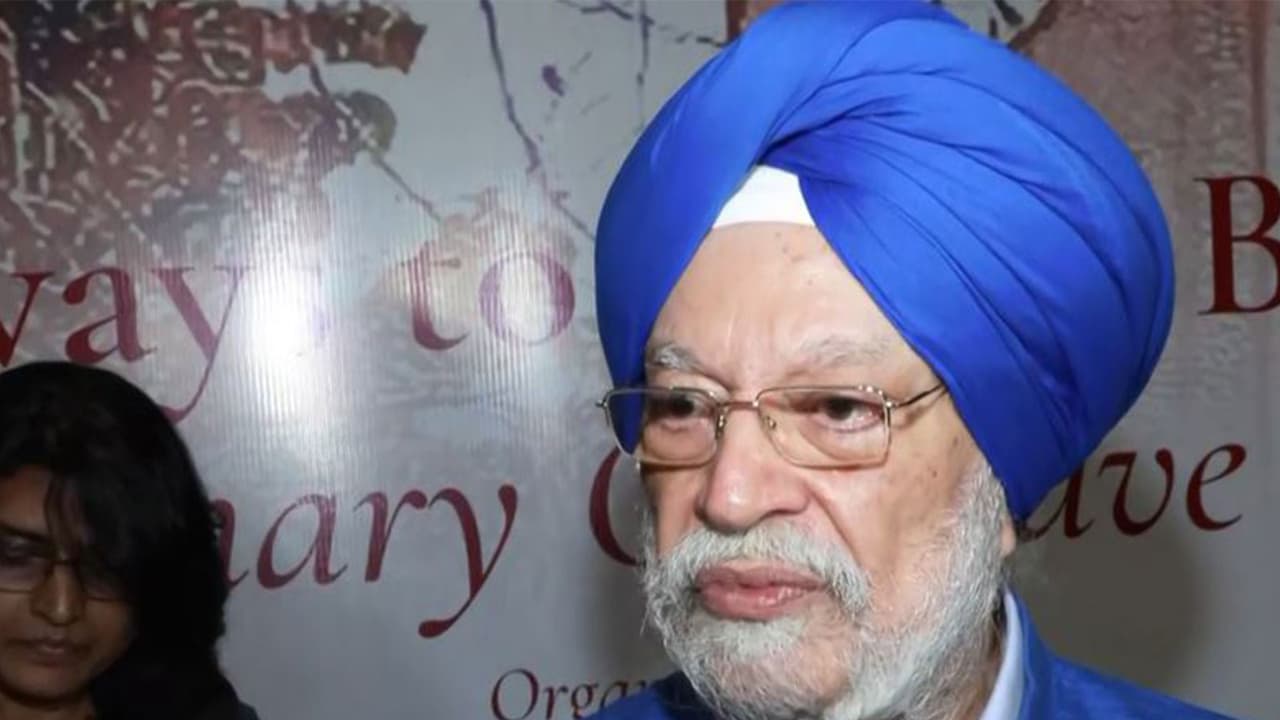
Union Minister Hardeep Singh Puri says India will diversify its energy supplies, expand refining, and explore new crude oil sources. This move aims to safeguard the Indian economy from external shocks caused by geopolitical tensions and market disruptions.
India will continue to diversify its energy supplies, expand refining capacity and explore new sources of crude oil as geopolitical tensions disrupt global energy markets, Union Minister of Petroleum and Natural Gas Hardeep Singh Puri said, highlighting the importance of strengthening domestic energy capabilities to safeguard the economy against external shocks.
Addressing the Pathways to Viksit Bharat Conclave at Shri Ram College of Commerce, Puri said disruptions along international shipping routes could affect Indian factories and household budgets, underlining the need for a resilient energy supply system amid continuing global uncertainty.
Diversifying Energy Supply Amid Global Uncertainty
“A disruption along a distant shipping route can alter the costs of an Indian factory and the budget of an Indian household,” Puri said, stressing the wider economic implications of geopolitical conflicts. He said India had diversified its sources of crude oil supply from 27 countries to 41, while procurement decisions would continue to depend on the availability of supplies at competitive prices.
“We have diversified our sources of supply from 27 to 41,” he said, adding that governments facilitate energy relationships, while commercial entities make purchasing decisions based on prices and availability.
Puri said disruptions around the Strait of Hormuz had demonstrated the importance of diversifying supplies, as a substantial share of global energy flows passes through the region. He also flagged emerging tensions in the Red Sea, saying the government was monitoring developments and working to maintain uninterrupted supplies.
Boosting Domestic Production for Rising Demand
Looking ahead, Puri said India would need to expand domestic energy production to meet rising demand as economic growth and industrial activity increase consumption. He expressed confidence that the Samudra Manthan scheme, which supports deep-sea oil and gas exploration, would strengthen domestic production over the next three years.
Under the scheme, the government plans to provide resources for drilling 150 wells, he said, adding that India needed to invest in exploration to unlock its domestic oil and gas potential. He also highlighted the Gobardhan scheme, which seeks to convert agricultural residue and organic waste into compressed biogas through support for investment, pricing and assured offtake. Puri said the integrated approach could encourage entrepreneurship while contributing to energy security.
Meeting Future Energy Needs
On future demand, the minister said the expansion of global capability centres and data centres would require large quantities of reliable energy. He added that India would need a mix of energy sources, including renewable energy, green hydrogen and conventional fuels, to ensure competitive and uninterrupted supply.
Focus on Green Hydrogen
On green hydrogen, Puri said successive tenders had brought production costs below USD 3 per kilogram from around USD 5.60 earlier. “I am confident that it is only a matter of time where we'll bring it down to about two or so,” he said, referring to the potential for further cost reductions.
Current Market Dynamics and Opportunities
Speaking to reporters on the sidelines, Puri said India was importing more than 5 million barrels of oil per day while also exporting around 1 million barrels, supported by expanding refining capacity.
On Venezuela, he said the government was “in the process of looking at all possibilities”, noting that ONGC already has assets there and that Venezuelan oil had returned to the market. (ANI)
(Except for the headline, this story has not been edited by Asianet Newsable English staff and is published from a syndicated feed.)