
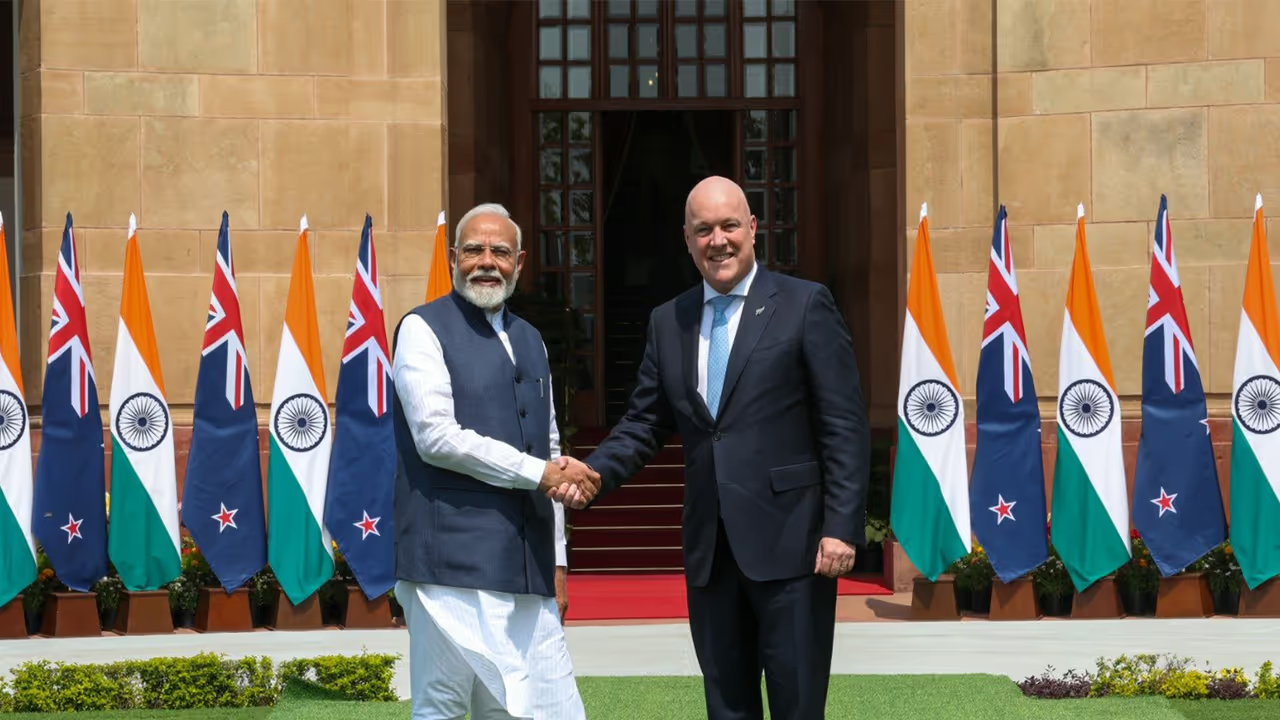
The India-New Zealand Free Trade Agreement has come into effect, offering duty-free entry for all Indian goods. Leaders from both nations hailed the pact, which is expected to boost exports, strengthen economic ties, and create new jobs.
The India-New Zealand Free Trade Agreement (FTA) came into effect on Tuesday, allowing all Indian goods to enter New Zealand duty-free and opening new opportunities in trade, investment and employment. Leaders from both countries welcomed the agreement, highlighting its potential to boost exports, strengthen economic ties and create jobs.
Key Benefits for India
Union Commerce and Industry Minister Piyush Goyal welcomed the implementation, saying in a post on X, "The India-New Zealand FTA comes into force today! A new chapter of opportunities begins!"
The agreement eliminates tariffs on 100 per cent of New Zealand's tariff lines for Indian exports, benefiting sectors including textiles, apparel, leather, footwear, engineering goods, pharmaceuticals and agricultural products. In graphics shared on X, Goyal highlighted the benefits for Indian exporters, stating, "100% Indian exports to pay ZERO duty."
The minister also highlighted the protection provided to sensitive agricultural sectors under the agreement. "We safeguarded our farmers' interests," one of the graphics stated, adding that sensitive sectors, including dairy and key agricultural products, would remain protected.
New Zealand's Perspective
New Zealand Prime Minister Christopher Luxon also welcomed the implementation, describing the agreement as an opportunity to expand exports, investment and employment. "As of today, our historic Free Trade Agreement with India is in effect," Luxon said in a post on X.
"From today, Kiwi businesses can reach over a billion more customers with significantly reduced tariffs," he added. Luxon said improved market access would allow New Zealand businesses to increase sales, expand operations and invest in additional capacity.
"That means it's easier for Kiwi businesses to sell more, hire more staff, invest in machinery and expand, creating more jobs and higher wages for Kiwis," he said.
Broader Economic Partnership and Goals
The agreement is expected to strengthen bilateral trade, which currently stands at approximately USD 2.4 billion in goods and services, while supporting the countries' ambition to double trade by 2030.
Beyond tariff reductions, the agreement includes provisions covering customs procedures, investment cooperation, services and movement of skilled professionals. Goyal highlighted New Zealand's commitment to facilitate USD 20 billion in investments into India over 15 years.
"New Zealand's commitment to facilitate USD 20 billion in investment into India holds immense potential to strengthen manufacturing, infrastructure, services & innovation, supporting enterprise & employment," he said.
Commerce Secretary Rajesh Agrawal said the agreement was designed to create a broader economic partnership between the two countries. "These ties are not only about market access and having more exports to each other," Agrawal said, emphasising the wider scope of economic cooperation.
New Zealand Trade and Investment Minister Todd McClay also welcomed the agreement's implementation, highlighting improved opportunities for exporters. More than half of New Zealand's exports to India will become tariff-free immediately, with the share expected to increase to 82 per cent over time, according to a Reuters report. Products benefiting from tariff elimination include sheep meat, wool and coal, while apples, kiwifruit and milk albumins will receive preferential access under specified quotas.
"The gains go well beyond exports. They reach suppliers, local businesses and the towns that depend on them," McClay said, according to Reuters.
GTRI Analysis: Gains and Challenges
Meanwhile, the Global Trade Research Initiative (GTRI), in a report released on Tuesday, described the agreement as India's 17th operational FTA and highlighted the potential benefits for Indian exporters, students and skilled professionals. "All Indian goods can now enter New Zealand at zero import duty," the report stated.
Services, Mobility, and Investment
The report identified services and professional mobility as areas where India could secure significant gains. "Services and mobility could deliver larger gains for India," it stated.
New Zealand has offered commitments across 118 services sectors, including information technology, healthcare, education, financial services and telecommunications.
Under the agreement, Indian students will be allowed to work up to 20 hours weekly, while eligible science, technology, engineering and mathematics graduates can access three-year post-study work visas. Doctorate holders will be eligible for four-year post-study work visas. A separate pathway will accommodate up to 5,000 skilled Indian professionals at any given time for employment lasting up to three years. Another 1,000 young Indians annually can participate in a 12-month Work and Holiday programme.
The agreement also sets an investment objective of USD 20 billion from New Zealand over 15 years. GTRI noted that the target remains aspirational, given that New Zealand's investment in India totalled less than USD 1 billion over the preceding 25 years.
The report also highlighted challenges for Indian exporters, including food-safety standards, certification costs, high freight charges and lengthy shipping times.
Immediate Business Impact
On the business front, Luxon announced that Auckland-founded property technology company Valocity had secured the biggest deal in its history on the agreement's first day.
"When Kiwi businesses win overseas, Kiwis win at home," Luxon said, describing the development as an example of the opportunities created by closer economic ties.
"That's what this agreement is about: opening doors so our businesses can grow, and bringing more jobs and higher incomes back home," he added. The value and other commercial details of the transaction were not disclosed.
The agreement, signed on April 27 and ratified on September 21, follows negotiations that began in 2010, stalled in 2015 and resumed in March 2025. Its long-term impact will depend on how effectively businesses use the tariff concessions, investment opportunities and professional mobility provisions to expand bilateral economic engagement.
(Except for the headline, this story has not been edited by Asianet Newsable English staff and is published from a syndicated feed.)