
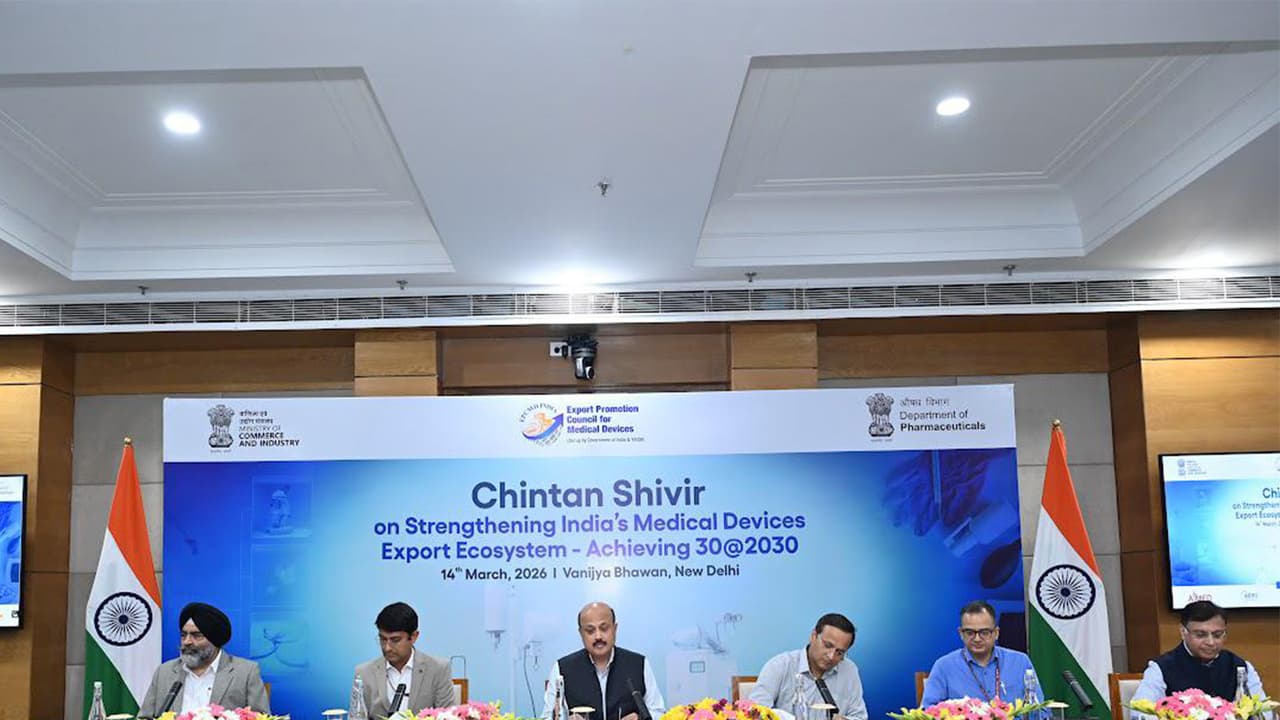
The Department of Commerce held a Chintan Shivir to strengthen India's medical device export ecosystem, aiming for a USD 30 billion market by 2030 by focusing on high-value manufacturing, quality, and regulatory harmonisation.
The Department of Commerce organised a Chintan Shivir on Saturday at Vanijya Bhawan to deliberate on strengthening India's medical device export ecosystem. The high-level meeting, held in collaboration with the Department of Pharmaceuticals and the Export Promotion Council for Medical Devices (EPCMD), focused on enhancing global competitiveness and addressing structural bottlenecks within the MedTech sector.
According to the Ministry of Commerce & Industry, the event centred on the theme "Achieving 30@2030 - USD 30 Billion Market Size by 2030". The gathering brought together over 150 participants, including policymakers, industry leaders, and regulators, to identify priority areas for manufacturing and export growth.
A Vision Beyond 'Pharmacy of the World'
Inaugurating the session, Secretary, Department of Commerce, Rajesh Agarwal, stated that India must move beyond its identity as the 'Pharmacy of the World' to emerge as a global MedTech manufacturing hub. He noted that while medical device exports surpassed USD 4 billion in FY25, the country needs to significantly increase its global market share over the next decade. He highlighted the importance of "high-value manufacturing, research and development investments, incremental innovation and regulatory harmonization" to reach the USD 30 billion target by 2030.
Collaborative Approach and Industry Perspectives
The discussions addressed the need for a collaborative approach between the government and private players. Joint Secretary, Department of Pharmaceuticals, Aman Sharma emphasized the quality aspect of production. Sharma said both industry and regulators need to work together toward the objective of "focusing on the quality of medical devices manufacturing in the country."
Additional Secretary and Director General of the Directorate General of Foreign Trade (DGFT), Lav Aggarwal, also delivered a special address regarding the pace of industry growth. He emphasised the "need to grow faster by addressing structural issues" and pointed to the role of trade policy measures in expanding India's international presence.
From the industry side, Forum Coordinator of AiMeD, Rajiv Nath, shared perspectives on scaling domestic production. He emphasised the need for continued government-industry collaboration to address global regulatory challenges and scale domestic manufacturing.
Focus on FTAs, Infrastructure, and Regulatory Frameworks
The Chintan Shivir featured three thematic sessions covering free trade agreements, infrastructure, and regulatory frameworks. One session explored how global trade deals open new pathways for MedTech exports, while another focused on strengthening manufacturing clusters and testing infrastructure to build a global brand for Indian products. The final session addressed the "evolving regulatory frameworks," focusing on streamlining approval processes and improving coordination between the industry and the Central Drugs Standard Control Organisation (CDSCO).
Actionable Pathways and Future Outlook
The Department of Commerce intends to use the insights from these sessions to promote a more vibrant export ecosystem. "The Chintan Shivir concluded with discussions on actionable pathways for strengthening India's medical devices manufacturing ecosystem and enhancing export competitiveness. The learnings from the Chintan Shivir will help the Department of Commerce leverage the advantages of India's medical devices industry and promote a vibrant export ecosystem through active engagement with the Department of Pharmaceuticals, CDSCO and EPCMD," the Ministry said. (ANI)
(Except for the headline, this story has not been edited by Asianet Newsable English staff and is published from a syndicated feed.)