
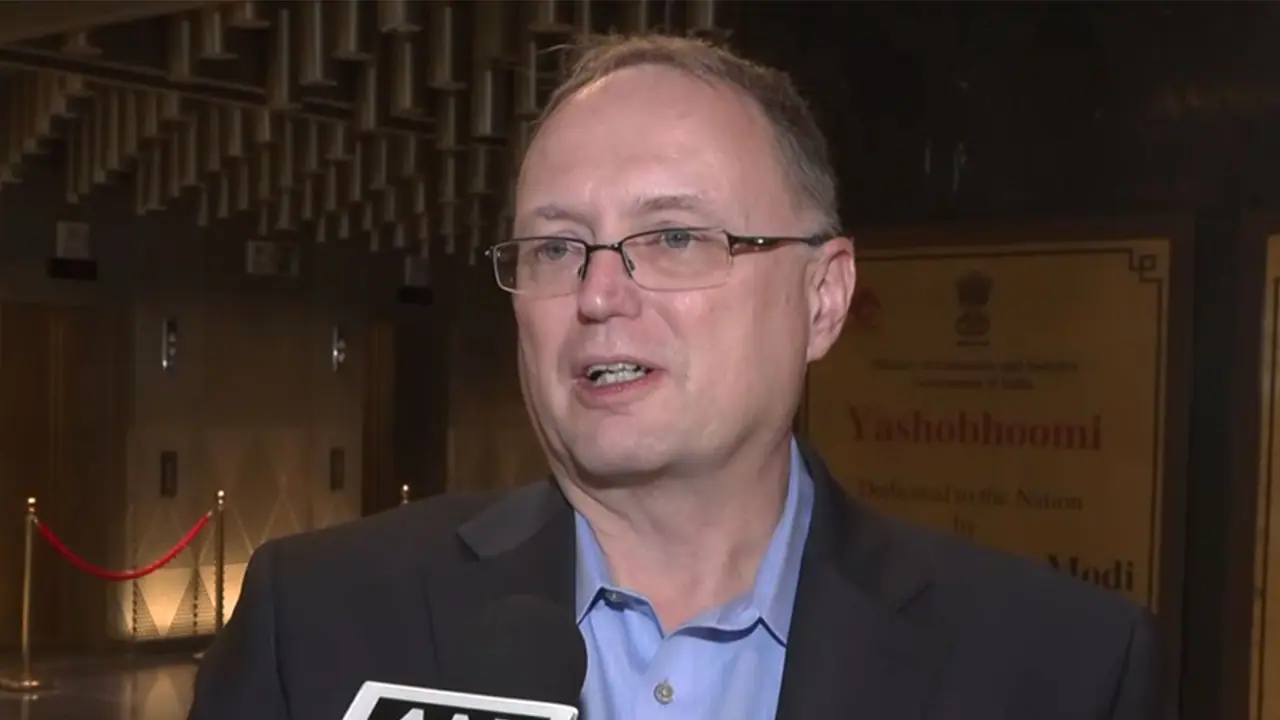
Lam Research's Peter Holland said India can emerge as a 'trusted and valued' hub for the global semiconductor industry. He stressed the importance of developing the domestic supply chain and highlighted the role of government-industry collaboration.
India can emerge as a “trusted and valued” hub for the global semiconductor industry, with continued development of the domestic supply chain crucial to achieving that goal, Lam Research’s Peter Holland said on Friday.
Speaking to ANI on the sidelines of Semicon India 2026, Holland said Lam Research’s expectation from the event was to see greater development of the semiconductor supply chain in India.
“My expectation really is to see more of the supply chain develop. Over the last few years, as we’ve invested in supply in India, we’ve seen more suppliers coming to us. This is a great forum for that kind of interaction,” Holland said.
India's Potential as a Trusted Hub
On India’s potential to emerge as a trusted and neutral manufacturing hub amid growing geopolitical pressures on semiconductor supply chains, Holland said there was “no doubt” that India could become a trusted and valued hub.
“Absolutely, India can become a trusted and valued hub. There’s no doubt in my mind that that’s possible,” he said.
Key Challenges to Address
However, Holland said India, like other semiconductor ecosystems globally, would need to address challenges related to talent, capital, land and critical utilities.
“The barriers to overcome, I think, are the same that face anyone wanting to engage in developing an ecosystem for a semiconductor supply chain and semiconductor fab equipment. That’s access to talent, access to capital, land, access to some of the utilities that are required, such as pure water, good power, this kind of thing,” he said.
Holland said these challenges were common across semiconductor manufacturing ecosystems worldwide.
“Those are all the same wherever you go in the world, and so under the same challenges that everyone faces,” he added.
Government-Industry Collaboration Crucial
When asked what India needs to do to move beyond its established strength in semiconductor design and engineering and capture a larger share of manufacturing and technology value, Holland highlighted the role of government-industry collaboration.
“I think the continued partnership between the government and the ecosystem in India is actually quite unique, and actually a very thoughtful way to accelerate progress in this area,” he said.
He added that the government could play a significant role in addressing some of the constraints faced by companies seeking to build semiconductor manufacturing and equipment ecosystems.
“If you think about those constraints that I previously mentioned, the government can have a very strong influence on removing those kind of constraints and barriers, and actually helping companies to much more,” Holland said.
Future Investment Plans
On whether Lam Research could announce further investments in India, Holland declined to comment on the company’s roadmap publicly at this stage.
“I don’t think I can comment on the roadmap publicly right now,” he said.
India has been seeking to build an end-to-end semiconductor ecosystem, with government support focused on semiconductor manufacturing, design, packaging and the wider supply chain.
Semicon India 2026 is bringing together global semiconductor companies, equipment manufacturers, investors and industry stakeholders to discuss opportunities across the ecosystem. (ANI)
(Except for the headline, this story has not been edited by Asianetnews Editorial staff and is published from a syndicated feed.)