
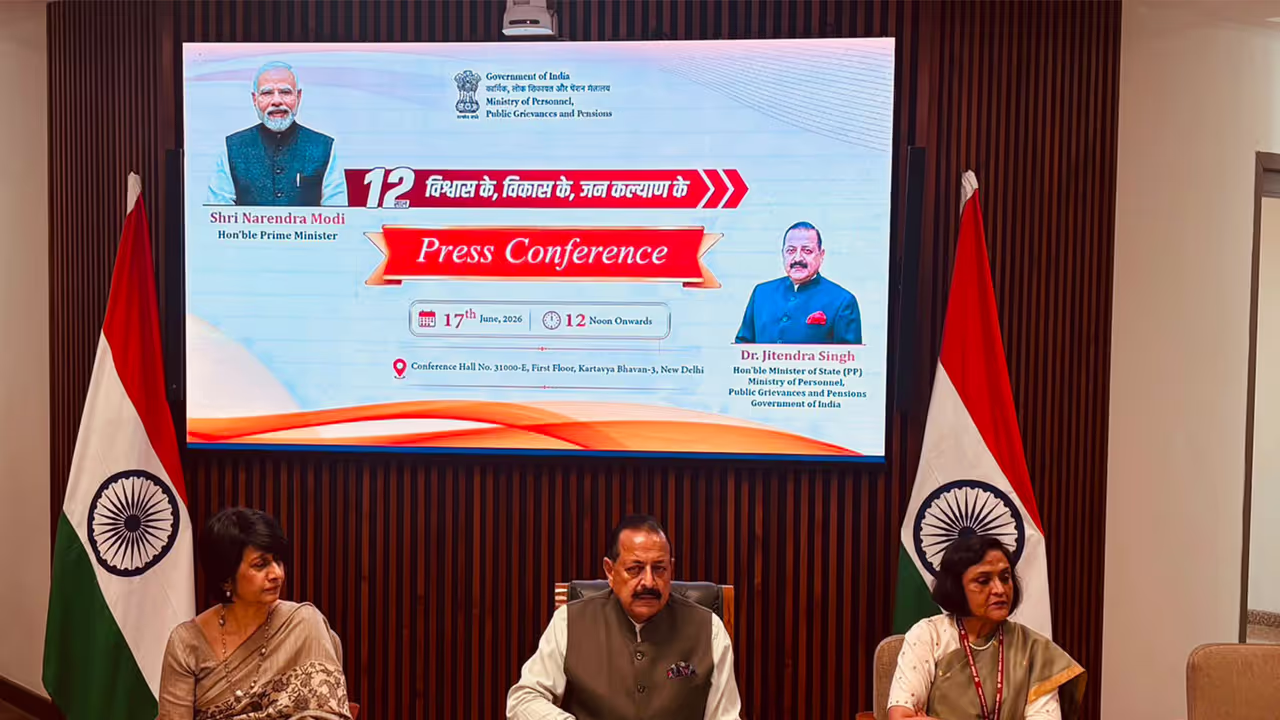
Union Minister Jitendra Singh announced a new hybrid grievance redressal model combining Artificial Intelligence and Human Intelligence to improve citizen satisfaction, noting that while grievance disposal was high, citizen satisfaction was not.
Hybrid AI-HI Model to Enhance Citizen Satisfaction
Union Minister of State (Independent Charge) for Personnel, Public Grievances and Pensions Jitendra Singh today said the government has developed a hybrid grievance redressal model combining Artificial Intelligence (AI) and Human Intelligence (HI) to improve grievance resolution and enhance citizen satisfaction.
Addressing a press conference on 12 Years of Achievements in Personnel and Pension Reforms, Singh said, "This is a hybrid model, which is AI plus HI, Human Intelligence. AI alone may not be giving the optimal results."
Singh said the model was developed after the government found that disposal of grievances alone did not always translate into citizen satisfaction. He said the new framework seeks to combine the speed and efficiency of technology with human intervention to ensure more meaningful resolution of grievances.
Evolution of CPGRAMS as a Feedback Mechanism
Highlighting the growth of the Centralized Public Grievance Redress and Monitoring System (CPGRAMS), Singh said the number of complaints filed annually with the Government of India has risen from about 2 lakh when the present government assumed office to nearly 25 lakh now. "Not that people have started filing complaints against us, but because we are responsive, we are prompt, we are following a timeline," he said.
The minister said the government initially focused on grievance disposal and achieved high disposal rates, but feedback indicated that complainants often remained dissatisfied despite their grievances being formally disposed of. The AI-HI model was therefore developed to improve grievance redressal and address citizen expectations more effectively.
"If the same complaint comes from different parts of the country, it indicates a systemic flaw," Singh said, adding that recurring complaints help the government identify rules and procedures that may require reform. He said CPGRAMS has evolved into an important governance feedback mechanism in addition to being a grievance redressal platform. He said the government had sought to create a model combining technology with human intervention rather than relying exclusively on automated systems.
Singh added that more states are being integrated with the CPGRAMS framework to strengthen grievance redressal across the country.
India's Governance Reforms Gain Global Recognition
Referring to India's governance reforms over the last decade, Singh said several initiatives introduced by the government have acquired global recognition. He said civil servant delegations from countries including South Africa, Mongolia and the Maldives are visiting India to study governance practices developed by the government.
According to him, CPGRAMS, Mission Karmayogi and the Digital Life Certificate system are among the initiatives now being studied internationally. Singh said many of the reforms introduced since 2014 have had a significant socio-economic impact beyond administrative changes.
Key Reforms to Improve Ease of Living
Self-Attestation and Trust in Citizens
He cited the decision to allow self-attestation of documents as one of the first major reforms undertaken by the government, saying it ended the requirement for citizens to obtain attestation from gazetted officers and reflected the government's trust in citizens.
Abolition of Interviews and Online RTI
He also highlighted the abolition of interviews for several lower-level government posts, saying the move reduced the scope for subjectivity and favouritism in recruitment. Similarly, making the Right to Information (RTI) application process online improved accessibility by allowing citizens to file applications at any time rather than only during office hours.
Pension and Welfare Reforms
Innovations in Pension Services
On pension reforms, Singh said the government introduced face-recognition technology for Digital Life Certificates after recognising that fingerprints of elderly pensioners may not always be reliable. He also highlighted measures extending family pension benefits to divorced and separated daughters and removing service-related barriers that had previously deprived some families of pension benefits.
Expansion of Maternity Leave Benefits
The minister further said the government expanded maternity-related leave benefits to include cases of stillbirth, arguing that women undergo the same physiological changes during pregnancy irrespective of whether the child survives.
He said governance reforms over the past decade have been guided by innovation, imagination and sensitivity, with the larger objective of improving ease of living and making governance more citizen-centric. (ANI)
(Except for the headline, this story has not been edited by Asianet Newsable English staff and is published from a syndicated feed.)