
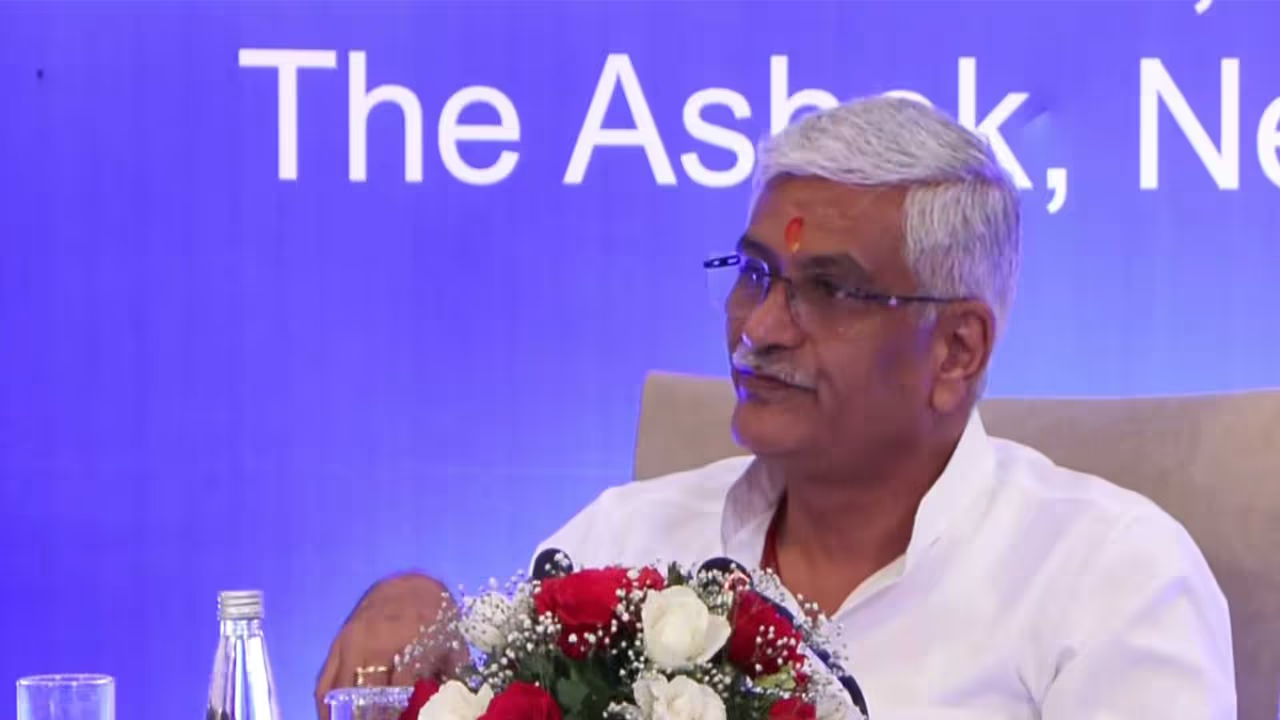
Union Minister Gajendra Singh Shekhawat announced a policy shift for tourism, with the government acting as a 'facilitator, not a regulator.' He promised to address licensing hurdles, interstate transport issues, and review visa costs.
Union Minister of Tourism Gajendra Singh Shekhawat on Monday signalled a major shift in the government's approach to the tourism sector, emphasising a mandate for "minimum government interference and maximum governance."
In a candid, open-platform interaction with industry leaders, the Minister advocated for a fundamental transition of the state's role from a rigid regulator to an active facilitator.
A New Mandate: Facilitator, Not Regulator
"The reform express agenda of the Prime Minister and the government, where he says that there should be minimum government interference and maximum governance. And especially for the tourism sector, the government should work as a facilitator, not as a regulator," he said.
Tackling State-Level Licensing Hurdles
Central to the Minister's address was the acknowledgement of licensing as a primary obstacle to business growth. Shekhawat highlighted that many operational bottlenecks, particularly the burden of diverse licensing requirements, are imposed at the state level rather than the central level. "In my earlier days, I understood clearly that there are so many problems with 20 types of licences. How can we reduce them? That is an issue," he noted.
The Minister urged stakeholders to move beyond generic grievances and submit detailed, sector-specific challenges, promising that his office would identify and promote the adoption of best practices from states that have successfully streamlined their bureaucratic processes. "It is a free platform... If you tell us freely, we will be able to understand. And after that, how can we integrate with it and work on this agenda?" he said.
Removing Operational Roadblocks
The Minister specifically addressed the "friction points" that currently impede the travel and transport industry. He cited the persistent difficulties faced by interstate transport operators, such as the regulatory hurdles faced by Delhi-registered vehicles operating in states like Uttarakhand, as a priority area for reform.
While maintaining that critical environmental regulations like the Coastal Regulation Zone (CRZ) are non-negotiable and demand high-level consensus, Shekhawat underscored the government's readiness to eliminate unnecessary administrative hurdles that stifle daily operations. "You mentioned various issues related to the registration and relocation of vehicles... there are vehicles registered in Delhi. And when they go to Uttarakhand, there is a huge problem. How can we take care of these types of things? We will be able to address those issues," said the tourism minister.
Re-evaluating the Visa Regime
A significant portion of the dialogue focused on the cost-benefit analysis of India's current visa regime. While the government maintains that its existing e-visa system for 169 countries is efficient--offering processing within 48 hours for a fee of $10-20--industry representatives argued that a fully free visa regime could act as a psychological catalyst for tourism, drawing a parallel to the success seen in Thailand. Minister Shekhawat took a pragmatic stance on the issue, inviting the industry to provide empirical evidence on the impact of visa costs. "I am open to considering the suggestion," he said, while noting the need to contextualise the nominal visa fee against the total $2,000-3,000 cost of travel for international visitors.
An Open Call for Partnership
The session concluded with an open-ended call for transparency. Shekhawat emphasised that the government views the tourism sector as a crucial engine for economic growth and is committed to an integrated agenda that prioritises the ease of doing business. By promising to work directly with stakeholders to identify state-specific roadblocks, the Minister signalled a move toward a more dynamic, responsive partnership between the public and private sectors. (ANI)
(Except for the headline, this story has not been edited by Asianet Newsable English staff and is published from a syndicated feed.)