
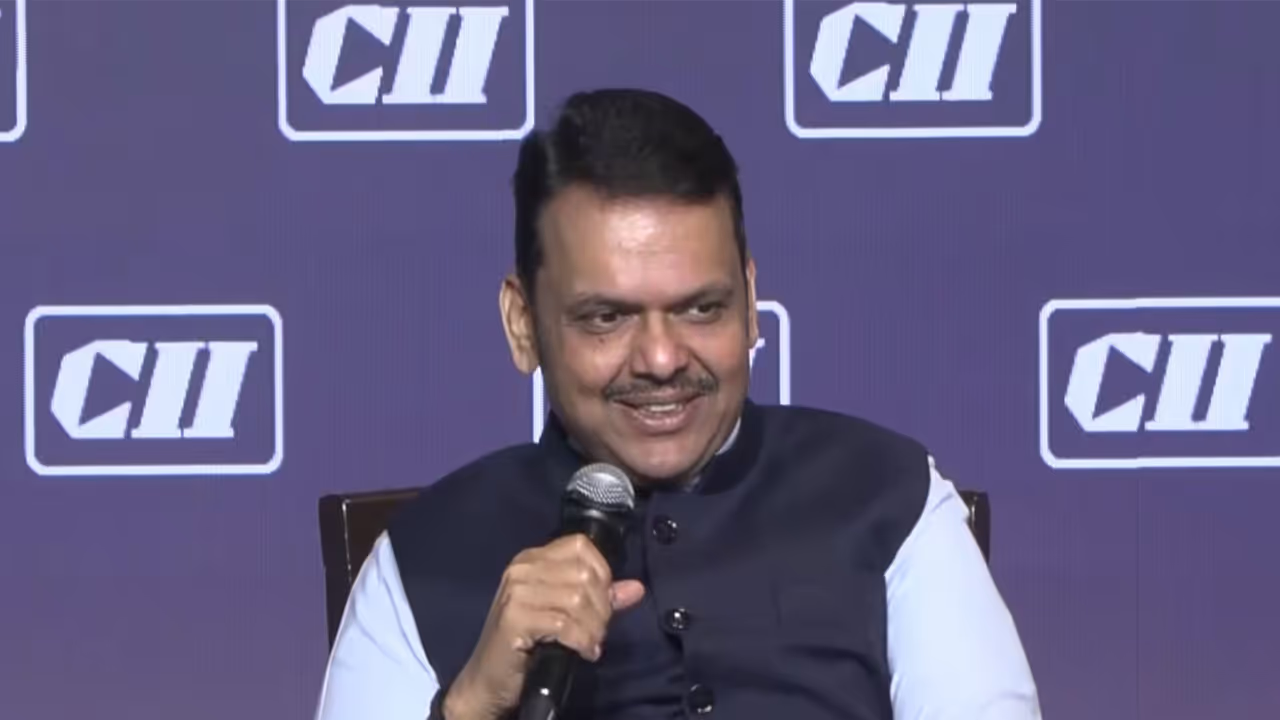
Maharashtra CM Devendra Fadnavis has unveiled an ambitious roadmap for the state to become a $1 trillion economy by 2030, emphasizing transformational growth through massive infrastructure, technology, innovation, and urban development.
Maharashtra is positioning itself to lead India's next phase of economic transformation, with Chief Minister Devendra Fadnavis outlining an ambitious roadmap to build a $1 trillion economy by 2030 and among the world's most significant regional economies by 2047. Speaking at the CII Annual Business Summit 2026 in New Delhi, Fadnavis said this is "India's movement to define" its future amid global disruption, and Maharashtra intends to lead that journey "not with incremental, but with transformational ambition."
Fadnavis highlighted that Maharashtra, already a $660 billion economy contributing nearly 15% to national GDP, is now preparing for a much larger role in the 21st-century economy. "For decades, Maharashtra has been India's economic engine. But we are now preparing Maharashtra for the next era of global economy. An era where economic leadership will be decided by infrastructure, innovation, talent, energy, urbanization, technology, and institutional trust," he said.
Unprecedented Capital Investment
On capital expenditure, Fadnavis emphasized that Maharashtra's strategy goes beyond the state budget. "In the budget you may see that 10% allocation is on capital investment but Maharashtra works through parastatals," he explained. While the budget funds around Rs 1 lakh crore, agencies like MMRDA, SIDCO and MSRDC are together executing projects worth Rs 10 lakh crore.
"If you look at the capital investment that is done across the country I think Maharashtra has the largest amount of investment done in CAPEX," he stated, citing a 2020 report where Maharashtra accounted for 49% of big-ticket infrastructure projects.
Flagship Projects Redefining Geography
The state is redesigning its economic geography through flagship projects including the Mumbai Trans Harbour Link, Samruddhi Mahamarg, Navi Mumbai International Airport, Vadhavan Port, metro networks and industrial corridors. "Infrastructure is no longer about concrete alone. Infrastructure is destiny and that is why Maharashtra is investing at unprecedented scale," Fadnavis said.
Focus on Future-Ready Sectors
Maharashtra is also positioning itself at the center of the future economy driven by AI, semiconductors, EVs, clean energy and data centers. The state hosts 24% of India's Global Capability Centers and accounts for 60% of the country's data center capacity. Its automotive ecosystem is evolving into next-generation mobility, with 20% of automobile output and a leading EV manufacturing and utilization base. The CM added that Maharashtra's ambition is to "designing Maharashtra, innovating Maharashtra, build global intellectual property from Maharashtra because future economic leadership will belong to those who create technology."
Strategic Urban Transformation
Urban transformation is central to the vision, with Mumbai evolving as a global financial and innovation capital, Pune as a manufacturing and R&D powerhouse, Nagpur as a logistics hub, and Gadchiroli set to become "India's largest Green Steel producer by 2032." Fadnavis stressed that "balanced regional development not only is socially important, it is economically intelligent."
Enhancing Ease of Doing Business
Responding to questions on ease of doing business, the CM said Maharashtra's Maitri platform serves as a one-stop shop with overriding powers over all departments. "If the department doesn't give approval within time, then Maitri can override them and Maitri can issue the approval," he said.
Reviewing the platform recently, he noted that "in 96% projects and 96% investments, we have been on time." He added that the government has launched a 100-reform agenda to benchmark Maharashtra against the best globally.
Building Trust Through Consistency
Fadnavis identified "trust" as Maharashtra's biggest differentiator in competitive federalism. "One may offer as much incentive as they can, but their ability to fulfill those incentives... is something which defines where industry will go," he said. "Maharashtra is one state which has never defaulted on incentives. In fact... 2025, all incentives we have cleared. Now we are clearing the 2026 first quarter incentives."
He also highlighted policy consistency, saying Maharashtra has avoided "knee-jerk policy change" even after government changes.
On energy costs, he pointed to a recent regulatory order that will reduce power tariffs by 3% annually from 2025 to 2030. "This was the first time... cumulatively if you look at last 20 years every year's power tariff has gone up by 9% and now every year it will go down by 3%," he said.
Fadnavis said Maharashtra's openness and entrepreneurial spirit remain its greatest strength, and the state sees industry as a partner in nation building. "When India celebrates 100 years of independence in 2047, future generations should be able to say, this was the period when India transformed... and this was the period when states like Maharashtra helped power that transformation with confidence, courage and execution," he said. (ANI)
(Except for the headline, this story has not been edited by Asianet Newsable English staff and is published from a syndicated feed.)