
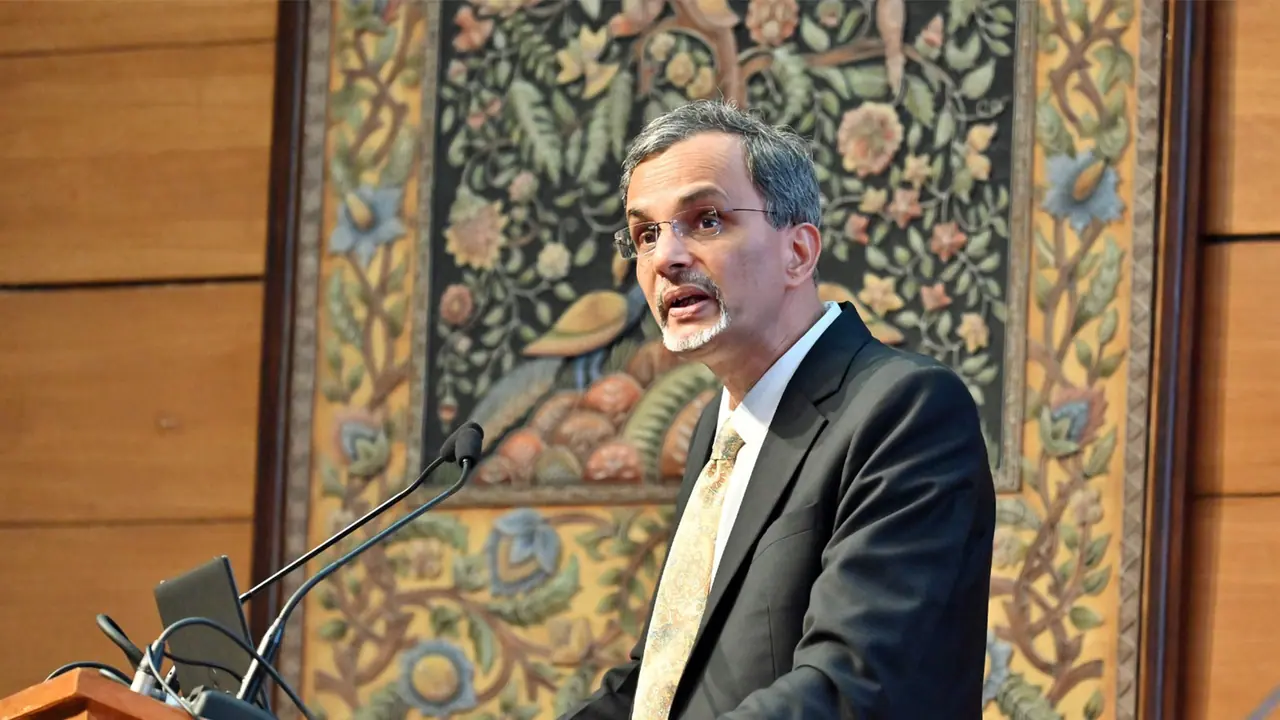
Industry leaders have lauded the Economic Survey 2025-26, which projects a 6.8-7.2% real GDP growth for FY 2026-27. The survey is praised for its pragmatic assessment of India's macroeconomic stability amid global challenges.
Industry leaders and economic experts on Thursday welcomed the Economic Survey 2025-26, describing it as a pragmatic assessment of India's macroeconomic stability. The Survey projects a real GDP growth of 6.8-7.2 per cent for the 2026-27 financial year, underscoring the resilience of the domestic economy despite a volatile global environment.
Expert Analysis and Projections
PHDCCI on Macroeconomic Strength
Rajeev Juneja, President of the PHD Chamber of Commerce and Industry (PHDCCI), stated that the Indian economy maintains a strong macroeconomic fundamental pitch despite a fragmented geopolitical landscape. "The central theme of the survey is the paradox of macroeconomic strength and external vulnerability with growth, inflation control and fiscal consolidation having put India on a sturdy footing," he said.
"The Economic Survey outlines three global scenarios for 2026. First, a baseline of managed disorder with continued volatility but no systemic collapse. Second, a disorderly multipolar breakdown marked by intensified geopolitical competition and financial stress. Thirdly, a low probability but high impact systemic shock", said Juneja.
CII's View on Growth and Policy
Chandrajit Banerjee, Director General of the Confederation of Indian Industry (CII), termed the Survey a professional assessment at a critical juncture. "It is our sense that with moderate level inflation, we can be looking at double-digit nominal growth, which should help augment revenues and therefore, have a moderating effect on borrowings. That would further ease pressures on the real interest rate, thus triggering a virtuous cycle," he said.
CII finds the Survey's thrust to be the requirement that the state machinery evolve into an "entrepreneurial state" by building deeper system-level institutional capacity and adopting entrepreneurial policymaking to support the growth and job-creation imperative.
EY India on Fiscal Deficit and Investment
On the fiscal front, the Union Government reduced its fiscal deficit to 4.8 per cent of GDP and targets 4.4 per cent in FY 2026. DK Srivastava, Chief Policy Advisor at EY India, noted that the 7 per cent potential growth is largely driven by capital stock growth. "Going forward, GoI has to progressively bring down its fiscal deficit to GDP ratio to a level of 3%. States may also stabilise their fiscal deficit at 3% of GDP. Thus, as more and more borrowing space is vacated by the government, the private corporate sector would find it easier to access available investible resources," he said.
Srivastava notes that once global uncertainties are resolved, it may be possible to return to more conventional rule-based fiscal consolidation targets for the fiscal deficit and debt, aligned with their respective sustainable levels.
India's Resilience and Global Influence
Ranjeet Mehta, CEO & SG, PHDCCI, said that a country capable of not only surviving but thriving amid geopolitical and geo-economic uncertainty is a destination for greater foreign capital inflows.
"Overall, the survey argues that India must maximise growth and build buffers against shocks simultaneously for lasting resilience and global influence," he said. (ANI)
(Except for the headline, this story has not been edited by Asianet Newsable English staff and is published from a syndicated feed.)