
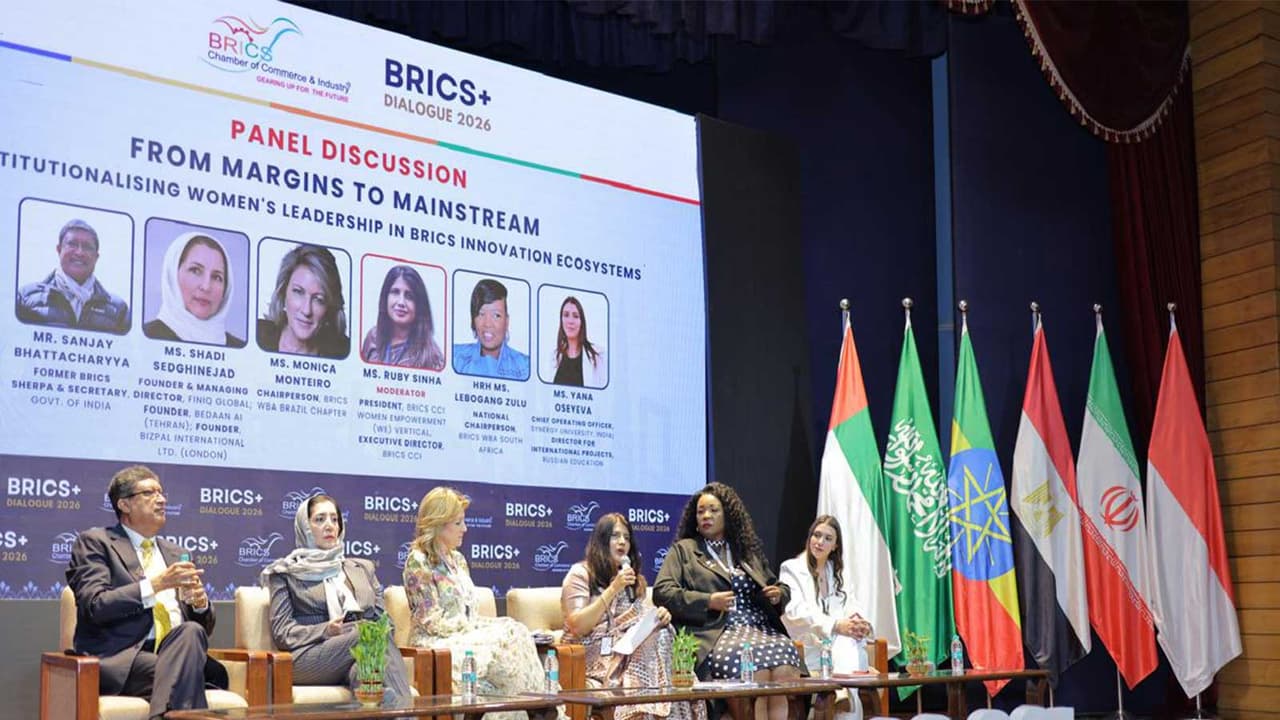
Women leaders from BRICS+ countries called for binding language and institutional mechanisms with funding and accountability to ensure continuity for commitments on women's leadership in innovation, funding, and entrepreneurship ahead of the 18th Summit.
Women leaders from BRICS+ countries have called for binding language in the grouping’s declarations and institutional mechanisms to give continuity to commitments on women’s leadership in innovation, funding and entrepreneurship ahead of the 18th BRICS Summit.
The call was made at the BRICS+ Dialogue 2026 organised by the BRICS Chamber of Commerce and Industry (BRICS CCI), where representatives from Brazil, Russia, South Africa, Iran and India discussed ways to institutionalise women’s leadership across the grouping’s innovation ecosystem.
'Margins to Mainstream': A Call for Institutional Design
Ruby Sinha, President of BRICS CCI WE and Programme Lead of Women in Innovation, Science and Entrepreneurship (WISE), said greater representation alone would not be enough and called for institutional structures with funding and accountability. “The shift from ‘margins to mainstream’ requires a focused institutional design not just visibility. We got the first-ever Joint Statement under the BRICS Women Track this year in Kochi which is a big accomplishment. What hasn't happened yet is the harder step: giving these commitments continuity beyond a single Chairship,” Sinha said.
She said initiatives such as WISE were intended to create a standing mechanism that could continue across BRICS presidencies “with clear real resourcing and accountability behind it”. Sinha also pointed to the funding gap faced by women-led businesses, saying women-led startups receive less than 2 per cent of global venture capital funding, according to reports cited by her. She said women account for about 15.4 per cent of partner or decision-making roles at venture capital firms.
Push for Greater Representation and Financing
Former BRICS Sherpa Sanjay Bhattacharyya said the grouping needed to push for greater participation of women in leadership positions. “What we need to do is push and press for leadership positions (for women), because BRICS from the beginning has been a pragmatic, project-oriented process built on sectors of excellence, joint programmes and, of course, the New Development Bank,” Bhattacharyya said.
He added that while women had significant representation in technology, innovation and creative industries across BRICS countries, gaps remained in education and empowerment in less-privileged sections.
The discussion also focused on financing women-led businesses. Lebogang Zulu, National Chairperson of the BRICS Women’s Business Alliance in South Africa, said the alliance has a database of more than 100,000 startup businesses through the BRICS Women’s Startups Contest, but lacks a platform connecting them with venture capital investors, markets and buyers. “The core deliverable of the 2026 WBA presidency is driving a BRICS Women Advancement Fund framework — one that makes sense to us and also speaks the NDB's language,” Zulu said.
Call for Common Standards and Shared Platforms
Russian Education Agency Director for International Projects Yana Oseyeva also called for BRICS-level common due-diligence and procurement standards and an independent accreditation and ranking system.
The panel concluded by calling for shared platforms covering knowledge exchange, cross-border business mechanisms, entrepreneurship financing and digital access across BRICS+ countries. (ANI)
(Except for the headline, this story has not been edited by Asianet Newsable English staff and is published from a syndicated feed.)