
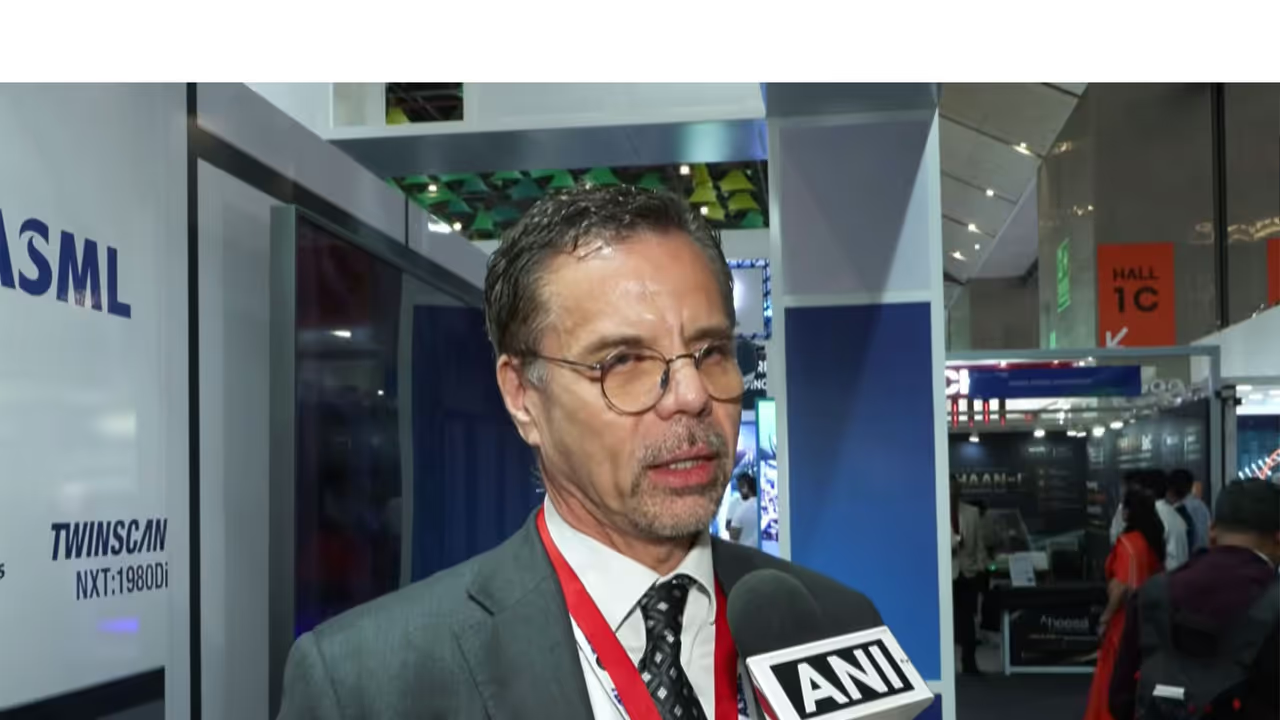
ASML's EVP Wayne Allan emphasized the company's partnership with Tata Electronics to ensure the success of India's first 300mm semiconductor fab, which he believes will pave the way for more such facilities and industry growth in the country.
Semiconductor equipment maker ASML Holding’s Executive Vice President, Wayne Allan, underscored the significance of partnering with Tata Electronics to ensure the success of India's first 300mm commercial semiconductor fabrication facility, paving the way for further industry expansion in the country. Speaking to ANI on the sidelines of Semicon India 2026, Wayne said, "I think it starts for us with our first customer on 300mm, which is Tata Semiconductor and we have an MOU with them and we're partnering with them to make sure that the first 300mm fab in India is highly successful, so there will be many more to come."
Importance of Domestic Ecosystem
Allan emphasised that establishing domestic manufacturing across the broader supply chain remains critical for India to fulfill its domestic semiconductor requirements. "Moving further into the supply chain and actually producing silicon as well, which I think is extremely crucial. So I think you really have to have the entire ecosystem at some point in India to be able to even satisfy the local market. If you think about it, you need to wait for silicon, you need to be able to package it, you need to be able to test it, you need to be able to turn it into modules and products,” he said. Allan mentioned that having the full ecosystem is very important for India and “I think it’s a big opportunity for companies like ASML."
India's Market Growth and Policy Stability
The Executive VP projected strong growth for the Indian market, pointing out that the domestic semiconductor segment will reach USD 110 billion by 2030 and potentially double by 2032–33. He observed that while technical competencies in coating, cleaning, precision mechanics, and optics require continued development, policy stability under Prime Minister Narendra Modi's administration supports this transition.
AI Demand and Global Supply Chain
"I think in general for us, the amount of increase in demand is unprecedented for us and it is for all of our peer companies as well to be able to meet the AI demand. And I think in doing so, we look very deep into our end tier to understand whether it's components or PCB boards or whatever it is, that we understand the supply limitations and we globalise our supply chain because if you have more degrees of freedom, if you have more capacity and more places to go, then you have the access to talent, you have the access to capacity, you have the access to competence. And so India is going to become an important part of that," Allan said.
Tata-ASML MoU Details
On May 16, Tata Electronics and ASML signed a Memorandum of Understanding (MoU) to support the planned USD 11 billion Dholera fab in Gujarat. Under the agreement, ASML will deploy its suite of advanced lithography tools, while partnering with Tata Electronics on talent development, local supply chain integration, and research initiatives. The Dholera facility, developed in partnership with Taiwan's Powerchip Semiconductor Manufacturing Corporation (PSMC), produces chips for automotive, mobile, and artificial intelligence applications across 28nm to 110nm process nodes. (ANI)
(Except for the headline, this story has not been edited by Asianet Newsable English staff and is published from a syndicated feed.)