
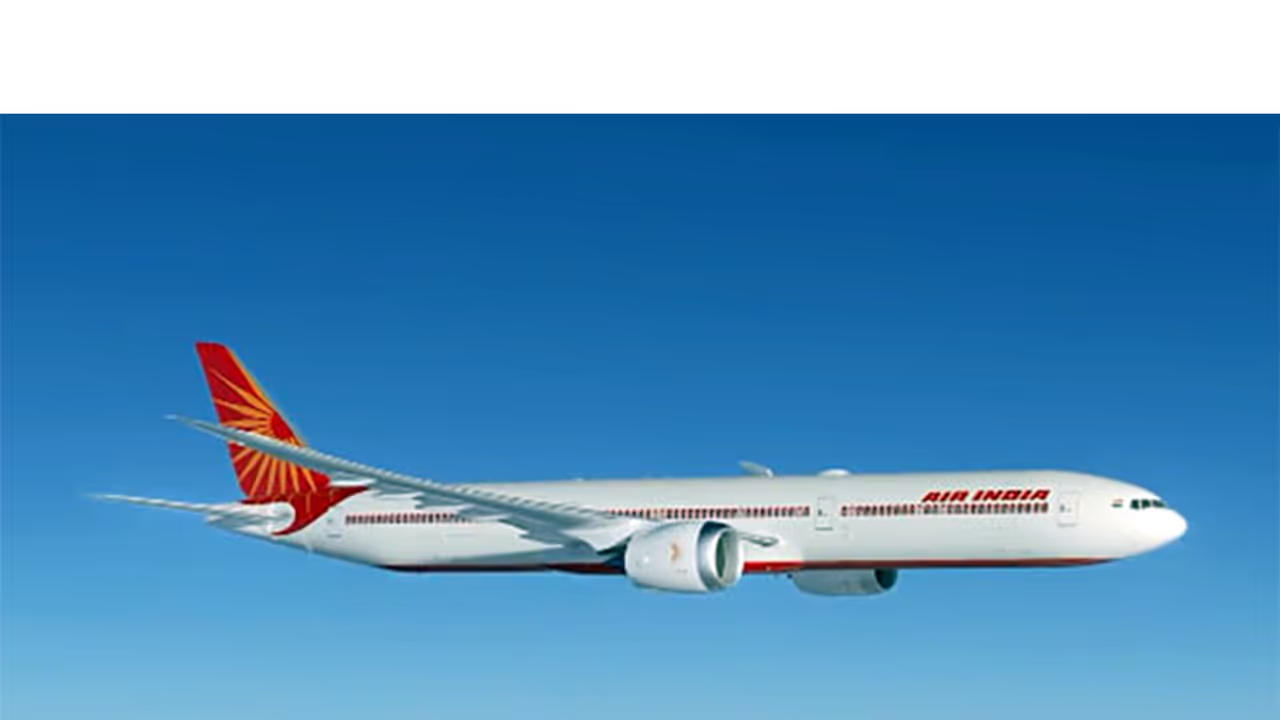
Air India CEO Campbell Wilson calls for a 'relentless focus on costs' due to global headwinds like geopolitical tensions and high fuel prices. While annual increments are deferred, the airline will pay variables and plans no layoffs.
Air India CEO Campbell Wilson on Friday signalled a shift toward fiscal conservatism, urging employees to maintain a "relentless focus on costs" as the airline grapples with a volatile cocktail of geopolitical tensions and soaring operational expenses, as per sources.
Sources said that, during a company-wide town hall, Wilson, alongside key executives, CHRO (Chief Human Resources Officer) Ravindra Kumar GP and CFO Sanjay Sharma, balanced a sombre outlook on global "headwinds" with a reassurance that the airline's long-term transformation remains on track.
Global Headwinds and Cost Pressures
The sources shared that Wilson outlined the significant external challenges facing the aviation industry and their impact on Air India. These include the continued closure of Pakistan airspace that is expected to persist for the foreseeable future, geopolitical conflicts leading to disruptions and airspace closures across West Asia, a sharp depreciation of the rupee, and a 2.5x-3x increase in jet fuel prices. Collectively, these factors have adversely affected travel sentiment and consumer confidence.
Jet fuel, which constitutes a substantial portion of operating costs, remains highly volatile, adding to cost pressures on international operations. Emphasising the need for discipline in the current environment, Wilson called for a relentless focus on costs. "We need to focus relentlessly on our costs in these tough times," he said. He urged employees to suspend discretionary spending, renegotiate rates where feasible, and defer non-critical expenditures.
Sources said the AIR India CEO called for a 'laser-sharp focus on eliminating wastage and leakages', while highlighting the importance of continuing to improve customer experience, as reflected in the Net Promoter Score (NPS), in a cost-conscious manner.
Financial Outlook and Employee Measures
Sources also shared that CHRO Ravindra Kumar GP said that Air India will proceed with variable pay for the last financial year and continue with planned promotions. However according to the sources the CHRO emphasised that the Airline does not anticipate layoffs, while noting that annual increments will be deferred by at least one quarter in light of the uncertain economic environment.
According to the source, CFO Sanjay Sharma noted that while strong revenue growth and fleet expansion drove financial momentum through FY25, FY26 has seen a softening in revenue amid heightened external uncertainties. This follows a period of robust performance, with Air India delivering an approximate 40 per cent CAGR in revenue between 2022, when the airline was privatised, and 2025.
Transformation and Performance Improvements
Despite the volatility, Campbell Wilson reaffirmed that Air India remains focused on protecting its core, optimising deployment, and building a future-ready network strength.
Fleet and Network Enhancements
In FY26, the airline completed the retrofit of its legacy narrowbody fleet and commenced work on its widebody aircraft, the first of which has already re-entered service. It also undertook rapid network optimisation to redeploy capacity more efficiently, strengthened its India-Europe and India-Far East presence, and deepened synergies with Air India Express by eliminating overlapping routes and improving network efficiency.
Additionally, the airline expanded its Southeast Asia feeder network from two destinations to seven.
Operational and Customer Satisfaction Gains
Operationally, domestic on-time performance continued to improve, rising from 73 per cent to 76 per cent in FY26. International OTP was on par with the prior year despite several significant external shocks, thanks to the underlying reliability improvement of the fleet.
Customer Net Promoter Score (NPS) improved by 50 per cent, to 30, in March 2026 from 20 in April 2025 and -19 in 2023, reflecting ongoing product upgrades and improved customer experience. (ANI)
(Except for the headline, this story has not been edited by Asianet Newsable English staff and is published from a syndicated feed.)