LPG Black Market Rates Surge Across India: City-Wise Price List From Delhi To Patna
Synopsis
Reports of LPG cylinder shortages and black marketing have emerged from several Indian cities amid disruptions linked to the ongoing West Asia conflict. Domestic and commercial cylinders are reportedly selling at higher prices, sometimes nearly double the official rate. The Centre has asked states to prevent hoarding and monitor supply closely.
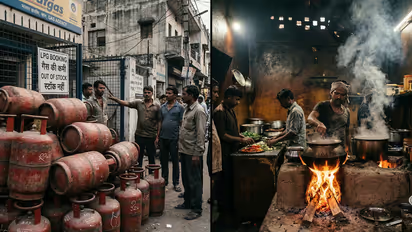
Reports of shortages of commercial LPG cylinders have started emerging in several Indian cities as tensions and conflict in West Asia continue to affect energy supply routes. Restaurants, caterers, households and even temple kitchens in some places are reporting delays in receiving LPG cylinders. As concerns grow, many consumers say they are being forced to buy cylinders at higher prices in the black market. In some cities, the price of LPG cylinders has reportedly reached nearly double the official rate.
The central government has tried to calm fears by saying that domestic LPG supplies remain stable. At the same time, it has asked state governments to closely monitor distribution and prevent hoarding and black marketing.
Also Read: From Aruna Shanbaug To Harish Rana: Key Cases That Changed India's Euthanasia Laws
Black market prices reported in many cities amid LPG shortage
Local reports, as published by News18, from several cities suggest that black marketing of LPG cylinders has begun in different parts of the country.
- In the Delhi-NCR region, domestic LPG cylinders are reportedly being sold for around ₹1,400 to ₹1,500 in the black market. This is much higher than the normal price charged by authorised distributors.
- In Bareilly, domestic cylinders are said to be selling for ₹200 to ₹500 more than the official rate. In nearby Pilibhit, the extra price reported is around ₹100 to ₹200.
- In Meerut, some areas are seeing domestic cylinders selling for more than ₹1,400. In Mirzapur, black market rates for domestic cylinders are being reported at around ₹1,300.
- Ghaziabad has also seen price increases, where domestic cylinders are being sold about ₹100 above the official rate. Some buyers have also complained about extra charges for commercial cylinders.
Shortages affect several Uttar Pradesh cities
Several cities in Uttar Pradesh have reported rising prices due to supply delays.
- In Gorakhpur, domestic LPG cylinders are reportedly being sold ₹250 to ₹300 above the official price. Commercial cylinders in the city are said to be selling for ₹500 to ₹700 more than normal rates.
- In Ayodhya, domestic cylinders are being sold with an extra charge of around ₹200, while commercial cylinders are reportedly difficult to find.
- Kanpur has also reported higher prices, with domestic cylinders selling ₹200 to ₹250 above the usual rate. Commercial cylinders there are reportedly priced ₹400 to ₹500 higher than the official price.
Major metros also see steep prices
The situation is not limited to smaller cities. Major metropolitan areas are also seeing sharp increases in prices in the black market.
- In Mumbai, commercial LPG cylinders are reportedly selling for ₹2,800 to ₹3,000. In Hyderabad, the price for commercial cylinders has also reached around ₹3,000 or even higher.
- In Bengaluru, some reports say black market prices have reached up to one and a half times the normal rate.
- In Kolkata, commercial cylinders in some areas are reportedly selling for up to ₹3,000.
Eastern India reports high black market rates
Cities in eastern India are also seeing steep increases in LPG cylinder prices.
- In Patna, domestic cylinders are reportedly selling in the black market for ₹1,500 to ₹1,800. Commercial cylinders there are said to be selling for ₹3,000 to ₹3,200.
- In Purnia, domestic cylinders are being sold for ₹1,500 to ₹2,100 in the black market, while commercial cylinders are selling for more than ₹3,000.
- In Gaya, domestic cylinders are reportedly priced between ₹1,500 and ₹2,000 in the black market.
Jharkhand cities have also seen similar trends. In Jamshedpur, domestic cylinders are being sold for around ₹1,400. In Hazaribagh, black market prices are reported between ₹1,500 and ₹1,700.
- In Ranchi, domestic cylinders are reportedly selling for ₹1,500 to ₹1,800.
High prices reported in Andhra Pradesh cities
Cities in Andhra Pradesh have also reported rising prices for commercial LPG cylinders.
In places such as Vijayawada, commercial cylinders in the black market are said to be selling for as much as ₹3,200.
These higher prices have raised concerns among small businesses such as restaurants and food stalls, which rely heavily on commercial cylinders for daily cooking.
Government clarifies LPG storage rules
As reports of hoarding increase, authorities have reminded the public about the rules related to LPG storage at home. According to existing guidelines, a household can keep two domestic LPG cylinders connected at the same time. In addition, one spare cylinder can be kept as a backup.
Keeping more cylinders than allowed without proper permission can lead to penalties under safety and petroleum regulations. Officials have urged people not to store extra cylinders unnecessarily and to buy LPG only from authorised distributors.
Centre asks states to monitor supply closely
The central government has stepped in to address the situation. Union Home Secretary Govind Mohan recently held a virtual meeting with chief secretaries of states and Union territories.
Senior officials from the consumer affairs ministry and state police chiefs also attended the meeting.
During the discussion, Mohan asked states to closely monitor LPG supply and distribution systems. He also directed them to take strong action against hoarding and black marketing.
Police chiefs were told to ensure that LPG sales continue smoothly and that law and order is maintained around distribution centres.
Officials also stressed the need to control rumours that could lead to panic buying.
Also Read: When A Child Became Anti-Tobacco Ambassador After Heartfelt Letter To Father
Government says LPG supply remains adequate
Even as reports of shortages appear in some areas, the central government and oil companies have assured the public that domestic LPG supply remains adequate.
India consumes about 31.3 million tonnes of LPG every year. Nearly 87 per cent of this is used by households for cooking, while the rest is used by commercial establishments such as hotels, restaurants and catering services.
However, India depends heavily on imports for LPG. About 62 per cent of the country’s LPG consumption is sourced from overseas markets.
West Asia conflict affecting supply routes
The current concerns about LPG supply are linked to the ongoing conflict in West Asia.
After the United States and Israel launched attacks on Iran, Tehran responded with retaliation that led to the closure of the Strait of Hormuz. This narrow sea route is extremely important for India’s LPG imports. Around 85 to 90 per cent of LPG shipments from West Asia pass through the Strait of Hormuz.
Many of these supplies come from countries such as Saudi Arabia and Qatar.
Any disruption in this shipping route can affect LPG imports and cause delays in supply.
Government takes steps to avoid panic buying
Authorities say they are carefully monitoring the situation and are working to keep supply chains stable.
Earlier on March 9, the government increased the booking period for LPG cylinders from 21 days to 25 days. This step was taken to reduce hoarding and panic buying.
Government sources said some consumers who earlier booked cylinders every 55 days had started booking them within just 15 days because of fear of shortages.
Refineries asked to increase LPG production
To deal with possible supply pressure, the government has asked domestic refineries to increase LPG production.
Officials have also directed companies to give priority to domestic consumers over commercial users if supply becomes tight. Government sources said household LPG connections will always be given priority.
India is also exploring new LPG supply partnerships with other countries. Countries such as Algeria, Australia, Canada and Norway have reportedly approached India to supply LPG if needed.
Fuel prices expected to remain stable
Government sources also said that petrol and diesel prices in India are unlikely to increase unless crude oil prices rise above 130 US dollars per barrel. Officials believe crude oil prices may remain around 100 dollars per barrel in the near future.
They also said India currently has enough fuel stocks and there is no shortage of petrol or diesel at any fuel pump in the country.
Aviation fuel supply also stable
Authorities have also reassured airlines and the aviation sector about fuel availability. Officials said India produces and exports Aviation Turbine Fuel (ATF), so there is no immediate concern about shortages in aviation fuel.
They added that India is currently in a better position than many other countries when it comes to managing fuel supply during global disruptions.
(With inputs from agencies)
Stay updated with the Breaking News Today and Latest News from across India and around the world. Get real-time updates, in-depth analysis, and comprehensive coverage of India News, World News, Indian Defence News, Kerala News, and Karnataka News. From politics to current affairs, follow every major story as it unfolds. IMD cities weather forecastsRain Cyclone Asianet News Official App