THIS Antarctic Volcano Spews Gold Every Day—Scientists Still Can't Fully Explain It

Published : Jul 03, 2026, 04:08 PM IST

A remote volcano hidden beneath Antarctica's icy wilderness quietly releases microscopic gold crystals into the atmosphere every day. Scientists have studied the phenomenon for decades, yet its exact cause remains an unsolved geological mystery
PREV
12
THIS Mountain Releases Tiny Gold Crystals

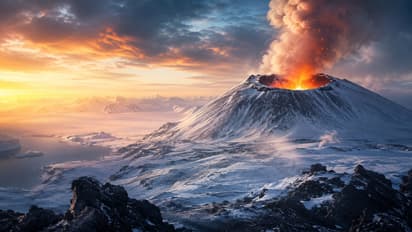
Located on Ross Island near the Ross Sea, Mount Erebus is Antarctica's southernmost active volcano, situated around 1,350 kilometres from the South Pole. It is one of the few volcanoes on Earth with a long-lasting lava lake, which constantly releases volcanic gases into the atmosphere.

According to a landmark scientific study published in 1991, the volcano emits nearly 80 grams of microscopic gold particles every day. At today's gold prices, that would represent millions of dollars' worth of gold annually. However, these particles are so incredibly small that they cannot be seen with the naked eye or recovered for commercial use.

Scientists have found that the gold crystals can travel as far as 1,000 kilometres before eventually settling onto Antarctica's snow and ice.

22
How Does Gold Escape From a Volcano?

Researchers used electron microscopes to examine the volcanic particles and discovered that the gold exists as tiny crystal-like grains measuring up to about 60 micrometres in size.

Scientists believe the gold is transported upward through volcanic gases containing chlorine- and sulphur-rich compounds. As these gases cool after leaving the volcano, the gold separates from them and crystallises into microscopic particles.

Interestingly, traces of gold have also been detected in gases from several other volcanoes around the world, including Hawaii's Kilauea, Italy's Mount Etna, Alaska's Augustine Volcano and Mexico's El Chichón. However, the concentration and behaviour of gold at Mount Erebus appear to be far more unusual, making it one of the most fascinating volcanic systems on Earth.

Scientists Are Still Searching for the Exact Answer

Despite decades of research, experts have not reached a definitive conclusion about how Mount Erebus produces these gold crystals.

Two leading theories have emerged:

• The first suggests that gold separates directly from chlorine-rich volcanic gases as they cool in the atmosphere, forming tiny crystals. Some researchers question this explanation because the amount of gold present in the gases is extremely small.

• The second theory proposes that the gold crystals form first on the surface of the volcano's lava lake. Later, volcanic gases carry these pre-formed crystals into the atmosphere, where they are dispersed over vast distances.

Although neither theory has been fully confirmed, Mount Erebus continues to offer scientists valuable insights into volcanic chemistry and the movement of rare metals within Earth's interior.

The volcano remains one of Antarctica's most extraordinary natural wonders, proving that even after decades of study, our planet still holds geological mysteries waiting to be solved.

Explore the latest Lifestyle News covering fashion, wellness, travel, Food and Recipes, and more. Stay updated with trending Health News, fitness tips, and expert insights to inspire your daily living. Discover personalized lifestyle trends that keep you stylish and informed. Download the Asianet News Official App from the Android Play Store and iPhone App Store for everything that adds value to your everyday life.


Read more Photos on

Recommended Stories