Not Originally Indian? The 1,000-Year Middle Eastern Journey of Your Favourite Crispy Jalebi

Published : Aug 14, 2026, 11:36 PM IST

Jalebi may feel unmistakably Indian, but its earliest recorded relatives can be traced to West Asia, where sweets called zalabiya appeared in medieval Arabic cookbooks. Bengal's jilipi to Indore's jaleba show how a sweet became a part of our culture.
PREV
16
Jalebi: How A West Asian Sweet Became An Indian Mithai Icon

The next time you bite into a hot, crisp jalebi, there is a good chance you will not think about medieval cookbooks, travelling recipes or centuries of culinary exchange. You will probably think about its syrup, its crunch and whether you should have one more.

Yet behind those familiar orange spirals is a remarkably long journey.

Jalebi is deeply woven into Indian food culture today, but its earliest recorded history points beyond the subcontinent. Similar fried sweets were known in West Asia as zalabiya, zulabiya or related names. One of the earliest surviving written records comes from the 10th-century Arabic cookbook Kitab al-Tabikh, compiled by Ibn Sayyar al-Warraq. A later 13th-century cookbook by Muhammad bin Hasan al-Baghdadi also describes zalabiya.

That does not mean today's jalebi was simply imported into India unchanged. Its story is better understood as one of adaptation.

26
From zalabiya to jalebi

Food rarely travels in a straight line. Recipes move with merchants, travellers, cooks and communities, changing as they enter new kitchens.

Over centuries, the West Asian sweet found its way into the Indian subcontinent and acquired a form and identity that became distinctly South Asian. The name itself is believed to be related to the older words used for zalabiya, although the exact linguistic journey is not completely settled.

The earliest widely cited Indian literary reference is found in Priyamkarnrpakatha, a Jain work associated with Jinasura and dated to around 1450 CE. The sweet appears in the account of a merchant's dinner, showing that it was already familiar in India by the 15th century.

Later Indian culinary writings provide further evidence that the sweet had become part of the local food landscape.

So, while its ancestry appears to reach West Asia, the jalebi that Indians know today is the product of centuries of Indian culinary evolution.

36
Why Indian jalebi is so different

Part of the fun is that there is no single jalebi experience across India.

The familiar version is generally made by piping batter into hot oil or ghee in tight spirals, frying it until crisp and then soaking it in sugar syrup. But recipes, thickness, texture and serving styles vary considerably from one region to another.

In Bengal, for example, jilipi can refer to several preparations. There are versions made with different batters, while chhenar jilipi uses chhena and can be fried in ghee. In parts of Bengal, moong dal is also used for a preparation known as moong jilipi or papri.

Then comes imarti, jalebi’s more intricate cousin, known as amriti or jangiri in different parts of the subcontinent. It looks related to jalebi but is made differently, traditionally using urad dal (black gram) batter, and has a thicker, flower-like shape. The two sweets are therefore similar but should not simply be treated as the same dessert.

46
The jalebi has many Indian versions

Travel across India and the sweet keeps changing.

In some places, jalebi is thin and sharply crisp. Elsewhere, it is thicker, softer or more intensely syrupy. Madhya Pradesh is known for its large jaleba, while regional versions such as khoya jalebi add another layer of texture and richness.

In Bengal, the word jilipi itself has become part of the local food vocabulary. Similar naming variations can be found across South Asia, reflecting how recipes travelled and were absorbed into different culinary traditions.

This regional diversity is perhaps the strongest evidence that jalebi's story in India is not simply about an imported recipe. It is about what happened after the recipe arrived.

56
From festive sweet to everyday craving

Today, jalebi comfortably moves between different parts of Indian life.

It appears at weddings, festivals and religious celebrations. In some cities, it is an early-morning treat, eaten alongside milk, curd or other breakfast foods. In Gujarat, the famous pairing of jalebi and fafda has become closely associated with festive eating, particularly around Dussehra.

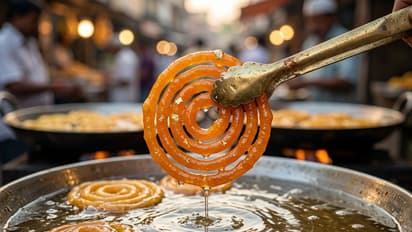
Street-side halwais have also turned its preparation into a spectacle. A steady hand squeezes batter into bubbling oil, creating almost perfect spirals within seconds. Once fried, the coils are lifted and dropped into warm syrup, where they absorb sweetness while retaining their characteristic bite.

That combination of crunch, warmth, sweetness and slight tang is what makes a good jalebi instantly recognisable.

66
So, the main question: is jalebi Indian?

The simplest answer is: its ancestry appears to be West Asian, but its identity is unmistakably Indian today.

Trying to give jalebi a single modern nationality misses the more interesting part of its history. The evidence shows an older family of fried sweets in West Asia, followed centuries later by clear references to jalebi in India. Between those points came movement, experimentation and adaptation.

India did not merely receive jalebi. It reshaped it.

That is why the question of whether jalebi is 'Indian' has a more delicious answer than a simple yes or no. Its origins may cross borders, but generations of Indian cooks, halwais and families turned those syrup-soaked spirals into something that now feels completely at home here.

And perhaps that is the real story behind jalebi: a sweet that travelled across regions and centuries, only to become one of India's most recognisable tastes.

Explore the latest Lifestyle News covering fashion, wellness, travel, Food and Recipes, and more. Stay updated with trending Health News, fitness tips, and expert insights to inspire your daily living. Discover personalized lifestyle trends that keep you stylish and informed. Download the Asianet News Official App from the Android Play Store and iPhone App Store for everything that adds value to your everyday life.


Read more
Read more Photos on

Recommended Stories