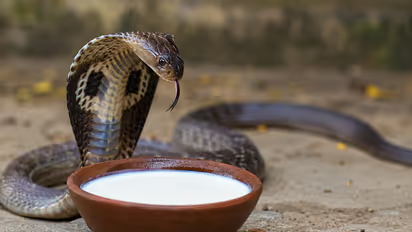
Do cobras really drink milk? Discover the truth behind this popular belief and other common snake myths, from milk-drinking cobras to snake charmers, venom and fascinating snake behaviour.
The Real Truth About Snakes? It's Not What You Think
Most of us are terrified of snakes. But along with the fear, our society is full of stories, movies, and superstitions about them. Even today, we see viral videos of 'a snake taking revenge' or 'a cobra being offered milk'. But how much of this is true? Simply put, what you see in movies isn't real life. Let's find out what science actually says.
26
The Milk Myth: Do Snakes Actually Drink It?
This is one of the biggest myths in our country. We often see people offering milk to snakes during Nag Panchami. But scientifically, snakes are reptiles, not mammals. Their bodies don't have the enzymes to digest milk. A snake in the wild will never go looking for milk.
So why do they drink it sometimes?
Snake charmers often capture them before festivals and keep them dehydrated. When they see a bowl of milk, they drink the liquid just to survive. In fact, drinking milk can damage their lungs and liver, and can even be fatal.
36
Revenge of the Cobra: Just a Movie Plot?
We've all seen movies where a snake remembers a person's face and hunts them down for years to get revenge. But in reality, this is completely false. Snakes have very small brains. They don't have the ability to remember human faces or feel emotions like revenge. A snake bites a person for two main reasons: it's scared, or it feels threatened. If our movements make it feel unsafe, it will attack to defend itself. The whole 'I will remember you and come back' concept is just movie drama, as experts say.
Our folklore is filled with fascinating stories about the 'Naagmani' or snake gem. People believe it glows in the dark, is worth crores, and brings good luck. Scammers still use the 'Naagmani' story to cheat people. But till date, no scientific research anywhere in the world has found any proof of such a gem inside a snake's head. Biologically, a snake's head contains bones, muscles, and venom glands—not precious stones. The 'Naagmani' is purely a work of fiction.
56
The Snake Charmer's Tune: Does It Really Work?
We often see a snake charmer playing a 'pungi' or flute, and the cobra sways with its hood open. Many think the snake is mesmerised by the music. But the truth is, snakes don't have external ears. They cannot hear airborne sounds. They can only feel vibrations from the ground. When the snake charmer sways the 'pungi', the snake sees the moving object as a threat. It follows the movement of the instrument to stay alert, moving its head from side to side. To us, it looks like it's dancing to the music, but it can't even hear it.
66
Are All Snakes Venomous? Let's Find Out
The moment people see a snake, they often grab a stick to kill it. But the reality is that the majority of snakes found in India are non-venomous. Only a few species, like the Cobra, Krait, and Russell's Viper, have venom that is dangerous to humans. Most snakes will try to flee when they see a person. They only attack when they have no escape route or when we accidentally step on them. Snakes play a crucial role in our ecosystem by controlling the population of rats and pests, which helps protect crops. So, instead of killing them out of fear, experts advise that if you see a snake, you should immediately inform a snake rescue team or the forest department.