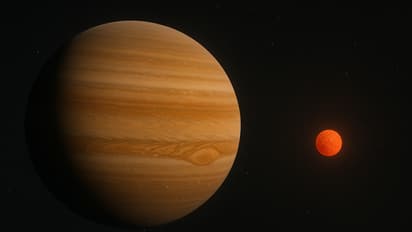
Astronomers have discovered a massive gas planet orbiting a tiny red dwarf star, TOI-6894, challenging long-held beliefs about planet formation. This unusual pairing has baffled scientists and could reshape our understanding of how giant planets form
Astronomers have found a huge gas planet, named TOI-6894b, orbiting a very small star called TOI-6894, which has just 20% the mass of our Sun. This is surprising because such small stars weren’t thought to be capable of forming or hosting giant planets.
27
A Record-Breaker
This is the smallest star ever discovered to have a gas giant planet. The planet is slightly larger than Saturn but has only half of Saturn’s mass. It completes an orbit around its star in just over three days.
37
Discovered Through NASA’s TESS Telescope
The planet was spotted while scanning over 91,000 small stars using NASA’s TESS telescope. Its existence was later confirmed with ground-based telescopes, including the Very Large Telescope in Chile.
Current theories about how planets form struggle to explain this planet's existence. Tiny stars usually don’t have enough material around them to form large planets, yet TOI-6894b exists, defying both leading theories.
57
An Unexpectedly Cool Planet
Unlike many gas giants that are extremely hot (called "hot Jupiters"), this planet is quite cool — less than 150°C, which is very cold for such planets. This unusual temperature adds another layer of mystery.
67
A Chance to Spot Ammonia in Space
Because TOI-6894b is so cool, scientists believe they may be able to detect ammonia in its atmosphere — something never before observed on any planet outside our solar system.
77
More Cosmic Mysteries and Discoveries
This discovery adds to a string of exciting recent space findings — including a possible new dwarf planet in our solar system, an unknown object emitting X-rays and radio waves, and a spiral-shaped simulation of the distant Oort Cloud that could change how we view the edge of the solar system.