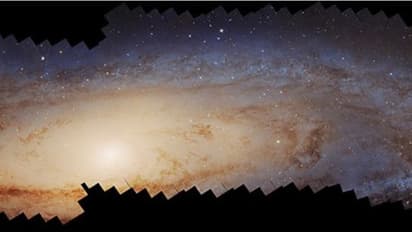
Andromeda Galaxy: Here's everything we need to know about about our neighbour galaxy

Published : May 28, 2025, 02:35 PM IST

The Andromeda Galaxy (M31) is the closest large spiral galaxy to the Milky Way, visible to the naked eye and set to merge with our galaxy in the distant future

PREV
14

The Nearest Large Spiral Galaxy:

Although several smaller galaxies are closer, Andromeda (M31) is the nearest large spiral galaxy to the Milky Way, located about 2.5 million light-years away. It is visible to the naked eye under dark skies and is the brightest galaxy outside our own that we can see without optical aid.

24

Structure and Size:

Andromeda is roughly twice the size of the Milky Way, containing an estimated one trillion stars. It spans a significant portion of the night sky and appears as a faint smudge even larger than the full moon when viewed from Earth.

34

Best Time and How to View:

The galaxy is visible year-round from mid-northern latitudes, with optimal viewing from late summer through winter. You can locate it using either the Cassiopeia constellation or the Great Square of Pegasus as guides. While visible to the naked eye, binoculars offer a much-enhanced view.

44

Historical Significance and Scientific Discovery:

Once thought to be a nearby nebula, Andromeda’s true nature as an external galaxy was confirmed in the 1920s by Edwin Hubble. This discovery helped establish the concept of galaxies as separate "island universes," vastly expanding our understanding of the cosmos.

Future Collision with the Milky Way

Astronomers predict that Andromeda will collide with the Milky Way in about 4 billion years, although their halos of gas and dust might already be interacting. This cosmic event will not result in stars crashing into each other due to the vast distances between them but will eventually form a new, merged galaxy.

Read more Photos on

Recommended Stories