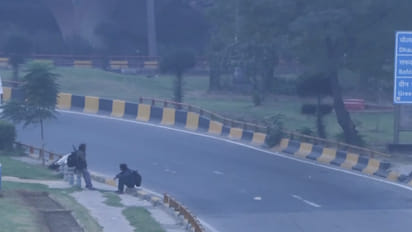
CAQM directed Delhi-NCR states to prepare district-level air pollution action plans for 2027 for the first time, alongside existing state and municipal plans. The measures will target major pollution sources. Delhi recorded an AQI of 237 on Sunday.
CAQM seeks district-level plans to curb Delhi-NCR's air pollution
The Commission for Air Quality Management (CAQM) has directed Delhi and the National Capital Region (NCR) states to prepare district-level action plans for 2027, marking a new approach to tackling air pollution through targeted interventions and closer monitoring.
For the first time, the Commission has asked governments to draw up pollution-control plans at the district level, in addition to the existing state and municipal corporation-level plans. The move is aimed at ensuring better implementation of measures on the ground, identifying gaps and fixing accountability for results.
In an order dated November 20, the CAQM said the district-level plans would help strengthen efforts to improve air quality through coordinated action across the NCR.
26
Why has CAQM asked for district-level action plans?
The Commission said tackling air pollution requires sustained and coordinated efforts based on the airshed approach, which considers pollution across geographical areas rather than treating individual cities or districts in isolation.
Under the new directive, the Annual Action Plan-2027 must include clearly defined measures for different pollution sources, along with measurable targets, timelines and monitoring parameters.
36
What do the interventions involve
The proposed interventions are expected to contribute towards a 15-20 per cent reduction in annual average air pollution levels in 2027 compared with 2026. The targets will cover the Air Quality Index (AQI), PM2.5 and PM10 levels.
CAQM has commenced ranking of the States and Delhi Govt in terms of their performance on the front combating pollution casued by various factors. Report Card for year 2026- upto October 2026, has been prepared. The final Report Card for 2026 will be out in January2027. States and Delhi Govt have the opportunity to improve their ranking by accelerating their efforts during the remaining time of the year 2026.
— ANI (@ANI) November 22, 2026
Officials responsible for implementing these measures will also be identified by their names and designations. This, the Commission said, would establish clear ownership and accountability for achieving the prescribed targets.
The CAQM has identified several major sources that require focused interventions. These include vehicular emissions, road dust, industrial pollution, construction and demolition activities, solid waste management and crop residue burning.
The plans will also address pollution caused by diesel generator sets, crematoria and other local sources.
By assigning specific responsibilities and setting measurable targets, the Commission hopes to improve monitoring and ensure that pollution-control measures translate into tangible improvements in air quality.
The CAQM described these additions to the existing action plans as important for achieving sustained improvements and making the air breathable for people across Delhi-NCR and adjoining areas.
56
Delhi's air quality on November 22
Meanwhile, Delhi's air quality remained in the 'poor' category on Sunday morning, with an AQI of 237 at 9 am, according to official data.
Of the 54 monitoring stations in the city, 36 recorded 'poor' air quality, while five were in the 'very poor' category, according to the Central Pollution Control Board's (CPCB) Sameer app.
IGNOU-Maidan Garhi recorded the highest AQI at 377, followed by Uttam Nagar at 340.
#WATCH | Delhi: Air Quality Index (AQI) around AIIMS is 326, categorised as 'Very Poor', as per the CPCB (Central Pollution Control Board).
(Visuals shot at 06:50 am) https://t.co/HJzLni3iW7
— ANI (@ANI) November 22, 2026
#WATCH | Delhi: Air Quality Index (AQI) around Anand Vihar is 251, categorised as 'Poor', as per the CPCB (Central Pollution Control Board).
(Visuals shot at 07:15 am) https://t.co/xVlTjt57oZ
— ANI (@ANI) November 22, 2026
Delhi's air quality had settled at an AQI of 265 on Saturday, showing a gradual improvement over the previous three days. The index had fallen from 280 on November 19 to 270 on November 20 and further to 265 on November 21.
66
What is the weather forecast for Delhi?
The India Meteorological Department (IMD) recorded a minimum temperature of 11.8 degrees Celsius on Sunday, slightly lower than Saturday's 12.2 degrees Celsius. The minimum temperature was close to the seasonal average.
The weather office has forecast clear skies, with the maximum temperature expected to reach 27 degrees Celsius. Relative humidity stood at 96 per cent at 8.30 am.
Daily Weather Briefing (22.11.2026)
Under the influence of easterly waves, isolated heavy rainfall likely over Tamilnadu from 23rd to 27th and over Kerala from 24th to 26th November, 2026.
For more information, visit Us : https://t.co/BPpoTbykBF
— India Meteorological Department (@Indiametdept) November 22, 2026
According to the CPCB, an AQI between zero and 50 is classified as 'good', 51-100 as 'satisfactory', 101-200 as 'moderate', 201-300 as 'poor', 301-400 as 'very poor' and 401-500 as 'severe'.