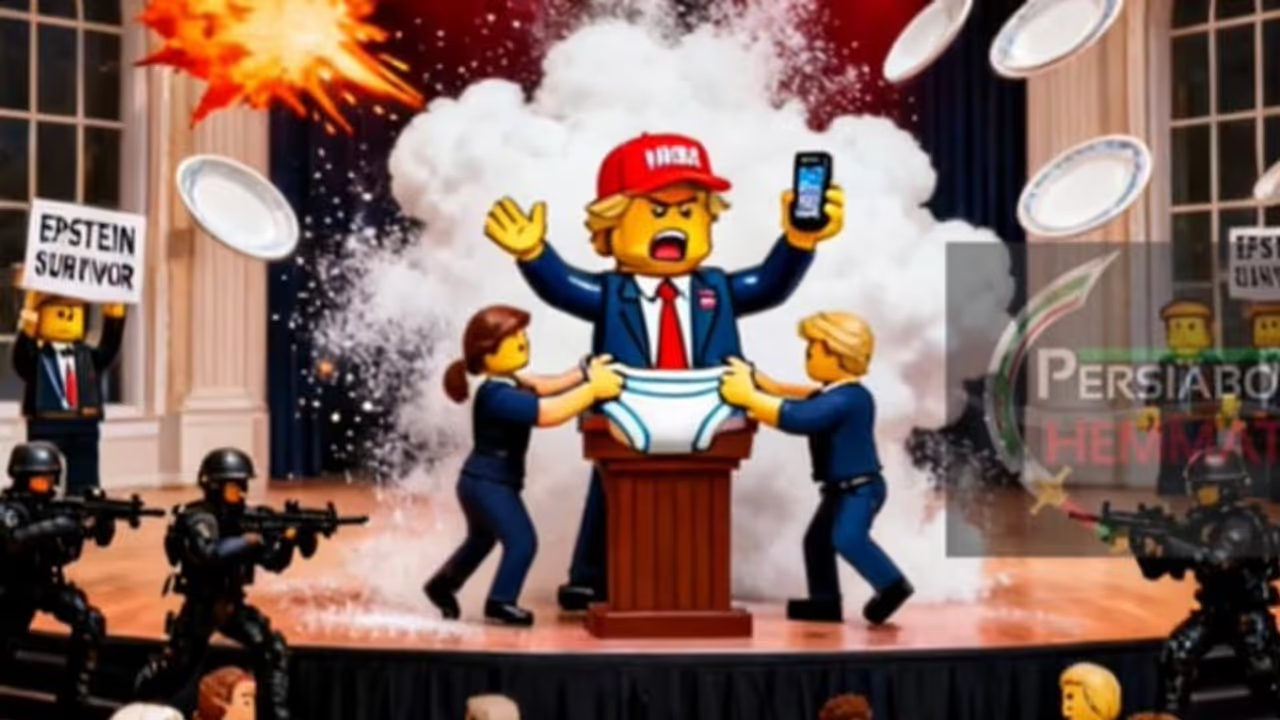
Iran-linked creators release a viral Lego-style diss track mocking Donald Trump after the White House dinner scare, questioning his leadership, narrative control, and the chaos during the evacuation.
A bizarre and sharply satirical video has surfaced online in the aftermath of the shooting at the White House Correspondents’ Dinner in Washington, with Iran-linked creators taking aim at US President Donald Trump through a Lego-style animated “diss track.”
The video, which has quickly gone viral across social media platforms, uses a rap format to mock Trump’s leadership and question the narrative surrounding the dramatic evacuation during the high-profile event.
Also read: Trump rejects WHCA dinner shooter's manifesto, calls him 'sick'
Related Articles

Satire meets geopolitics
At first glance, the clip appears playful — Lego-like characters, bright visuals, and a catchy beat. But the messaging is anything but light.
The track delivers pointed criticism of Trump’s leadership style, accusing his administration of manipulating public perception during moments of crisis. One of its central lines states: "Every time your polls drop, you pull up the same scheme."
The implication is clear: the video suggests that moments of chaos are politically convenient, used to divert attention when approval ratings dip.
Another biting line reads: "Snowflake ego so high, can't handle the smoke. Hire the mentalist, so you don't get roasted."
The lyrics repeatedly target Trump’s personality, portraying him as thin-skinned and overly concerned with image.
Referencing the dinner chaos
The timing of the video is significant. It comes just after the disruption at the White House Correspondents’ Dinner, where reports of gunfire triggered panic inside the venue.
Trump, who was speaking at the time, was swiftly escorted out by security personnel. Guests — including First Lady Melania Trump, Vice President JD Vance, Secretary of State Marco Rubio, and Defence Secretary Pete Hegseth — were later evacuated in an orderly but tense sequence.
The video leans heavily into that moment, using phrases like "empty plates," "rushed exit," and "staged scene" to suggest the incident was more spectacle than substance.
It goes further, claiming that despite the panic, “nothing actually happened,” framing the episode as confusion amplified into drama.
A narrative battle
Beyond the mockery, the video underscores a deeper message — that control over narratives differs across borders.
One recurring theme suggests that while Trump may shape media discourse within the United States, he cannot extend that influence globally, particularly in adversarial regions like Iran.
Another lyric drives this point home: "You control the dinner, but you lost the same. You control the narrative, but you still a loser."
The track also hints at economic dissatisfaction and eroding support, claiming: "MAGA waking up, country going broke."
Also read: Trump Gala Shooting: Lawmakers Unite, Say Violence Has No Place in US
More than just a one-off
This is not the first time such content has emerged. Analysts note a pattern of AI-generated, satirical videos linked to pro-Iran networks targeting Trump.
Earlier this month, YouTube took down a channel associated with “Explosive Media,” a group widely suspected of ties to Iranian influence operations. The creators had built a following with similar Lego-style videos mocking Trump and US politics.
The latest clip appears to follow that template — visually engaging, easily shareable, and politically loaded.
Humour with an edge
While the video is framed as satire, its tone is unmistakably sharp. It portrays Trump as “super fragile,” claims he is mocked behind closed doors, and suggests that public strength is merely performative.
Its viral spread highlights how political messaging is evolving — blending humour, AI-generated visuals, and music to reach younger, digital-first audiences.
What might once have been dismissed as fringe content is now part of a broader information ecosystem, where memes and music videos double as geopolitical commentary.
Why it matters
The emergence of such content points to an ongoing digital narrative war — one where perception can be shaped not just through official statements, but through viral culture.
In this case, a Lego-style rap video has managed to capture global attention, turning a moment of confusion in Washington into an international talking point — and a fresh front in the long-running tension between the US and Iran.