
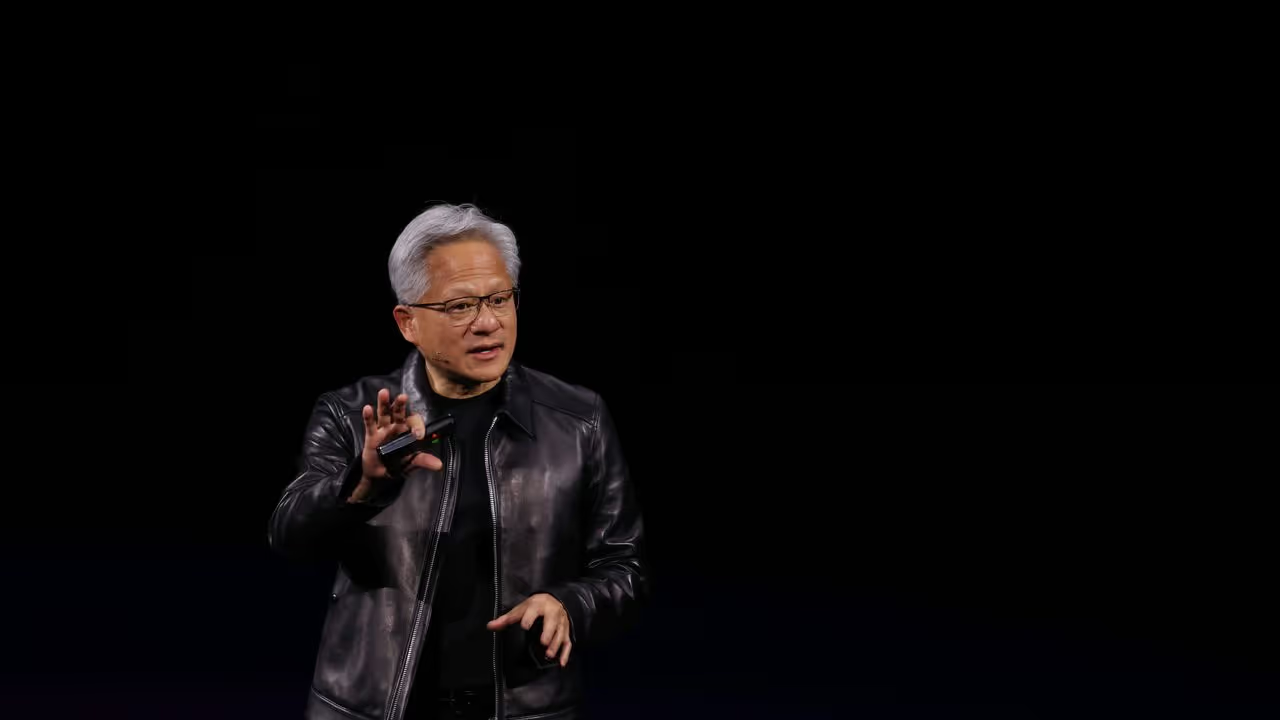
Nvidia CEO Jensen Huang cited about 100,000 sites and 100 gigawatts of distributed data center capacity in outlining the potential scale of the opportunity.
- At GTC Berlin, Huang announced that T-Mobile completed what Nvidia and Nokia described as the first AI-RAN call on a live commercial network.
- The companies are working to combine wireless network functions and AI computing on shared infrastructure.
- Huang said nearly 20 operators have announced AI-RAN collaborations, with commercial services targeted for 2027.
Nvidia (NVDA) CEO Jensen Huang said at GTC Berlin on Wednesday that telecommunications networks are becoming a new layer of artificial intelligence infrastructure, with T-Mobile (TMUS) and Nokia (NOK) among the companies helping bring that vision closer to reality.
According to Huang, telecom operators could eventually transform their networks into distributed AI infrastructure, using computing capacity across cell sites and data centers to run AI workloads closer to users and connected devices.
“Every single telco in the future, and I predict this, every single telco in the future, with 100,000 sites representing some 100 gigawatts of distributed telco base stations and data centers, will in the future evolve into a distributed AI network.”
– Jensen Huang, CEO, Nvidia
NVDA stock rose as much as 1.7% in pre-market trade, while NOK stock gained 3.5%. TMUS stock slid around 3% amid broader weakness in the telecom sector after SpaceX (SPCX) earnings.
On Stocktwits, retail sentiment around TMUS continued to trend in ‘bearish’ territory over the past day, while sentiment around Nokia jumped to ‘bullish’ from ‘bearish’ territory.
Nvidia Sees AI Opportunity Beyond Data Centers
Huang’s vision builds on Nvidia’s work with telecom equipment providers and wireless carriers to integrate accelerated computing into radio access networks (RANs). The technology, known as AI-RAN, aims to combine traditional network operations with AI computing on shared infrastructure.
Huang said Nvidia and Nokia had completed the first commercial phone call on T-Mobile’s network after nearly eight years of work. According to him, the milestone demonstrates that Nvidia’s computing platform can support conventional cellular communications.
BT, Deutsche Telekom and Elisa have already announced pilots on Nokia’s software, with BT and Deutsche Telekom planning field trials in 2027. Huang said nearly 20 operators have announced AI-RAN collaborations, with commercial services targeted for 2027.
The pitch lands as carriers face a new competitor. SpaceX (SPCX) said this month it plans to turn Starlink into a major U.S. mobile carrier, which was confirmed in the earnings call on Tuesday. After SpaceX’s announcement, Bernstein cut its T-Mobile target to $180 from $220 and cited pressure from SpaceX.
Jensen Huang’s 5-Layered AI Cake
“A simple model is to think of AI as a five-layer cake,” Huang said. He listed the layers as energy, compute, AI factories, models and applications.
“Energy powers advanced computers that are part of an AI factory that generates tokens,” he said, with the models running on it integrated into every application. The backdrop presentation showed Nvidia as the only logo on the compute layer.
Siemens Energy and Schneider Electric were on the energy layer. Nscale and Firebird were on the AI factory layer, along with Nokia and T-Mobile. Mistral appeared among the model makers. About 30 applications, including DeepL and Legora, sat on top.
The telecom AI push builds on Huang’s main GTC Berlin announcement, Nvidia’s DSX POD platform, designed to accelerate AI factory deployment, with Huang estimating that a 1-gigawatt facility costs $50 billion and can generate roughly $40 billion in annual revenue.
Read also: Nvidia GTC Berlin Keynote: Jensen Huang Puts $50 Billion Price Tag On 1GW AI Factory Amid DSX POD Launch
For updates and corrections, email newsroom[at]stocktwits[dot]com.<
