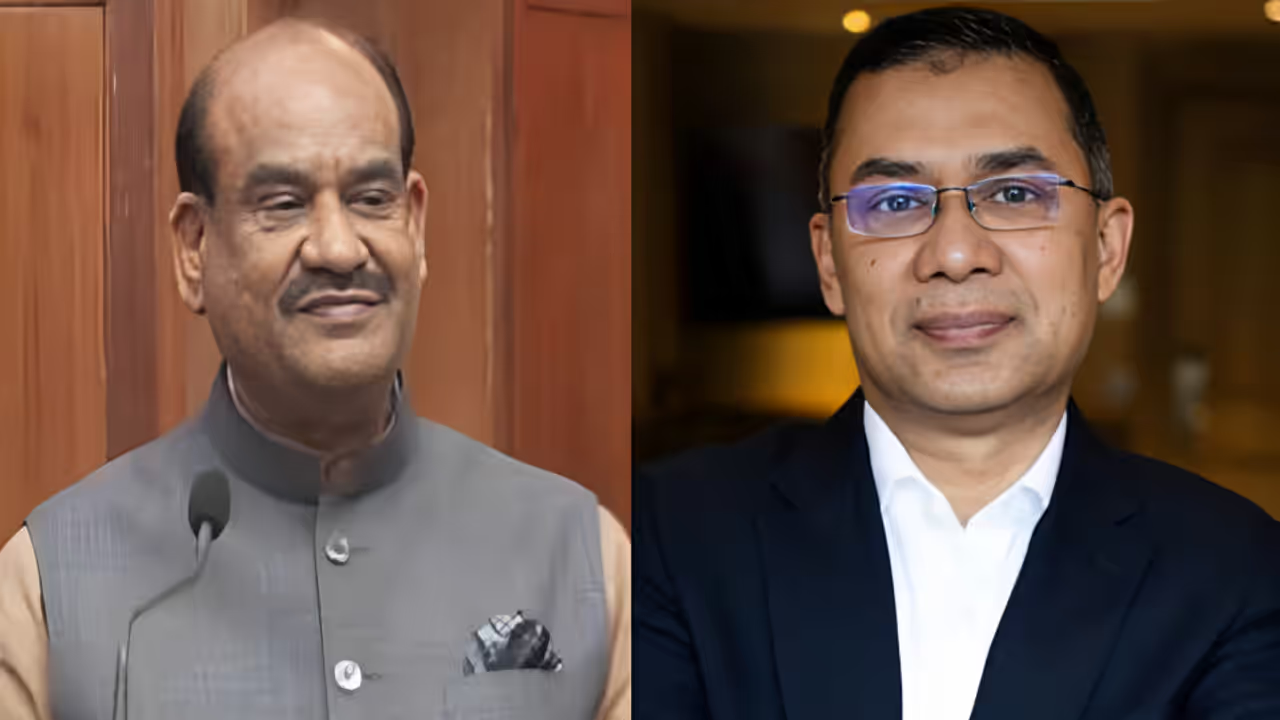
India will be represented by Lok Sabha Speaker Om Birla at the swearing-in ceremony of Bangladesh PM-elect Tarique Rahman. He will be accompanied by Foreign Secretary Vikram Misri.
India will be represented by Om Birla at the swearing-in ceremony of Bangladesh prime minister-elect Tarique Rahman. Birla will be accompanied by Vikram Misri on February 17.
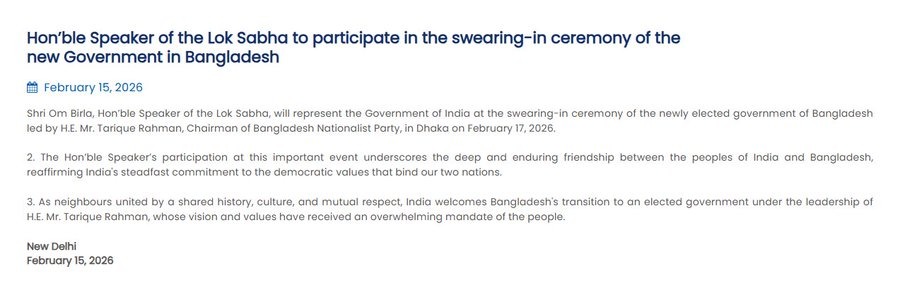
Ministry of External Affairs in a statement said that India will be represented by Om Birla at the swearing-in ceremony of the newly elected government of Bangladesh led by Tarique Rahman in Dhaka on February 17, 2026. The government said Birla’s participation reflects the deep and enduring friendship between India and Bangladesh and reaffirms India’s support for democratic values and closer bilateral ties. The statement read:
- The Hon’ble Speaker’s participation at this important event underscores the deep and enduring friendship between the peoples of India and Bangladesh, reaffirming India's steadfast commitment to the democratic values that bind our two nations.
- As neighbours united by a shared history, culture, and mutual respect, India welcomes Bangladesh's transition to an elected government under the leadership of H.E. Mr. Tarique Rahman, whose vision and values have received an overwhelming mandate of the people.
Related Articles

BNP victory and foreign policy focus
Following a landslide win in Bangladesh’s 13th national parliamentary elections, Tarique Rahman said the country’s foreign policy will be guided by national interest and the welfare of its people. Speaking at a press conference in Dhaka, he stressed that “people come first” in every diplomatic decision.
Rahman said Bangladesh will shape its international relations by protecting sovereignty and prioritising citizens’ needs. The remarks came after the Bangladesh Nationalist Party secured a decisive mandate in the polls.
Balanced approach to global relations
Rahman explained that Bangladesh will maintain balanced ties with major regional powers, including India, China and Pakistan. He described the party’s approach as practical and centred on mutual benefit.
Senior BNP leader Amir Khasru Mahmud Chowdhury said the party follows a multilateral foreign policy. He noted that Bangladesh does not pursue a country-specific strategy but instead bases relations on mutual respect, shared interest, non-interference and strategic autonomy.
The BNP leadership said these principles will guide Bangladesh’s engagement with all nations.
India signals readiness to work together
India has welcomed the election outcome and expressed willingness to deepen cooperation with the incoming government. Narendra Modi congratulated Rahman on the victory and said India looks forward to strengthening bilateral ties and advancing shared development goals.
According to official statements, Modi also spoke directly with Rahman and offered support for his efforts to meet the aspirations of the Bangladeshi people. The BNP, in turn, thanked India for recognising the election result and expressed hope for stronger cooperation.
Key issues expected in bilateral ties
Observers expect several matters to shape relations between the two neighbours. These include border security, concerns over illegal migration and insurgent activity, sharing of transboundary river waters such as Teesta and Padma, protection of minority communities, and expanding trade and investment.
Rahman has indicated that Bangladesh will pursue cooperation based on mutual respect and understanding while protecting national interests.
Call for unity after decisive mandate
In his first address after the election result, Rahman called for national unity. He urged people across political differences to work together for the country’s future. He described unity as strength and division as weakness.
Election Commission figures showed the BNP-led alliance winning 212 seats, while a Jamaat-e-Islami-led bloc secured 77 seats. The Bangladesh Awami League did not participate in the election.
Rahman returned to Bangladesh in December after 17 years in exile and is expected to become the country’s next prime minister. He is the son of former president Ziaur Rahman and former prime minister Khaleda Zia. His leadership marks a significant shift in Bangladesh’s political landscape.
Political transition and future outlook
The election followed a turbulent period that included the removal of former prime minister Sheikh Hasina after a 2024 uprising. Analysts say the new government’s policies will shape Bangladesh’s domestic governance and regional diplomacy in the coming years.
Rahman said the election result reflects public trust in democratic values and pledged to work towards stability, development and inclusive governance.