Pakistan vs Afghanistan: Why Experts Warn Islamabad Is 'Playing With Fire'
Synopsis
Pakistan’s air strikes in Afghanistan spark intense clashes and rising war fears. Experts warn Islamabad may be underestimating Taliban capabilities and risking a dangerous escalation in the region.
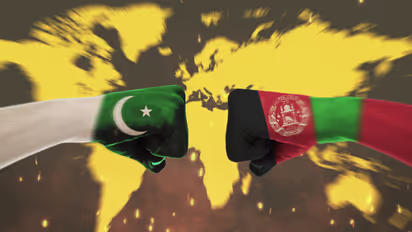
A fresh wave of air strikes and retaliatory attacks has pushed tensions between Pakistan and Afghanistan to one of their most dangerous points in recent years. What began as cross-border clashes has now spiralled into open military action, raising fears of a wider regional conflict.
While officials from both sides are trading accusations and casualty figures, strategic experts say the situation may reflect deeper problems inside Pakistan and a miscalculation about Afghanistan’s battlefield realities.
Also read: How Afghanistan-Pakistan Standoff Is Rapidly Turning Into a Full-Blown Conflict
Air Strikes Mark Major Escalation
Pakistan launched night-time air strikes on multiple locations in Afghanistan, including the capital Kabul, the southern city of Kandahar, and parts of Paktia province.
According to Pakistan’s Information Minister Attaullah Tarar, the targets were defence positions. The strikes came after Afghan forces reportedly attacked Pakistani border troops following earlier air raids by Islamabad.
Though neither country has formally declared a full-scale war, Tarar said on X that the situation has effectively crossed that line, describing it as “open war.”
Islamabad maintains that the operation is a response to militant attacks originating from Afghan territory — an allegation the Taliban-led government in Kabul continues to deny.
Border crossings remain largely shut, and dozens of people have been killed in clashes over recent months, deepening fears that diplomacy may be failing.
Conflicting Claims Over Casualties
Both sides are presenting sharply different versions of the fighting.
Taliban spokesman Zabihullah Mujahid said Afghan forces killed 55 Pakistani soldiers, while acknowledging 13 Afghan troop deaths.
Pakistan’s military, however, claims a far higher toll on the other side. Lieutenant General Ahmed Sharif Chaudhry, head of the army’s publicity wing, said 274 Taliban members and militants were killed, while Pakistan lost 12 soldiers.
Independent verification of these numbers remains difficult.
Meanwhile, civilians are also caught in the crossfire. Officials in Nangarhar said multiple civilians were wounded in a Pakistani strike near a camp for returnees close to the Torkham border crossing. One woman was reported killed and several others hospitalised.
The Core Issue: Militants and the TTP
At the heart of the confrontation is Pakistan’s long-running accusation that Afghanistan is not doing enough to control the Tehreek-e-Taliban Pakistan (TTP).
Since the Taliban returned to power in Afghanistan in 2021, attacks inside Pakistan have increased, according to analysts. Islamabad says many of the militants operate from Afghan soil — something Kabul denies.
The renewed militant violence has deepened mistrust between the neighbours and pushed relations into a cycle of retaliation and denial.
Former Pakistani diplomat Maleeha Lodhi told AFP that Islamabad’s current approach appears aimed at forcing Kabul to act against the TTP.
Experts Warn Pakistan Could Face Severe Consequences
Indian military experts say Pakistan may be underestimating the risks of confronting Afghanistan directly.
Major General Sudhakar Jee (Retd) offered a stark assessment of Islamabad’s strategy:
“Internal instability in Pakistan being externalised. The Pakistan Army is playing with fire,” he told Asianet Newsable English.
“Afghanistan has a historical and traditional name of being the ‘ graveyard of empire’. Afghanistan Taliban may not have the Air Force, but they have the hybrid force to defeat strongest of attackers like Soviet Union and USA. They sent them packing with body bags and destruction. They will destroy and obliterate Pakistan from the map of the planet,” the defence expert added.
His comments reflect a growing belief among some strategic observers that Afghanistan’s unconventional fighting capability could make a prolonged conflict extremely costly for Pakistan.
Another security expert, Major General Ashok Kumar (Retd), DG CENJOWS, also warned that Islamabad may have misjudged the situation following the Taliban’s return to power.
“After installation of Taliban government in Afghanistan, Pakistan was buoyant to feel safe on it’s backyard reinvigorating the feeling of having claimed it’s strategic depth. It attempted to exploit Afghanistan’s core sensitivities and in the process, major differences erupted not only on and around Durand Line but all over including issues related to refugees and their mishandling by Pakistan. The aerial attacks by Pakistan along with declaration of war on Afghanistan may give some momentary gains but given the war fighting dynamics in this region, Pakistan will suffer huge losses as it goes ahead. This could be also a diversionary tactics by Pakistan to move away from its commitment of deployment of forces in Gaza.”
According to Kumar, what Pakistan once saw as a strategic advantage — the Taliban’s control in Kabul — may now be turning into a major strategic challenge.
Diplomacy Struggling to Keep Pace With Escalation
Several countries have attempted to mediate between the two sides in recent months.
A truce brokered by Qatar and Turkey last year briefly reduced tensions after deadly clashes that killed more than 70 people. However, subsequent negotiations failed to produce a lasting agreement.
Saudi Arabia recently helped secure the release of three Pakistani soldiers captured by Afghan forces. Iran has also offered to assist with dialogue between the neighbours.
But some analysts now believe diplomacy may be struggling to keep up with the pace of military escalation.
A Conflict Rooted in History
The tensions are also tied to long-standing disputes, particularly over the Durand Line, the colonial-era border that Afghanistan has never formally recognised.
Cross-border militancy, refugee issues, and accusations of interference have strained relations for decades.
Since the Taliban returned to power, the relationship has swung between cautious engagement and open hostility. Frequent border closures have disrupted trade and movement for communities living along the frontier.
Now, analysts say the latest violence marks a turning point — especially because Pakistan appears to be targeting Taliban government sites rather than only suspected militant positions.
South Asia experts warn that this shift could make the conflict far harder to contain.