Operation Rising Lion: Satellite images reveal major damage to Iran's nuclear and missile sites in Israeli strikes
Synopsis
Satellite images confirm Israel’s Operation Rising Lion caused major destruction at Iran’s nuclear and missile sites, including Natanz and Kermanshah. The escalation has left dozens dead amid fears of a wider Middle East conflict.
Israel's powerful aerial campaign under “Operation Rising Lion” has caused significant destruction to key Iranian nuclear and missile infrastructure, confirmed by newly released satellite imagery. The conflict between the two arch-rivals has now entered its third consecutive day of tit-for-tat missile exchanges, leaving dozens dead and the region on the edge of a larger war.
Missile bases in Kermanshah and Tabriz hit
High-resolution satellite imagery analysed by Planet Labs PBC and reviewed by the Associated Press shows massive damage at two missile bases of Iran, one in Kermanshah and another in Tabriz, both located in western Iran, reports the Times of India.
At Kermanshah, satellite pictures reveal scorched earth and widespread fire damage across the mountainside base, indicating an intense strike.
Tabriz images show structural damage at multiple locations within the military site.
Natanz nuclear facility severely impacted
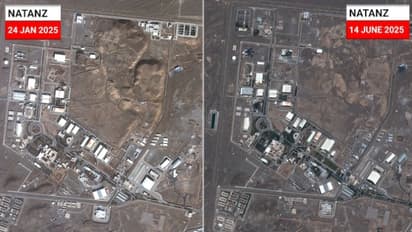
Images provided by Maxar Technologies show considerable damage at the Natanz nuclear enrichment facility, a critical site in Iran's nuclear programme located southwest of Tehran.

Several buildings appear damaged or destroyed. Experts suggest the targeted structures likely supplied power to the facility. Natanz is known for enriching uranium up to 60% purity, dangerously close to the 90% required for weapons-grade material.
Importantly, the underground enrichment halls, which house the bulk of Iran’s centrifuges, seem to have escaped the bombardment. Iran has neither confirmed nor denied the damage but has acknowledged Israeli attacks in the area.
Other key nuclear sites also affected
Additional imagery suggests damage at other Iranian nuclear and military locations, including:
- The Fordow fuel enrichment plant, another key nuclear site buried deep inside a mountain.
- The Piranshahr nuclear facility, where reports indicate a blast disrupted nearby power lines.
- The Ghadir missile site, operated by the Islamic Revolutionary Guards Corps (IRGC).
Israel reportedly targeted and killed several high-ranking IRGC officials and nuclear scientists in these attacks, escalating tensions sharply.
Iran retaliates with deadly missile strikes
In retaliation for Israel’s strikes on its nuclear infrastructure, Iran launched multiple ballistic missiles at Israeli targets, including the commercial hub of Tel Aviv. The barrage killed at least three people and injured dozens more. Israeli defense systems intercepted several projectiles, but some managed to land in populated areas, triggering panic and mass evacuations.
Israel strikes Iran’s energy and defense hubs
Following Iran’s retaliation, Israel expanded its target range to include Iran’s energy infrastructure and defense ministry headquarters in Tehran. Satellite images confirmed fires and structural damage at fuel depots in Shahran, northwest of the capital. Iran’s state media acknowledged the attack but did not provide casualty figures.
Meanwhile, Israel claimed it intercepted seven drones launched by Iran or its proxies, including those from the Houthi rebels in Yemen.
Fears grow over a wider Middle East war
This is the fiercest direct confrontation between Iran and Israel to date. While previous attacks have often been covert or attributed to proxy groups, this direct exchange marks a dangerous new phase in the conflict. Global leaders, including US President Donald Trump and Russian President Vladimir Putin, have urged Benjamin Netanyahu and Masoud Pezeshkian to ensure restraint.
However, diplomacy has suffered a blow. Iran has suspended its participation in nuclear talks, with officials accusing Israel of attempting to derail any future agreement. Tehran says there will be no negotiations while it remains under Israeli attack.
With new fronts opening, nuclear diplomacy stalling, and civilian casualties rising, the Israel-Iran conflict is entering uncharted and dangerous territory. The release of satellite imagery has only confirmed what many feared that this is no longer a shadow war, but an escalating direct confrontation that could destabilise the entire Middle East.