Durga Complexion: Molten Gold to Pitch Black, What Is True Colour Of Goddess Uma?
Synopsis
We usually see a golden yellow Goddess Durga in pandals. But do the scriptures describe her exactly like this? Can the Goddess be blue or black? Find out the true complexion of Uma according to the Dhyana Mantra, Matsya Purana, and Chandi.
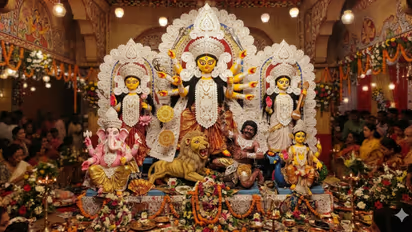
We usually see Goddess Durga in puja pandals with a bright yellowish glow. She wears a red sari and has a golden shine on her face. We have seen this traditional look of Durga since childhood. But theme pujas show something different these days. You can spot a blue, black, or even a white Durga in some places. Many people wonder about the actual skin colour of Uma according to the scriptures. Is she really yellow like hot gold, or is she dark like the night?
We must look at the Dhyana Mantra of the Goddess to find the right answer. The scriptures say that idol makers must follow the exact description given in the Dhyana Mantra. The first four lines of Durga's Dhyana Mantra give a complete picture of her appearance.
Jatajuta samayuktam arddhendu kritasekharam. Lochanatraya samyuktam purnendu sadrisanananm. Atasipushpa varnabham supratishtham sulochanam. Navayauvana sampannam sarvvabharana bhushitam.
This means the Goddess wears a crown of matted hair. She has a half-moon on her forehead. She has three eyes, and her face looks like the full moon. The most important phrase here is 'Atasipushpa varnabham'. This means her skin colour matches the Atasi flower. The Atasi flower in rural Bengal has a bright yellow colour. So, the Goddess is yellow or golden according to this mantra. Ancient clay artisans of Bengal used a yellowish-golden colour for the Goddess because of this reason. Interestingly, the Atasi flower also blooms in blue in some parts of India. People worship a blue Durga in those regions.
The Matsya Purana and Brihaddharma Purana make this point even stronger. These texts directly call the Goddess 'Taptakanchanabarna'. This means her skin glows exactly like bright liquid gold when you melt it in fire. The Brihaddharma Purana shares an interesting story. Lord Brahma came to earth to find the Goddess for Lord Rama's Akal Bodhan. He reached a difficult place and saw a young girl sleeping among the green leaves of a Bel tree. The girl had the colour of molten gold. That young girl was actually Durga. Brahma woke her up with the Bodhan prayers. So, the Goddess has a molten gold complexion even in her young girl form. People have added adjectives like Gauri, Swarnabarna, and Peetambari to Durga's name over the centuries.
Who are the black or blue Durgas then?
Durga is one and unique. But the Chandi mentions three main manifestations of her. They all have different skin colours.
1. Mahakali: She came out of Lord Vishnu's body to kill the demons Madhu and Kaitabha at the end of the Kalpa. The texts describe her as pitch black. She has ten faces and ten arms. She is the first character in the Chandi.
2. Mahalakshmi: She was born from the combined energy of all gods to kill Mahishasura during the Swayambhuva Manvantara. She has multiple colours or a molten gold complexion. She has eighteen arms and rides a lion. She is our familiar Mahishasuramardini Durga. The middle section of the Chandi tells her story.
3. Mahasaraswati or Kaushiki: She took birth from the body cells of Goddess Parvati to kill Shumbha and Nishumbha. She has a white complexion and eight arms. The final section of the Chandi describes her.
The Navadurga also has nine forms with different colours. Goddess Kalaratri is black. Mahagauri is white. Goddess Kushmanda shines bright like the sun.
So, the scriptures give a clear answer. The Mahishasuramardini Durga we worship during Sharadiya has a yellow complexion like the Atasi flower or a golden glow like molten gold. But the supreme energy is one, and its expressions are endless. That is why Uma visits the pandals of Bengal sometimes as Gauri, sometimes as Kali, and sometimes as the blue Saraswati.
Explore the latest Lifestyle NewsFood and RecipesHealth NewsAsianet News Official App