Buddha Purnima 2026: Remembering the Prince Who Became the Buddha
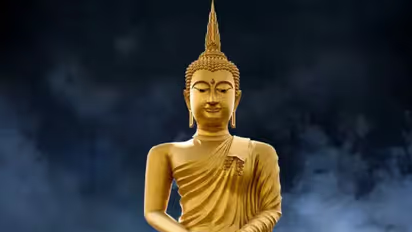
Synopsis
This article discusses Buddha Purnima and Siddhartha's road to enlightenment. It shows how Buddha's Four Noble Truths, Panchsheel values, and non-violence teachings are still applicable today.
By C. P. Radhakrishnan
Vice President of India
A wise man who taught us to live in the present and see the truth.
On this auspicious day of Chitra Pournami, when festivals are celebrated in temples, I pray for prosperity in every home. Heartfelt Buddha Purnima greetings to all my brothers and sisters. Among the many great gifts India has given the world, Buddhism is one of the most important. The life and precious teachings of Lord Buddha have been a guiding light for millions of people across the globe.
India taught the whole world the importance of 'knowing oneself' or self-realisation. The word 'Buddha' itself means 'the awakened one' or the one who has attained enlightenment. It is very special that the birth and enlightenment of this great soul, who worked to bring self-awareness to mankind, happened on the very same day.
From Riches to Simplicity:
Prince Siddhartha grew up surrounded by all kinds of comforts and luxuries. But at the age of 29, he left behind the splendour of his palace, his wife, his son, and all his wealth to set out in search of the truth. After six years of difficult penance, he attained supreme enlightenment under the Bodhi tree in Bodh Gaya. From that day on, he became famous as the Buddha.
Buddhism's four 'Noble Truths' and the path of moral living gave rise to a new philosophy. This played a major role in increasing India's prestige in world history.
At Sarnath, near Varanasi, he gave his first teaching to five monks. This teaching, known as 'Dharmachakra Pravartana', became the foundation of Buddhism and marked its formal beginning.
Over time, many people were drawn to Buddha's teachings and became his followers. King Bimbisara of Magadha donated the 'Venuvana' (bamboo grove) in Rajagriha, while a rich merchant named Anathapindika covered the entire 'Jetavana' park with gold coins to build a Buddhist monastery. Such acts show the unwavering faith people in India had in dharma back then.
The Buddhist monasteries promoted the Four Noble Truths: desire is the root cause of suffering; freedom from suffering is possible only by conquering desire; and by following the Eightfold Path, a person can find peace.
These are Buddha's Teachings:
Don't worry about the past, live in the present. Truth has great power. The mind is the source of all actions, so cultivate positive thoughts. Don't run away when faced with difficulties. The journey of life is ultimately a personal one. Walk on the spiritual path. Words can hurt, so speak gently. Love and non-violence are essential—these were his teachings.
The great Tamil epic *Manimekalai* explains the essence of Buddhism like this: ‘Wise people never approve of intoxicating substances that cloud the mind, nor do they approve of taking a life. Those with awareness stay away from these things. Birth, death, and rebirth after death are as natural as sleeping and waking. Those who do good deeds attain a higher state, while those who do bad deeds suffer immensely. The wise who understand this truth break free from worldly attachments.’ (Adhirai Pichaiyitta Kadhai: 84–90)
Buddha's Panchsheel Principles:
Buddha taught the Panchsheel principles: non-violence, not stealing, moral conduct, truthfulness, and staying away from intoxicants. He didn't just teach a religion; he taught the psychological truth that the mind is the root of everything. Good thoughts and actions create peace in society. He is called the ‘Light of Asia’ because he brought clarity and the light of knowledge to troubled minds.
Prime Minister Narendra Modi's words from his 'Mann Ki Baat' programme come to mind here: ‘Lord Gautama Buddha's message is still relevant today. He taught us that peace begins from within. He showed us that conquering ourselves is the greatest victory in the world. In the midst of the conflict and tension in today's world, Buddha's teachings are more necessary than ever before.’
It was these very teachings that transformed Emperor Ashoka, a warmongering ruler, into a messenger of peace and non-violence.
Emperor Ashoka promoted the principles of Buddhism by carving inscriptions and building stupas across the country. Even today, the stupas at Sanchi and Sarnath attract tourists from all over the world. The 'Lion Capital' from the Ashoka Pillar at Sarnath is now India's official national emblem.
Ashoka didn't just spread Buddhism within the country; with the help of monks, he spread it across Asia. The fact that Buddhist monks also preached in Tamil Nadu is proven by the traces of Buddhism still found in several areas there.
Fame Spread Across the World
For thousands of years, various spiritual thoughts and philosophies have been born and have flourished in our holy land. Whether it's Buddhism or Jainism, every religion has been accepted with a sense of unity across India. This proves that our country has always been one, culturally and emotionally.
Buddhism, which emphasised continuous learning, built educational institutions and libraries on a massive scale. About 1500 years ago, Nalanda University emerged as one of the world's greatest centres of learning. It's a matter of pride that around 10,000 students and 1,500 teachers were engaged in study and teaching there.
Historical records show that just like Nalanda, there was a famous university in Kanchipuram, Tamil Nadu. Universities like Vikramshila and Odantapuri, and the vast literature created there, introduced India's intellectual power to the entire world.
Scholars from every corner of Asia came to India to study at these Buddhist centres. The famous Chinese monk Fa-Hien travelled in India for 15 years just to study Buddhism. Similarly, another Chinese monk, Hiuen Tsang, spent 16 years in India, studied at Nalanda University, and took valuable texts back to his country.
According to Hiuen Tsang's travelogues, he visited Kanchipuram in Tamil Nadu. He stayed at the Buddhist university there, copied manuscripts, and is even said to have given special lectures to the students.
Due to his intense penance, Buddha had become very weak physically. Seeing his condition, a kind woman named Sujata offered him milk porridge (kheer) with love. This not only revived Buddha and saved his life but also gave him the energy he needed to meditate under the Bodhi tree for enlightenment. In memory of her compassion and kindness, there is a tradition of preparing and offering kheer on Buddha Purnima even today.
‘Love is the source of happiness, love is the light of the world, and love is the greatest power of all’—Buddha's teachings are extremely necessary for today's modern world. I pray that love and peace may always prevail throughout this world.
Explore the latest Lifestyle NewsFood and RecipesHealth NewsAsianet News Official App