Does China Really Have a Caste System? Viral Hukou Debate Explained
Synopsis
A viral debate on social media has reignited questions about whether China's Hukou household registration system functions like a caste system. While critics argue it creates birth-based inequality in education, opportunities, scholars say it differs from India's caste system because it lacks religious, cultural and marriage-based restrictions.
New Delhi: We all know China as the world's manufacturing hub and a socialist nation run by the Communist party. But a serious allegation is now doing the rounds on the internet: that China has a rigid, birth-based caste system. Indian netizens are claiming this system decides a person's access to education, health, and life opportunities. So, is there really a caste system in China? Let's find out the real story.
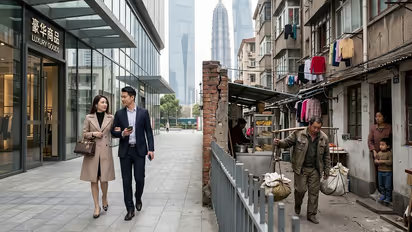
Officially, China champions socialist equality. In recent years, social media has been flooded with slick videos of China's beautiful cities, massive buildings, and efficient systems. But some Indians living there have started showing the world the 'real' China, claiming that just like in India, a form of caste system exists from birth.
Chhattisgarh Man Assaults Estranged Wife, Chops Off Her Hair; Victim Seeks Justice
This debate blew up after Indian users and several others on X started posting comparisons between China's social structure and India's caste system. They argued that a person's progress is decided by the family they are born into, pointing to China's 'Hukou' household registration system as proof. They directly accused this system of creating discrimination in education, healthcare, welfare schemes, and economic growth.
In 🇨🇳 China, The Hukou system is state-enforced, birth-based caste system.
It legally divides people into Upper-Caste Urban elites and Lower-Caste Rural (Nong/Gong/Shang) untouchables from birth.
The Shi CCP keeps its lower-caste people trapped in poverty forever. pic.twitter.com/NtxkYV2sc1— आदर्श 🇮🇳 (@im_adarsh01) June 18, 2026
CHINA HUKOU CASTE DISCRIMINATION EXPOSED
In India , according to British inducted caste system SC ST BC classified people get more priority for their uplifting financially and socially.
On the Contrary China still discriminates and prevents lower caste from getting admission in…— Pattern Preacher (@chanakyaspeakss) June 19, 2026
In China 🇨🇳, lower caste Nong workers are given cheap yellow helmets, while upper caste Shi managers are given strong, red colored helmets. pic.twitter.com/I5jnfqtGSH
— Sharroh (@Sharroh45) June 19, 2026
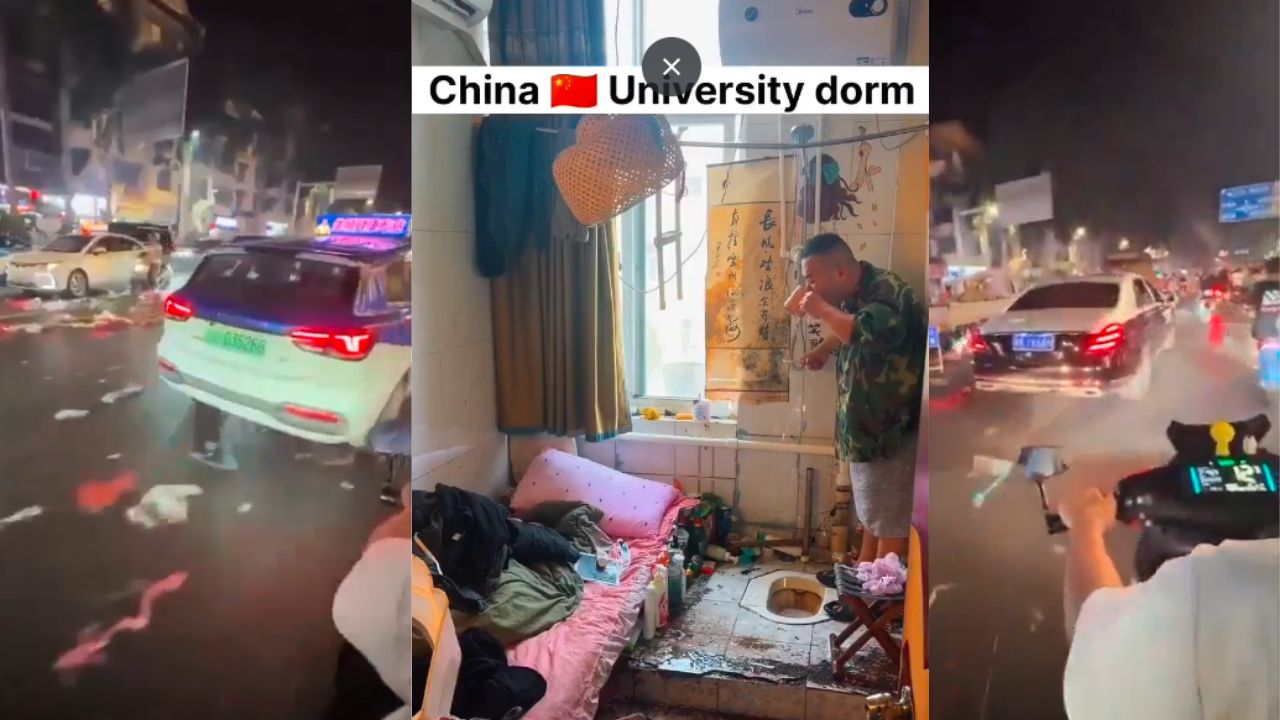
This is the condition of a college hostel in China 🇨🇳. pic.twitter.com/Ra7sdqNn4C
— Sharroh (@Sharroh45) June 16, 2026
In China 🇨🇳 this is how Lower-Caste Chinese (Nong, Gong, Shang) are forced to live. Meanwhile the Evil Upper Caste "Shi" elites enjoy luxury skyscrapers and luxury life.
For centuries the Shi Regime has oppressed them And the Truth is finally out.pic.twitter.com/1ZQmlqKDR9— आदर्श 🇮🇳 (@im_adarsh01) June 18, 2026
However, some people have pushed back against this comparison. They argue that comparing the Hukou system to India's caste system is wrong. They say Hukou is just an administrative and economic classification, not a social structure. Some even claimed that Indians are just looking at China through the lens of their own 'four-tiered ancient social system'.
Young Man Saves Elderly Devotee with CPR After Medical Emergency at Bikaner Temple (WATCH)
Ancient China's 'Four Professions' Hierarchy (Shi-Nong-Gong-Shang)
When Indians talk about a caste system in China, they usually bring up two things. First, the ancient social hierarchy called 'Shi-Nong-Gong-Shang', and second, the modern 'Hukou' system which is still in place. Before the Communist party came to power, Chinese society was divided into these four professional groups:
- Shi: Scholars and officials (the highest position in society)
- Nong: Farmers (second, as agriculture was seen as essential for the nation's survival)
- Gong: Artisans and labourers (third position)
- Shang: Merchants and traders (last, as Confucian thinkers were suspicious of those who made profits)
China’s hukou vs India’s caste system: Is it a fair comparison? pic.twitter.com/8qJ8mtefIr
— Ankit (@Extreo_) June 19, 2026
This is the reality of communism in China.
Ancient China use to have a caste system. "Shi" people were at the top. "Shang" people and "Jianmin" people were at the bottom.
In 1958, the Hukou system permanently classified Chinese citizens at birth based on their ancestral region… pic.twitter.com/5dPxp5f1Pr— Incognito (@Incognito_qfs) June 15, 2026
According to historians, this system was formalised during the 'Han Dynasty' around 111 AD. But historians say it shouldn't be compared to India's caste system. It was a classification based on profession, not a strictly hereditary system. The son of a merchant could study, pass the imperial exams, and become a high-ranking official. So, they say it was closer to India's ancient 'Varna system' rather than a rigid caste system.
The Communist Era's 'Hukou' System (Still in use today)
Even though the old professional system is gone, the 'Hukou' household registration system, introduced in the 1950s, divides people into two groups and provides benefits based on birth. You can think of it as China's 'internal passport'. It decides whether a citizen is a rural resident or an urban resident based on their registration. Their access to education, healthcare, housing, and social security depends on this status.
In his book 'A Social Dharmic History of India', author Aravindan Neelakandan argues that Mao Zedong's government turned the Hukou system into an extremely cruel and rigid form of social stratification. "The Hukou system gave officials the power to determine a person's position, role, and available resources right from birth," he wrote.
From 1959, this Hukou status became hereditary. This meant that the children of rural farmers were strictly prevented from migrating and settling in cities. Anthropologists Sulamith Potter and Jack Potter have even called it a "caste-like barrier".
Why do scholars call it an 'urban caste system'?
It's not just Indians who are making this comparison. A Dean at the Chinese University of Hong Kong actually titled an essay "The Chinese Urban Caste System in Transition"!
According to him, China introduced this system to speed up Soviet-style industrialisation. The profits from rural agriculture were used for urban development. As a result, urban residents got guaranteed jobs, subsidised housing, healthcare, and pensions, while rural residents were left out of all these benefits. This effectively created two classes of citizens in China.
According to the US-based 'Diplomatic Courier' magazine, even if people with a rural Hukou move to the city, they are given low-paying, highly dangerous jobs. This has led not just to economic inequality but also to social discrimination. The magazine analysed that China has divided itself into "two separate nations".

So, does China really have a caste system?
European colonisers used the word 'caste' to describe India's profession-based system. The word 'caste' itself comes from the Spanish and Portuguese word 'casta', which means "breed, race, or lineage". Its root is the Latin word 'castus', meaning "pure or chaste". This means such hierarchical systems also existed in Europe. So, the answer to whether China has a caste system depends on how we define 'caste':
Yes: If we consider 'caste' to be a system that distributes opportunities, education, health, and resources discriminatorily based on birth, then China's 'Hukou' system shows major signs of being a caste system.
No: But, if 'caste' is not just about birth-based benefits but also includes endogamy (marrying within the community), religious rituals, concepts of purity and pollution, and a deep cultural identity, then China's Hukou system definitely does not fit this description.
However, one thing is undeniable: the Hukou system has created a massive social divide in modern China. Whether to call it a 'caste system' or an 'administrative classification' remains a topic of global debate.