From Chandrayaan-1 to Chandrayaan-3: The evolution of India's lunar expedition
Synopsis
Here is a quick glance at how the nation's lunar expedition has changed over the years as the scientific community waits with bated breath in hopes that the third iteration of India's moon mission, Chandrayaan-3, will be successful on Friday.
As India and the scientific community awaits with bated breath aiming for the successful third edition of the nation's moon mission, Chandrayaan-3 on Friday, here is a quick look at how the country's lunar expedition evolved over the years.
The initiative was announced by former Prime Minister Atal Bihari Vajpayee on August 15, 2003. The maiden mission, Chandrayaan-1, was launched on October 22, 2008, aboard ISRO's PSLV-C11 rocket. Weighing 320 tonnes at lift-off, the rocket used larger strap-on motors to increase its payload capability. It carried 11 scientific instruments developed by India, the United States, the United Kingdom, Germany, Sweden, and Bulgaria. Mayilsami Annadurai from Tamil Nadu led the project as the Mission Director.
Chandrayaan-1 successfully orbited the moon at a height of 100 km to conduct chemical, mineralogical, and photo-geologic mapping. The mission surpassed expectations by making over 3,400 orbits around the moon. However, communication with the spacecraft was lost on August 29, 2009, leading to the conclusion of the mission.
Also read: Chandrayaan-3: How ISRO decided on launch window of 2:35 pm
Chandrayaan-2 was designed as a more complex mission, consisting of an orbiter, lander (Vikram), and rover (Pragyan). Its objective was to explore the unexplored South Pole of the moon. Launched on July 22, 2019, it entered lunar orbit on August 20 of the same year. During the descent, the lander encountered issues, and communication was lost at an altitude of 2.1 km.
The mission failed to achieve a soft landing, leaving the ISRO team disheartened. Emotional images of ISRO Chief K Sivan being consoled by Prime Minister Narendra Modi remain memorable. Chandrayaan-2 aimed to expand lunar scientific knowledge through the study of topography, seismography, mineral identification, surface chemical composition, and thermo-physical characteristics. The mission sought to gain a new understanding of the moon's origin and evolution.
Also read: Chandrayaan-3: Meet the rocket that will power India's space ambitions
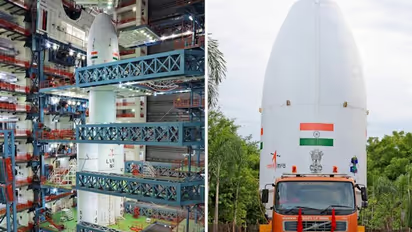
Chandrayaan-3, scheduled for Friday, follows the objectives of Chandrayaan-2, specifically focusing on achieving a successful soft landing. If accomplished, India will become the fourth country, after the United States, China, and the former Soviet Union, to achieve this milestone.
Stay updated with the Breaking News Today and Latest News from across India and around the world. Get real-time updates, in-depth analysis, and comprehensive coverage of India News, World News, Indian Defence News, Kerala News, and Karnataka News. From politics to current affairs, follow every major story as it unfolds. IMD cities weather forecastsRain Cyclone Asianet News Official App