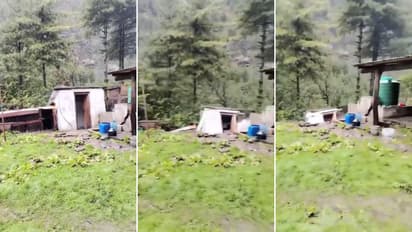
A terrifying video of a massive landslide in Nepal has gone viral on social media, showing what appears to be a huge section of a steep Himalayan slope suddenly giving way. The footage has left viewers stunned as earth, rocks and debris rapidly move down the mountainside, creating the impression that an entire section of the mountain is collapsing within mere three seconds.
The video is being widely shared as Nepal battles several days of torrential rain, floods and landslides. The footage has been linked to the Chame area of Manang, where a landslide has affected the flow of the Marsyangdi River. Local authorities have urged people living near the river and surrounding settlements to remain on high alert.
Terrifying: Entire mountain collapses in seconds in Nepal's Manang
One moment the mountain is standing. The next, it's gone. Rock, mud and trees crash down all at once, with nothing anyone can do but watch.
Praying for everyone there.
For those of us in the hills, this is a… pic.twitter.com/epw77zrUJX— Kumaon Jagran (@KumaonJagran) September 28, 2026
The dramatic visuals have also triggered a wave of reactions online, with many users expressing shock at how quickly the mountainside appears to move.
Massive landslide caught on camera
The video begins with a large, steep mountain slope appearing relatively still. Within moments, a section of the terrain starts moving before a much larger mass of soil, rock and vegetation breaks loose.
The debris rushes down the slope in a broad wave, sending clouds of dust and loose material into the air. The scale and speed of the collapse make the footage particularly alarming.
A massive landslide has struck Nepal and the footage is hard to believe
It looks like an entire mountain collapsed in seconds pic.twitter.com/P3vUPZMj6X— Surajit (@surajit_ghosh2) September 28, 2026
Several people who reacted to the video said they would have immediately run away rather than remain close to the scene. One user wrote that the situation was too risky to stand nearby and watch unfold. Another said the footage was sad to watch and hoped people living in the affected area were safe.
Other reactions focused on the unstable terrain, with users questioning whether the surrounding ground may also have been moving. Some blamed climate change, while others criticised people who appeared to keep filming instead of moving away from the danger.
The viral footage comes as the mountainous Manang district faces a series of weather-related hazards. A landslide in Chame, the headquarters of Manang, recently obstructed the Marsyangdi River. The river flow was affected for some time before partially resuming, but the landslide remained active, prompting authorities to warn people living along the river corridor to remain extremely cautious.
An entire mountain collapsed into the Kaligandaki River in Nepal pic.twitter.com/hlE6BVQ5FF
— Surajit (@surajit_ghosh2) September 28, 2026
The combination of steep Himalayan terrain and persistent rain has created dangerous conditions in several parts of Nepal. In Chame, reports said landslides were occurring repeatedly from surrounding hills, forcing residents and officials to remain alert for sudden movement.
The latest situation is part of a much wider weather emergency that has affected several districts across Nepal.
More than 20 people have died across Nepal after four days of torrential rain triggered floods and landslides between September 24 and 27, according to the National Disaster Risk Reduction and Management Authority (NDRRMA).
Landslides have accounted for the largest share of the deaths, with 14 people killed and five others reported missing in landslide-related incidents. Floods have killed four people, while three deaths have been attributed to continuous heavy rainfall.
The severe weather has affected 247 families. At least 260 houses have been completely destroyed and another 80 have suffered partial damage. Around 3,000 people have been moved from high-risk locations to safer areas as authorities continue rescue and relief operations.
The situation has also disrupted roads and transport links. Several highways leading towards Chitwan have remained blocked by landslides, while authorities have warned residents in low-lying areas about the possibility of further flooding.
NDRRMA said a low-pressure system originating in the Bay of Bengal brought heavy to excessive rainfall to parts of Nepal during the four-day period.
Rainfall measurements show just how intense the spell has been. More than 100 mm of rain was recorded at 106 monitoring locations across the country.
Dumkuali in Nawalparasi recorded 455.2 mm of rainfall, while Pokhara received 407.2 mm and Anbu Khaireni in Tanahun recorded 373.2 mm.
Such prolonged and intense rainfall can saturate soil and increase the risk of slope failures, particularly in steep mountainous terrain. The current landslide activity has also created additional danger around rivers, where falling debris can temporarily block water and raise the possibility of sudden flooding if those blockages break.
NDRRMA has issued high-alert warnings for people living along major river basins because of these risks.
The danger is not limited to roads and houses.
A landslide in Chame affected the Marsyangdi River, while another landslide in Mustang partially obstructed the Kali Gandaki River. Authorities have warned communities downstream to remain particularly cautious because landslide-created blockages can cause sudden releases of water.
The situation has already damaged transport infrastructure elsewhere.
A bridge connecting Mirmi in Syangja with Harmichaur in Gulmi was swept away by the powerful current of the Kali Gandaki River. The Bailey bridge, which was used by four-wheeled vehicles, was washed away around 6 am on Sunday after water flow increased significantly near the Kaligandaki A hydropower project, reported Nepal's Hindusthan Samachar.
The collapse disrupted road connectivity between Mirmi and Harmichaur.
Emergency teams have been working in several of the worst-hit districts. In Jajarkot, Myagdi and Sankhuwasabha, helicopters have been used to evacuate people trapped by the weather and damaged roads.
Authorities have also issued warnings to tourists and trekkers. NDRRMA estimated that around 9,000 foreign tourists and trekkers were in Nepal during the period of heavy rain and advised people in vulnerable terrain to suspend travel and move to safer locations.
The crisis has also affected the high mountains.
An avalanche struck Himlung Himal in Manang, a 7,126-metre peak, leaving climbers and support staff missing. Four bodies had been recovered by September 28, while 12 people remained unaccounted for, according to the latest report from the Kathmandu Post.
Nepal's viral landslide videos have added a striking visual dimension to an already serious disaster situation in the country. While the video makes the collapse look as though an entire mountain is falling apart, the available reports describe it as a major landslide affecting a section of the Himalayan terrain.
What is clear is that the danger remains active. Nepal has recorded multiple landslides, river blockages, floods and an avalanche during the latest spell of extreme weather.
With rain continuing in parts of the country, authorities are monitoring vulnerable slopes and river systems and urging residents to avoid dangerous areas.
(With inputs from agencies)