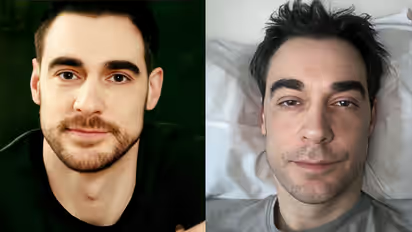
French actor and theatre director Arnaud Denis died by euthanasia in Belgium on September 22, 2026, at the age of 43, after years of severe health problems that he linked to complications following surgery for a right groin hernia. His lawyer Philippe Courtois told AFP that the decision was taken in consultation with three doctors in Namur.
Denis had become severely disabled after a polypropylene mesh implant was fitted during the hernia operation in July 2023. He later said the procedure was followed by persistent and debilitating pain and a serious decline in his quality of life. His death has now drawn attention to both his medical ordeal and the campaign he started for other patients who reported problems after hernia-mesh surgery, according to a report by Euro News.
Denis underwent surgery for a right groin, or inguinal, hernia on July 17, 2023. A polypropylene prosthesis was implanted during the procedure.
According to Denis, his health deteriorated after the operation. He experienced persistent pain and a range of other problems, which he attributed to the implant. The implant was eventually removed in the United States in April 2024, but removing it did not restore his health.
Arnaud Denis s’est fait euthanasier en Belgique, à l’âge de 43 ans pour mettre fin à ses souffrances, a annoncé son avocat, Philippe Courtois. Le comédien et metteur en scène souffrait depuis des années d’atroces douleurs liées, selon lui, à un implant anti-hernie.
➡️… pic.twitter.com/KVl9xMi6np— 20 Minutes (@20Minutes) September 22, 2026
He was later diagnosed with myalgic encephalomyelitis, with reports also referring to ASIA syndrome in connection with an inflammatory response. These medical links were part of Denis's account of his condition and his legal campaign.
By early 2026, Denis said his illness had left him largely confined to his home and unable to maintain a normal social or professional life.
Denis had publicly discussed euthanasia before his death, saying he believed there were no further medical options that could restore his quality of life.
In an interview earlier this year, he described being unable to leave his home or maintain a social life and said his doctors had nothing more to offer him.
His lawyer said Denis's decision was made with three doctors in Namur. He had entered palliative care in Belgium in March while his request for euthanasia was being considered.
Denis died in Namur on September 22. His lawyer said his death followed months of intense pain and a progressive loss of physical control.
Denis did not keep his experience private. He founded a collective called French Victims of Hernia Mesh, bringing together people who said they had suffered adverse effects after receiving anti-hernia implants.
The group collected hundreds of testimonies on social media and became an important part of Denis's campaign. His lawyer has described the issue as a wider public-health concern and argued that patients should receive clearer information about possible complications associated with such implants.
Denis's campaign focused particularly on whether patients had been adequately informed about possible risks before surgery.
His lawyer also said the manufacturer had acknowledged that parietal reinforcement devices could be associated with acute and chronic post-operative pain. This does not establish that the implant was legally responsible for Denis's death or that every reported complication was caused by the device.
Denis had also pursued legal action over what he believed happened to him.
On January 5, 2026, he filed a complaint against unknown persons for unintentional injuries. The Paris prosecutor's office later closed the case at the end of August, saying that the alleged offence was not sufficiently established.
The legal fight did not end there.
On September 18, only days before his death, his lawyer filed another complaint in which he joined the proceedings as an injured party, seeking a judicial investigation. Denis's family had not yet been ready to make public statements, according to his lawyer.
Denis was not only known because of his final years. He had spent much of his career working in French theatre as both an actor and director.
He founded the theatre company Les Compagnons de la Chimère in 2003 and developed a reputation for staging works from the classical French repertoire.
Among his best-known productions were adaptations of Choderlos de Laclos' Les Liaisons dangereuses and Molière's Les Femmes savantes. His 2024 production of Les Liaisons dangereuses at the Comédie des Champs-Élysées received significant attention in French theatre circles.
No lo conocía o al menos no lo recuerdo pero me ha impactado su muerte. Por eso he buscado información sobre lo que le ha pasado.
Antes de que Arnaud Denis cumpliera cuarenta años, le surgió un dolor en la ingle y le detectaron una hernia inguinal. El médico le recomemdó… https://t.co/lMsHU9FqEj pic.twitter.com/MebInBkzWU— Ana Refue (@Anarefue) September 23, 2026
Le comédien Arnaud Denis est mort mardi 22 septembre, à l’âge de 43 ans, après avoir eu recours à l’euthanasie en Belgique. Il souffrait d’une invalidité sévère et de douleurs intenses depuis plusieurs années. pic.twitter.com/eARIxfDO1L
— franceinfo (@franceinfo) September 23, 2026
In 2024, Denis also received the Critics’ Syndicate award for his direction of Les Liaisons dangereuses, adding to a career that had largely been built on stage rather than mainstream film and television.
Denis's death has therefore brought together two very different parts of his life: his career in French theatre and his later campaign over the complications he said followed hernia surgery.
His decision to undergo euthanasia in Belgium came after years of reported pain, medical treatment and attempts to find relief. His lawyer has said the fight over the alleged medical complications will continue, while the collective Denis founded remains open to testimonies from other patients.
For Denis, the decision was ultimately linked to his belief that his condition had left him without a life he considered tolerable. His story has since prompted renewed discussion in France about chronic pain, medical complications, patient information and access to euthanasia.
The legal questions surrounding his treatment remain separate from his decision to die. The Paris prosecutor's office had already closed his first complaint, while his lawyer's latest legal action seeks further judicial examination.
(With inputs from agencies)