US-Israel Strikes Hit Iran's Kharg Island Ahead Of Trump Deadline, Oil Supply Fears Rise

Published : Apr 07, 2026, 07:00 PM ISTUpdated : Apr 07, 2026, 07:25 PM IST

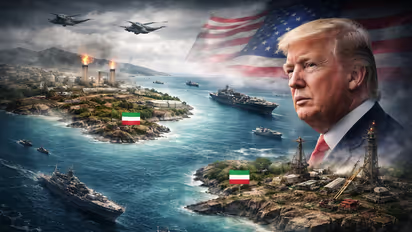
Fresh US strikes on Iran’s Kharg Island have raised global tensions, with explosions reported at main oil export hub. US officials say only military targets were hit. Attacks came just hours before a deadline set by Trump for Iran to agree to a deal.
PREV
17
Fresh strikes reported on Kharg Island

Tensions in the Middle East have increased sharply after fresh strikes hit Kharg Island, Iran’s most important oil export hub.

Iran’s Mehr news agency reported that several explosions were heard on the island after what it called attacks by the “American-Zionist enemy”. The island lies off Iran’s western coast and is a key part of its oil industry.

Journalist Barak Ravid, citing a US official, said the United States carried out strikes on military targets on the island.

US says oil facilities were not targeted

American officials have said that the strikes were aimed only at military targets. Reports from outlets such as The New York Times and CNN quoted officials saying oil infrastructure was not hit.

This claim is important because Kharg Island handles a large share of Iran’s oil exports. Any damage to oil facilities could affect global energy supply.

The strikes come shortly after reports that the US hit around 50 military targets on the island earlier on Tuesday.

27
Why Kharg Island matters so much

Kharg Island is at the centre of Iran’s oil export system. It handles up to 90 per cent of the country’s crude shipments.

The island has major oil storage tanks, pipelines and loading facilities. It can store around 30 million barrels of oil.

Located about 26 kilometres from Iran’s coast and near the Strait of Hormuz, it is often called the “Forbidden Island” because of its high security and isolation.

Any disruption here can affect oil prices around the world.

37
Strikes come ahead of Trump’s deadline

The attacks happened just hours before a deadline set by Donald Trump for Iran to agree to a ceasefire deal.

Trump has repeatedly warned Iran to reopen the Strait of Hormuz. He has said that if Iran does not comply, there could be serious consequences.

In earlier statements, Trump even warned that “a whole civilisation” could be wiped out if no deal is reached.

Deadlines extended multiple times

Trump had first given Iran a 48-hour deadline. However, this has been extended several times.

The initial deadline was increased to five days, then extended by another 10 days. The total time given has now reached around 408 hours.

The latest deadline is set for April 7. This pattern of strong warnings followed by extensions has created confusion about what action the US may take next.

47
Iran issues strong warning after strikes

After the latest strikes, Iran’s Islamic Revolutionary Guard Corps (IRGC) issued a strong warning.

It said its “restraint is over” and warned that energy infrastructure linked to the US and its allies could be turned “into ashes”.

The group also warned that oil and gas flows across the region could be disrupted for years. This statement has increased fears of a wider conflict in the region.

Background of ongoing conflict

The current tension is part of a larger conflict that has been ongoing for several weeks.

On February 28, the United States and Israel carried out strikes on Iran, targeting its nuclear programme. Several top leaders were reported killed in those attacks.

Iran responded by attacking US bases in the Gulf region. It also moved to shut down the Strait of Hormuz and targeted ships linked to the US and Israel.

Since then, tensions have remained high, with both sides issuing warnings.

57
Previous strikes on Kharg Island

Kharg Island has already been targeted before. Last month, the US struck more than 90 military targets on the island.

Those attacks destroyed naval mine storage areas and missile bunkers. However, oil facilities were mostly left untouched.

This shows that while the military infrastructure is being targeted, there is still caution around damaging oil assets.

67
Iran rejects US ceasefire plan

Iran has rejected a ceasefire proposal from the US. According to reports, Iran shared its response through Pakistan.

Tehran said it wants a permanent end to the conflict instead of a temporary ceasefire.

It also proposed a 10-point plan, which includes ending regional conflicts, ensuring safe passage through the Strait of Hormuz, lifting sanctions, and support for rebuilding after the war.

77
Global concern over oil supply and stability

The situation has raised serious global concerns. The Strait of Hormuz is one of the most important oil routes in the world.

A large share of global crude oil passes through this narrow waterway every year.

Any disruption can lead to higher oil prices and affect economies worldwide.

Uncertain path ahead

As the deadline approaches, it is still unclear what will happen next.

The US has not confirmed whether further strikes will take place or if more time will be given for talks. At the same time, Iran’s warning suggests that retaliation could happen soon.

The situation remains tense and unpredictable, with the world closely watching developments.

(With inputs from agencies)

Check the Breaking News Today and Latest News from across India and around the world. Stay updated with the latest World News and global developments from politics to economy and current affairs. Get in-depth coverage of China News, Europe News, Pakistan News, and South Asia News, along with top headlines from the UK and US. Follow expert analysis, international trends, and breaking updates from around the globe. Download the Asianet News Official App from the Android Play Store and iPhone App Store for accurate and timely news updates anytime, anywhere.


Read more Photos on

Recommended Stories