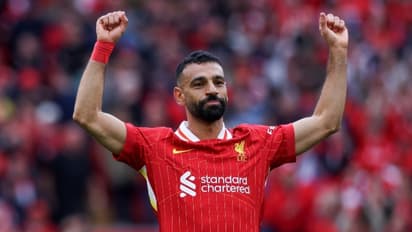
The tension around Liverpool this season has been simmering for months, but Mohamed Salah’s explosive postmatch remarks at Elland Road have turned it into full-blown crisis theatre. For the first time in years, the idea of Salah leaving midseason doesn’t feel like a distant rumour—it feels real. And inside the club, there’s no escaping a harsh truth: finding someone to fill his boots in January is close to impossible.
Over eight seasons, Salah has carried Liverpool’s attack with almost machine-like consistency. His numbers—250 goals and 116 assists in 420 games—are the sort most clubs spend decades trying to accumulate, not just one era. Even Liverpool’s long-standing targets—Antoine Semenyo at Bournemouth or Anthony Gordon at Newcastle—don’t come close to replicating that output, at least not immediately.
Liverpool’s summer spending spree, worth over €450 million, shows their appetite to rebuild: Alexander Isak (€145m), Florian Wirtz (€117m), Hugo Ekitike (€80m). Big names, big fees—but none of them are Salah-like in profile or productivity. So the search for a successor becomes a puzzle: find a high-volume attacking forward who can score, create, and shoulder the responsibility Salah carried every single week. That’s a profile that barely exists in world football.
Here are the names that Liverpool’s recruitment team would have circled—some realistic, some wildly ambitious—but all worthy of consideration.
If Liverpool want a marquee successor, Vinicius Junior is the headline act. His situation at Real Madrid is complicated: he’s under contract until 2027, unhappy with renewal talks, and struggling through an 11-game goal drought. His output—five goals and five assists in LaLiga—is still solid, but his on-target rate has dropped and his take-ons and offensive duels have dipped slightly, suggesting Xabi Alonso’s structure may be limiting him.
Stylistically, he’s not a mirror image of Salah: he works off the left, is right-footed, and loves to attack open spaces. But the explosiveness, close control at pace, and ability to decide games single-handedly place him in the conversation.
A January transfer is fantasy. A summer move? Not entirely off the table, and Liverpool are one of the few clubs capable of financing a €150m-plus deal.
At Bayern Munich, Michael Olise has become one of Europe’s most effective wide creators: 29 goals and 37 assists in 78 games since joining from Crystal Palace for €60m. That fee looks like daylight robbery now.
A left-footed right winger, Olise operates in almost identical zones to Salah but interprets them differently. While Salah is clinical and thrives on sharp bursts into the box, Olise prefers threading disguised passes, slipping runners through, or linking with overlapping full-backs.
There are similarities in their ability to control the ball under pressure, evade defenders, and enter high-xG areas. But Olise is more a creator than a finisher, which would change Liverpool’s right-sided dynamics.
Bayern won’t even pick up the phone unless the offer starts at €150 million. But a Premier League return may tempt him eventually.
If Liverpool want someone who can step into Salah’s role immediately, Raphinha is the closest fit. Since arriving at Barcelona for €58 million, he has produced elite numbers: 58 goals and 54 assists in 156 games and also carried Barca to a domestic treble and winning LaLiga Player of the Season.
Though often deployed on the left to accommodate Lamine Yamal, Raphinha thrives as a left-footed right winger—receiving wide, cutting inside, shooting or playing early whipped crosses. His shot volume (2.6 per 90) mirrors Salah’s, and his pressing intensity aligns with Liverpool’s DNA.
Barcelona’s chronic financial issues mean a €100m bid is difficult for them to refuse. Age is the only question mark, but in terms of fit, Raphinha might be Liverpool’s safest option.
Rafael Leao is the least Salah-like of the candidates, but his raw ability makes him impossible to ignore. A 6'2", right-footed left winger, Leao is built for chaos: long strides, blistering acceleration, and a direct, transition-heavy style.
In AC Milan, Leao has scored 76 goals and provided 63 assits in 272 game. His take-ons have dipped this season, but he still carries the ball into the box effectively.
To sign Leao, Liverpool would need to rethink their shape. His €175m release clause makes him expensive, but his contract until 2028 ensures clarity: pay the fee or walk away.
He wouldn’t mimic Salah—but he could force Liverpool into a new attacking era.
At Marseille, Mason Greenwood has rebuilt his footballing reputation. After Manchester United’s internal investigation and his eventual €31.6m transfer, his game has evolved: better chance creation, smarter shot selection, and a higher percentage of attempts coming from central or inside-right areas.
Technically, he resembles Salah more than most: a two-footed finisher capable of bending shots into the far corner with minimal backlift. He rarely wastes chances, and he excels at playing in tight spaces.
But the baggage, the optics, and the fact United would reportedly receive around half of any future fee make a Liverpool move nearly impossible. Talent? Yes. Feasible? No.
Bradley Barcola may not dominate headlines like the others, but his numbers at PSG are staggering for his age: 21 goals and 21 assists last season. Right-footed but comfortable on both flanks, he brings pace, power, and quick combination play.
His shot accuracy—51%, compared to Salah’s 39%—is elite. Off the ball, he presses aggressively and adapts well to high-tempo systems.
PSG wouldn’t entertain offers unless they can at least double the €45m they paid, but Barcola’s blend of potential and versatility makes him one of the most underrated candidates.
The sober truth: there is no one player who mirrors Mohamed Salah. His blend of durability, consistency, finishing, creativity, and big-game temperament is almost unmatched in modern football.
But Liverpool must prepare for the possibility of life without him. Whether they choose a ready-made star like Raphinha, a creative evolution with Olise, a high-risk restructure with Leão, or the blockbuster option in Vinícius, their next move will define the club’s next era.
Salah may stay. He may go. But Liverpool now stand at a crossroads—and the decision they make next could shape Anfield’s future for a decade.