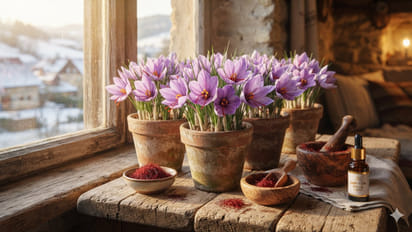
Saffron plant: You can easily grow the expensive saffron plant right at your home if you know the correct techniques. We explain everything from buying the right corms and preparing the soil mix to watering the plant and harvesting the spice.
Nothing beats the aroma of what saffron brings along with itself this winter season. If you want to plant these multifunctional plant babies, we have got you covered. Use it for skincare, consumption, and even for daily use.
211
Growing Saffron At Home
People call saffron the gold of spices because a single pinch adds beautiful color and aroma to dishes like biryani, payasam, and sweets. You might wonder if you can grow this expensive spice at home. You certainly can try.
Saffron does not grow from regular seeds. You need a special bulb-like stem called a corm. You can grow saffron in pots right at your home with the right soil, climate, and watering routine.
We will show you the exact plant, planting steps, flowering time, and harvesting methods.
311
Use it for skincare
Saffron can be used to make excellent toner for skin. It is great to make tea and use it in face packs. Saffron can also be used as a natural food colouring.
You cannot grow saffron from normal seeds. The plant reproduces through an onion-like structure called a corm.
A corm is not a real tuber like garlic or onion. It acts as a thick underground stem that stores food at the base of the plant. The plant pushes out new shoots, leaves, and flowers from this base.
The main corm produces smaller new corms around it as it grows. You can separate these tiny corms and replant them to multiply your saffron plants.
511
What You Need
Things required to grow saffron at home
Select quality corms
You must buy good quality, disease-free, and large corms from the market first. You should ideally buy these bulbs between August and September.
You need to select corms that weigh at least 10 grams. Large corms easily produce more flowers. You must pick a wide pot with a depth of at least 10 to 12 inches for planting.
611
Preparing The Soil
Mix the perfect soil
You need to mix one part garden soil, one part river sand or perlite, and one part well-rotted organic compost. This specific soil mixture helps drain the water quickly without letting it stagnate around the roots.
711
Planting The Corms
How to plant the corms
August to October remains the best time to plant saffron corms. You must fill the pot with your prepared soil first. You should plant each corm with its pointed sprouting end facing upward.
You can plant them about 8 to 12 cm deep in the potting soil. You must leave at least a 4-inch gap between each corm.
811
Plant Maintenance
Watering schedule
You need to pour a moderate amount of water right after planting. You should water the plant later only by checking the soil moisture. You do not need to water the plant every single day. You must ensure water never stagnates in the soil. Excess water rots the corms easily.
Find the right spot
The saffron plant needs good sunlight. Extreme heat and high humidity damage its growth. You must place the pot in an area with good ventilation, sufficient light, and moderate temperature.
911
Flowering Season
Care before flowering
Thin grass-like leaves appear once the corms sprout. The plant blooms beautiful purple flowers after that. The saffron plant generally starts flowering during the autumn season. You will most likely get the flowers between October and November.
1011
Harvesting The Spice
When and how to harvest saffron?
Shoots and flowers generally emerge within 30 to 90 days after you plant the corms. You will see three red stigmas inside once the flower blooms. These threads are the real saffron we use in our kitchens.
Pluck them gently
You must pluck those red stigmas carefully. You should place them on a paper towel and let them dry for 2 to 3 days. You must store them in an airtight glass jar after they dry completely. You can easily harvest saffron on your balcony or terrace with proper care.
You should wait for about a month before using freshly harvested saffron to get the best aroma.
1111
Ideal Climate
You get exactly three red stigmas from one single flower. Farmers spend heavy manual labor and time to produce saffron because of this reason. This makes it one of the most expensive spices in the entire world.
What climate does saffron need?
Climate plays a very crucial role in saffron growth.
The plant needs a moderately cool climate.
It requires good sunlight.
Well-draining soil remains absolutely necessary.
High humidity and continuous rain will rot the corms.
The plant needs specific temperature changes to form and grow flowers.