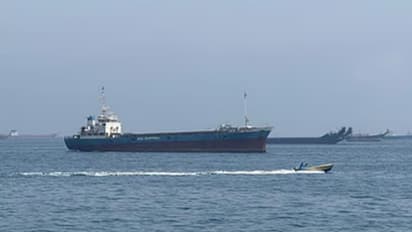
Ever wondered how a tiny nail sinks but a massive ship, weighing lakhs of tonnes, just floats on water? Let's check out the 'secret' science behind this.
It's a common sight: you throw something in the water, and it sinks. Even a small iron nail goes straight to the bottom. So, how does a massive iron ship float so easily? It's not magic, but amazing science. The secret lies in two key principles: buoyant force and Archimedes' principle. Let's break down these two science concepts in a simple way.
25
Archimedes' Principle
The Greek scholar Archimedes figured this out about 2300 years ago. His principle is simple: when an object enters water, it pushes aside an amount of water. If the weight of this displaced water is equal to or more than the object's weight, the object will float. A ship works on this very rule. When a ship enters the sea, its huge size displaces lakhs of tonnes of seawater. The weight of this displaced water is much more than the ship's total weight. This is why the ship floats so easily.
Buoyant force is another big reason why ships float. When you put an object in water, the water pushes up on it. This upward push is called buoyant force. A small iron nail has a tiny shape, so it displaces very little water. The nail's downward force (its weight) is greater than the water's upward push, so it sinks. But a ship has a massive surface area, so it displaces a huge amount of water. This makes the water's upward buoyant force strong enough to hold up the ship's weight.
45
Ship Design
A ship's design also plays a huge part in keeping it afloat. Ships are not made of solid iron all the way through. The inside of a ship is largely hollow, filled with nothing but air. If you calculate the overall density of the ship—including the iron and the air inside—it is actually less than the density of seawater. This is what allows the ship to float so comfortably on the water.
To put it simply, a ship's weight pulls it downwards because of gravity. But the huge amount of water displaced by the ship's massive shape pushes it upwards—this is the buoyant force. When these two opposing forces are perfectly balanced, even a ship weighing lakhs of tonnes can float easily on the sea.