On April 22, 2025, India was shaken by a deadly terror attack in Pahalgam, a popular tourist spot in Jammu and Kashmir. Pakistan-backed terrorists entered a village and killed 26 innocent people. The attack shocked the country and left many families broken.
As India marks one year since that day, attention has turned to a major but lesser-known moment that followed, when a possible missile strike on the national capital was stopped in time.
During the height of the India-Pakistan conflict in May 2025, a serious threat emerged. A Pakistani ballistic missile, believed to be from the Fateh or Shaheen series, was launched and was heading towards India.
The suspected target was Delhi.
The situation was critical. A successful strike could have caused large-scale damage and loss of life.
At this crucial moment, an Indian Air Force (IAF) unit stationed in Sirsa, Haryana, stepped in.
Sirsa is an important forward air base located close to the western border. Because of its position, it plays a major role in India’s air defence system.
The unit detected the incoming missile and acted quickly.
The IAF unit successfully intercepted the missile in mid-air over Haryana before it could reach its target.
The interception was carried out using the Barak-8 surface-to-air missile system, according to a report by India Today. This system is known for its ability to detect and destroy incoming threats at long range.
The quick response ensured that the missile was neutralised safely, preventing a possible disaster.
The operation was led by Air Commodore Rohit Kapil, who was the Air Officer Commanding of the 45 Wing at Sirsa.
His leadership and quick decisions played a key role in the success of the mission.
Air Commodore Kapil is also a Su-30MKI fighter pilot and has led an operational squadron in the past.
His experience helped guide the team during a very tense situation.
For his role during the conflict, Air Commodore Kapil was awarded the Yudh Seva Medal in 2025.
The award was given by President Droupadi Murmu in recognition of his leadership and service during active operations.
His work included both defensive actions, like intercepting threats, and planning offensive responses.
Days after the interception, debris was found in Sirsa.
The recovered parts confirmed the scale of the threat and showed how close India had come to a major escalation.
At the time, images and videos of the debris were widely shared, drawing public attention.
Even a year later, this remains a strong reminder of the danger India faced.
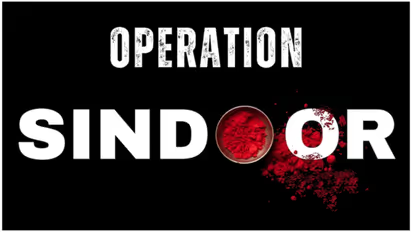
After the Pahalgam attack, India launched Operation Sindoor on May 7, 2025.
The aim was to target terror groups operating from Pakistan and Pakistan-occupied Jammu and Kashmir (PoJK).
Indian forces carried out strikes on nine major terror launchpads linked to groups like Lashkar-e-Taiba, Jaish-e-Mohammed, and Hizbul Mujahideen.
More than 100 terrorists were killed during the operation.
Following India’s strikes, Pakistan responded with drone attacks and shelling.
This led to a four-day conflict between the two countries.
India responded strongly, carrying out counter-strikes and damaging key Pakistani military targets.
Radar installations in Lahore and facilities near Gujranwala were destroyed.
The situation remained tense until Pakistan’s Director General of Military Operations (DGMO) contacted his Indian counterpart.
A ceasefire was agreed on May 10, bringing the immediate conflict to an end.
In another major success, Indian forces carried out Operation Mahadev.
This operation focused on tracking down the terrorists involved in the Pahalgam attack.
Security forces managed to find and eliminate three terrorists linked to the attack.
Apart from military action, India also took strong non-military steps.
The government decided to end the Indus Waters Treaty and stopped all bilateral trade with Pakistan.
These decisions were seen as part of a broader response to the attack and ongoing tensions.
On April 21, 2026, just a day before the anniversary, the Indian Army sent a clear message.
In a post on X, the Army said that when 'boundaries of humanity are crossed, the response is decisive'.
The message also stated that India does not forget such acts.
This was a reminder of the country’s stand against terrorism.
While security forces acted strongly, families of the victims are still dealing with their loss.
The wife of Prasanta Kumar Satapathy, who died in the Pahalgam attack, shared her struggle.
She said life has not been the same since her husband’s death. He was the main earner of the family.
She now works in a temporary job just to manage daily expenses.
She also said that although financial help was given, a government job promised to her has not yet been provided.
She has asked the government to fulfil its promise as soon as possible.
Prime Minister Narendra Modi has said that any terror attack on India will get a strong reply.
He made it clear that India will not separate terrorists from those who support them.
Defence Minister Rajnath Singh said that Operation Sindoor is still ongoing in spirit.
Army Chief General Upendra Dwivedi described Operation Sindoor as a strong example of coordination between the Army, Navy, and Air Force.
He said the operation showed how all three services worked together under clear political direction.
Air Chief Marshal Amar Preet Singh also called the operation a defining moment.
He said it showed the Indian Air Force’s strength, accuracy, and unity.
The Indian Navy also played an important role.
Chief of Naval Staff Admiral Dinesh K Tripathi said that deploying a carrier battle group in the northern Arabian Sea affected Pakistan’s naval movement.
This forced Pakistani naval forces to stay closer to their own ports.
On Independence Day 2025, Prime Minister Modi announced Mission Sudarshan Chakra.
This plan aims to improve India’s defence system and make it stronger against future threats.
It focuses on better coordination, faster response, and improved technology.
India is working on a multi-layered air defence system under the Sudarshan programme.
This includes advanced systems like S-400, Barak-8, and other indigenous interceptors.
The aim is to create a strong shield that can stop threats at different levels.
The interception over Sirsa stands out as a key moment.
It showed how quick action, good planning, and modern technology can prevent disaster.
It also highlighted the importance of being ready at all times.
As India remembers the Pahalgam attack, this moment serves as a reminder that vigilance and preparedness can save lives.
(With ANI inputs)
Stay updated with the Breaking News Today and Latest News from across India and around the world. Get real-time updates, in-depth analysis, and comprehensive coverage of India News, World News, Indian Defence News, Kerala News, and Karnataka News. From politics to current affairs, follow every major story as it unfolds. Get real-time updates from IMD on major cities weather forecasts, including Rain alerts, Cyclone warnings, and temperature trends. Download the Asianet News Official App from the Android Play Store and iPhone App Store for accurate and timely news updates anytime, anywhere.