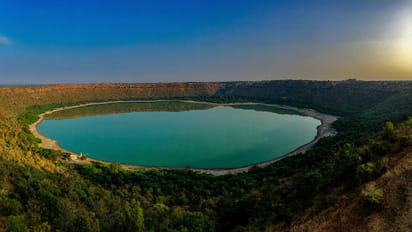
Maharashtra’s Lonar Lake, formed by a meteorite impact, has entered the IUGS Third 100 Global Geological Heritage Sites list. From its unusual basalt crater, saline water to the pink colour change in 2020, discover 10 facts about this natural wonder.
Maharashtra’s Lonar Lake Earns Global Geological Heritage Recognition
Maharashtra’s Lonar Lake, known for its unusual geological features, saline water and ancient temples, has earned international recognition.
The lake has been included in the International Union of Geological Sciences (IUGS) list of the ‘Third 100’ Global Geological Heritage Sites.
Formed by a massive meteorite impact, this remarkable natural site is recognised for its scientific importance and distinctive landscape. From its unusual rock formations to the water that turned pink in 2020, Lonar Lake has several fascinating features.
210
Lonar Lake Was Formed By A Meteorite Impact
Located near Lonar town in Maharashtra’s Buldhana district, the lake occupies a nearly circular crater measuring around 1.8 km in diameter and approximately 150 metres deep.
Scientists believe that a massive meteorite struck the area at high speed, creating the depression that eventually filled with water.
310
Scientists Initially Mistook It For A Volcanic Crater
Lonar lies within the Deccan Traps, a vast volcanic region formed around 66 million years ago. Its location initially led researchers to believe that volcanic activity had created the crater.
However, the discovery of maskelynite, a glass-like material formed under extreme pressure during an impact, provided evidence of its meteoritic origin.
Researchers have proposed different estimates for the crater’s age. Earlier studies suggested that it was around 52,000 years old, while subsequent research placed its formation at approximately 570,000 years ago.
However, the older estimate remains disputed because of concerns about the dating method used.
510
It Is The Only Known Impact Crater Formed Entirely In Basalt
One of Lonar Lake’s most significant features is the type of rock in which it formed. It is recognised as the only known terrestrial impact crater formed entirely in basalt.
Since basalt is also found on the Moon and Mars, scientists study Lonar to understand how meteorite impacts affect similar rocky surfaces.
610
Water Is Highly Saline And Alkaline
Unlike most freshwater lakes, Lonar contains highly saline and alkaline water, with a pH generally ranging from 9 to 10.5.
The crater forms an enclosed basin with no natural outlet. As water evaporates, dissolved salts and minerals become increasingly concentrated.
710
Microorganisms Survive In Its Unusual Water
Despite its harsh chemical conditions, Lonar Lake supports several microorganisms, including bacteria, archaea, fungi and phytoplankton.
Researchers have identified species from samples collected here, including Cecembia lonarensis, Indibacter alkaliphilus and Curvularia lonarensis.
Their ability to survive in such conditions makes the lake particularly interesting to scientists.
In June 2020, the lake attracted widespread attention when its normally green water turned reddish-pink within two to three days.
Studies suggested that falling water levels had increased the salinity, encouraging the growth of salt-loving microorganisms such as Halobacterium.
Pigments called carotenoids, produced by these organisms, contributed to the unusual colour.
810
The Crater Is Surrounded By Wildlife And Ancient Temples
The area around Lonar Lake supports rich biodiversity, including numerous bird, mammal and reptile species.
Freshwater springs help sustain vegetation along the crater slopes.
Several historic temples also stand around the lake, including Kamalja Devi Temple, Ram Gaya Temple, Sita Nahani Temple and the partially submerged Shanka Ganesha Temple.
910
Daitya Sudan Temple Is A Major Attraction
The Daitya Sudan Temple is among the best-known historic structures near Lonar Lake.
It is noted for its Hemadpanti architectural style and is associated with a local legend about Lord Vishnu defeating the demon Lonasura.
According to local tradition, the name Lonar is linked to the demon.
1010
Lonar’s Global Recognition Could Boost Tourism
The IUGS recognition highlights the lake’s geological importance and scientific value.
Maharashtra Chief Minister Devendra Fadnavis also welcomed the achievement, describing it as a proud moment for the state and highlighting opportunities for conservation, research and tourism development.
Lonar Lake Enters the List of Global Geological Heritage Sites; Another Prestigious Honour for Maharashtra! 🌏
Maharashtra’s iconic Lonar Lake has officially made it to the International Union of Geological Sciences (IUGS) list of the 'Third 100' Global Geological Heritage Sites.
Carved out by a massive meteorite impact thousands of years ago, this extraordinary lake is a geological marvel of immense scientific significance. This global recognition highlights its unique geological structure and scientific value, opening new avenues for its conservation, research and tourism development. Proud moment for Maharashtra! 🙌✨
लोणार सरोवराचा जागतिक भूशास्त्रीय वारसा स्थळांच्या यादीत समावेश; महाराष्ट्राच्या शिरपेचात मानाचा तुरा! 🌏
बुलढाणा जिल्ह्यातील जगप्रसिद्ध लोणार सरोवराचा समावेश इंटरनॅशनल युनियन ऑफ जिऑलॉजिकल सायन्सेसच्या (IUGS) तिसऱ्या 100 जागतिक भूशास्त्रीय वारसा स्थळांच्या यादीत झाला आहे. महाराष्ट्रासाठी ही अभिमानास्पद बाब आहे!
उल्कापातातून निर्माण झालेल्या या अद्वितीय सरोवराची वैशिष्ट्यपूर्ण भूशास्त्रीय रचना आणि वैज्ञानिक महत्त्व यांना मिळालेली ही जागतिक मान्यता आहे. या गौरवामुळे लोणार सरोवराच्या संवर्धन, संशोधन आणि पर्यटन विकासाला नवी दिशा मिळणार आहे.
#Maharashtra #LonarLake #GeologicalHeritage
— Devendra Fadnavis (@Dev_Fadnavis) November 18, 2026