Delhi Weather: AQI Rises To 280 As City Records Coldest Morning; Is Worse Pollution Ahead?

Published : Nov 19, 2026, 10:34 PM IST

Delhi's AQI rose to 280 on Thursday, worsening from 232 a day earlier, as the capital recorded its coldest morning of the season at 10.6 degrees Celsius. Biomass burning emerged as the largest estimated contributor to PM2.5 pollution.
PREV
17
Delhi Weather: AQI rises to 280 as capital records coldest morning of season at 10.6°C

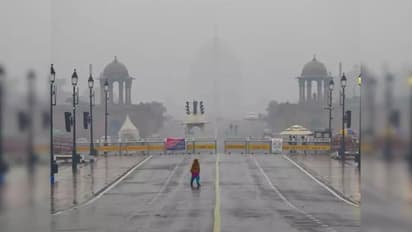
Delhi's air quality worsened on Thursday as the Air Quality Index (AQI) climbed to 280, keeping the capital in the 'poor' category. The rise came alongside a sharp increase in pollution linked to biomass burning and a drop in the morning temperature to 10.6 degrees Celsius, the lowest recorded in the city so far this season.

The AQI stood at 232 on Wednesday and 204 on Tuesday, showing a steady deterioration over three days. The capital is now facing two seasonal changes at the same time: colder mornings and worsening air pollution.

According to the Air Quality Early Warning System's real-time estimates, biomass burning was the biggest contributor to Delhi's PM2.5 pollution on Thursday. Its share increased to 33.3% from 24% on Wednesday and 18% on Tuesday.

The system has forecast that Delhi's air quality could slip into the 'very poor' category on Friday and remain there until November 22. Its outlook for the following six days also indicates very poor air quality.

27
Delhi air quality worsens: 37 monitoring stations record poor AQI

Of the 56 air quality monitoring stations that reported data on Thursday, 37 recorded 'poor' air quality, while 16 were in the 'very poor' category. Only three stations reported 'moderate' air quality.

Jawaharlal Nehru University recorded the worst air quality, with an AQI of 376. Siri Fort followed with an AQI of 363.

The Central Pollution Control Board (CPCB) recorded Delhi's AQI at 289 at 9 am on Thursday. The daily average later stood at 280.

The CPCB classifies AQI readings between zero and 50 as 'good', 51 and 100 as 'satisfactory', 101 and 200 as 'moderate', 201 and 300 as 'poor', 301 and 400 as 'very poor', and 401 and 500 as 'severe'.

This means that Delhi's overall air quality remained poor on Thursday, even though several monitoring stations recorded very poor conditions.

37
Biomass burning becomes biggest contributor to Delhi pollution

Biomass burning accounted for 33.3% of the estimated PM2.5 pollution load in Delhi on Thursday, making it the largest identified source. This category includes stubble burning as well as the use of solid fuels such as wood and dung cakes for domestic purposes.

Waste burning was the second-largest contributor at 19.7%. This includes the burning of municipal waste and materials containing plastic and rubber. Vehicular emissions accounted for 18%, while secondary organic aerosols contributed 14.1%.

Other sources included secondary inorganic aerosols at 9.5%, coal combustion at 1.8%, and industrial emissions and firecrackers at 1.5% each. Road dust and soil contributed 0.7%.

The figures are estimates of the sources contributing to PM2.5 pollution, rather than a direct measurement of the amount of pollution released by each activity.

47
Farm fires detected in Delhi and neighbouring states

Satellite monitoring by the Consortium for Research on Agroecosystem Monitoring and Modelling from Space (CREAMS) laboratory at the ICAR-Indian Agricultural Research Institute detected two farm-fire incidents in Delhi on Tuesday and one on Wednesday.

Across the seven states monitored, 772 farm-fire incidents were detected on Wednesday. Madhya Pradesh reported the highest number at 370, followed by Punjab with 202 and Uttar Pradesh with 109.

Rajasthan recorded 59 incidents, Haryana 30, while Delhi and Uttarakhand reported one each.

The increase in the estimated contribution of biomass burning comes as farm fires continue to be detected across parts of northern and central India. However, the source-apportionment estimate also includes domestic use of solid fuels, so the entire 33.3% share cannot be attributed to stubble burning alone.

57
Delhi weather: Why could air quality become very poor?

The weather conditions expected over Delhi in the coming days may make it harder for pollutants to disperse. The Air Quality Early Warning System has warned that unfavourable meteorological conditions could lead to a further build-up of pollution.

Two important measures used to understand how pollution spreads are mixing depth and ventilation index.

Mixing depth refers to the height up to which pollutants can rise and mix in the atmosphere. When this height is low, polluted air remains trapped closer to the ground instead of spreading upwards.

Delhi's predicted maximum mixing depth was around 1,100 metres on Thursday. It is expected to fall to 1,000 metres on Friday before rising to 1,400 metres on Saturday and 1,500 metres on Sunday.

The ventilation index measures the atmosphere's ability to disperse pollutants. A lower reading means that polluted air is less likely to move away from an area.

The index was forecast at 5,000 square metres per second on Thursday and is expected to drop sharply to 1,000 square metres per second on Friday. It may improve to 2,800 on Saturday and 3,100 on Sunday.

According to the Early Warning System, a ventilation index below 6,000 square metres per second, along with an average wind speed below 10 kilometres per hour, creates unfavourable conditions for pollution dispersal.

These conditions could allow pollutants to remain close to the ground, adding to the city's already poor air quality.

67
Weather expert says peak pollution season may be over

Despite the official forecast of very poor air quality, weather expert Navdeep Dahiya has suggested that the peak pollution period for Delhi-NCR and the northern plains may have passed.

In a post on X, Dahiya said that early morning and late-night pollution spikes could continue, but AQI levels during the rest of the day may mostly remain between 90 and 200 for the remainder of November.

He also said easterly winds are expected over the weekend and could help improve conditions. Northwesterly winds are likely to return next week, with stronger gusts expected during the afternoon.

Dahiya said pollution levels were unlikely to become as hazardous in the coming days. However, the official forecast continues to point towards very poor air quality, making the next few days important for the capital.

77
Delhi records coldest morning of the season

Along with worsening air quality, Delhi also experienced its coldest morning of the season so far on Thursday. The minimum temperature at the Safdarjung weather station settled at 10.6 degrees Celsius, which was 1.7 degrees below the seasonal normal.

Other weather stations also recorded relatively low temperatures. Palam reported a minimum of 11.2 degrees Celsius, 1.7 degrees below normal. Lodhi Road also recorded 11.2 degrees Celsius, although this was 0.2 degrees above normal.

The Ridge registered a minimum of 12.6 degrees Celsius, 0.9 degrees below normal, while Ayanagar recorded 10.8 degrees Celsius, 1.9 degrees below normal.

Daytime temperatures remained relatively comfortable. Safdarjung recorded a maximum of 28.1 degrees Celsius, 0.3 degrees above normal. Lodhi Road reported 28.2 degrees Celsius, 1.2 degrees above normal.

Palam recorded a maximum of 25 degrees Celsius, 2.6 degrees below normal. The maximum temperature was 27.4 degrees Celsius at the Ridge and 27 degrees Celsius at Ayanagar.

With colder mornings, unfavourable pollution-dispersal conditions and a forecast of very poor air quality, Delhi is likely to face continued weather and pollution challenges over the coming days.

Stay updated with the Breaking News Today and Latest News from across India and around the world. Get real-time updates, in-depth analysis, and comprehensive coverage of India News, World News, Indian Defence News, Kerala News, and Karnataka News. From politics to current affairs, follow every major story as it unfolds. IMD cities weather forecastsRain Cyclone Asianet News Official App

Read more
Read more Photos on

Recommended Stories